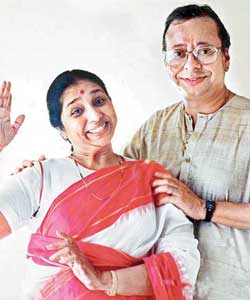
Rahul
Dev Burman, better known as R.D. Burman, was a famous Bollywood music
director during the 60's through the early 90's. He was known for
introducing an upbeat, Western copied music that defined much of the
music of the 1970's. This style has influenced generations of music
directors even to today.
R.D. Burman was born in Kolkata in 1939. His
father was the legendary music director S.D. Burman and his mother was
named Meera. His music education began very early on. Naturally there
was the influence of growing up in his father's home, with constant
music surrounding him. Furthermore after the family moved from Calcutta
(now Kolkata) to Bombay, he started to learn sarod from the famous Ali
Akbar Khan. He also learned to play the harmonica. With such a musical
environment, it is not surprising that he started to compose music very
quickly. He was only nine years old when he composed his first song;
this was Aye Meri Topi Palat Ke Aa and his father used it in the film
"Funtoosh". His professional career began in 1958. He began assisting
his father on films such as "Solva Saal", "Chalti Ka Naaam Gaadi", and
"Kaagaz Ka Phool". His first film as music director was Guru Dutt's
film "Raaz"; unfortunately, this film was shelved in the middle of the
project. His first released film as a music director was Mehmood's
"Chote Nawaab". From there his career was firmly launched.
The
1960's saw RD. Burman working in various capacities. Sometimes he
worked as an assistant music director to his father; he assisted his
father on such films as "Bandini", "Teen Deviyaan", "Guide", "Jewel
Thief" and "Talash". He also tried his hand at acting; he acted in such
films as "Bhoot Bangla" and "Pyaar Ka Mausam". But more significantly
he started working as a music director in his own right. For instance,
there was "Bhoot Bangla", and his first hit film "Teesri Manzil".
"Tesri
Manzil" marked a major milestone in his career. From this point on, he
was well establish, and was able to be the music director for a number
of major films. This brought him a number of successful films such as
"Padosan" and "Waris". The dawn of the 70s saw, RD Burman become
Bollywood's most sought after music director. This was represented by
such immortal hits as "Amar Prem", "Hare Rama Hare Krishna", "Seetha Aur
Geeta", and "Sholay".
This period of his life was marked by both
personal success and hardships. He married Rita Patel in 1966, but the
marriage did not last; they were divorced in 1971. In 1975 his father
passed away.
The death of his father may be seen as a punctuation in
his career. It did not stop him, but marked the start of another decade
of successful films in Bollywood. It is pointless to try and name them
all, but a few which particularly stand out are "Hum Kisi Se Kum
Nahin", "Golmal", "Kudrat", and "Burning Train".
His personal life was also good in this period. In 1980 he married Asha Bhosle. They remained happily married until his death.
The
mid 1980's were a very hard time for R.D. Burman, both personally as
well as professionally. The general perception was that he had lost his
touch. The songs that he did, generally failed to make a major impact
on the public. Where R.D. Burman had made a career from Western inspired
songs, he found that he was repeatedly being outdone by Bappi Lahiri's
Western inspired disco. In 1988 at the age of 49, he suffered a heart
attack. He underwent surgery and continued to make music. But his
career limped into the 1990's with very lacklustre commercial success.
There were a few exceptions to the publics rejection of his music, most
notably "1942: A Love Story". But by and large he was considered
finished in the Bollywood film industry. At the age of 54 he suffered
another heart attack. With his wife Asha at his side, he died on
January 4, 1994.
The writer is a freelance contributor.





