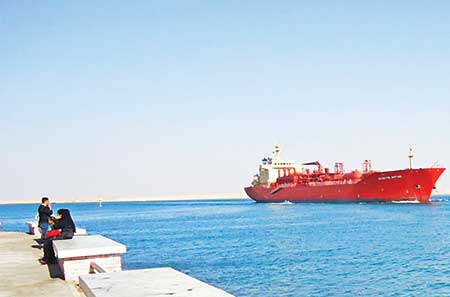
The Suez Canal is an artificial sea-level waterway in Egypt, connecting the Mediterranean Sea and the Red Sea. In Arabic it is called Qanat al-Suwais.
In my school life from the Geography book I came to know about this canal for the first time. From then I was dreaming to come across it. My trance came true when I visited Egypt on November 2010. Egypt is world famous for its pyramids. After quenching shove of touring pyramids, my destination was Suez Canal. On 19th November crack of dawn, I started for Suez Canal from Cairo along with 4 of my colleagues. A juvenile tour guide was with us on microbus. Distance of Suez Canal from Cairo is 140 kilometer (km) and the journey time is approximately 2 hours.
On the way we crossed two newly built satellite cities. First one was New Cairo city. It was approximately 30 km to the east of Cairo city. It will be new administrative and financial capital of Egypt. We came to know the city was established in the year 2000 to alleviate the congestion in downtown Cairo. It covers an area of about 30,000 hectares. The city could eventually host a population of 5 million. It has all utility facilities like parks, pools, gardens, golf course, walkways, offices, mall and factories.
The city is connected to other cities by a vast network of bus lines and taxis. The next city was Madinaty suburb and it was located 21 km east from New Cairo city. Here construction began on July 2006.
Following the tunnel road at last we reached the area Shallufa beside the Suez Canal. I was astounded at the first sight of the canal. The clear bluish water attracts anyone's mind. Like us many tourists had been walking and enjoying along the bank. I was really stunned to see vessels of gigantic size moving through it.
When first built, the canal was 164 km long and 8 meter (m) deep. It was publicly opened in November 1869. After several enlargements, the canal is 193.30 km long, 24 m deep and 205 m wide as of 2010. The northern terminus is Port Said and the southern terminus is Port Tawfiq at the city of Suez.
The Suez Canal can accommodate ships with a vertical height of 62 feet and 210,000 deadweight tons. Presently, supertankers can offload part of their cargo onto a canal-owned boat and reload at the other end of the canal. Our guide told us that the canal is single lane with passing places in the "Ballah By-Pass" and the Great Bitter Lake. Seawater flows freely through the canal as it contains no locks. The canal is owned and maintained by the Suez Canal Authority (SCA) of Egypt.
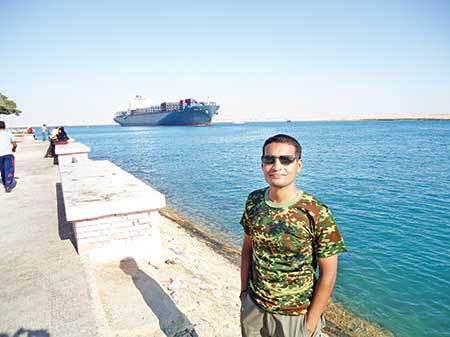
Under international treaty, it may be used in time of war as in time of peace, by every vessel of commerce or of war, without distinction of flag. The passage takes between 11 to 16 hours at a speed of around 8 knots. The low speed helps to prevent erosion of the canal banks by ship's wakes. Moreover, we were informed that three convoys transit the canal on a typical day, two southbound and one northbound.
The Suez Canal can handle more ship traffic and larger ships than the Panama Canal. Another fascinating fact we came to knew was that the Red Sea is generally saltier and more nutrient poor than the Mediterranean.
Accordingly, most Red Sea species invade the Mediterranean biota and only few do the opposite. This migratory phenomenon is called Lessepsian migration or Erythrean invasion. The canal's revenues over fiscal year (FY) 2015/2016 reached United States Dollar (USD) 5.1 billion. Total 275 ships transited the canal, with a total load of 16.8 tons from 8 to 13 October 2017. It also has a railroad running its entire length parallel to its west bank.
We were very close to Ahmed Hamdi Tunnel. It is 1640 m long tunnel constructed under the canal for automobiles. The tunnel is named for Ahmed Hamdi, an Egyptian engineer and General killed in action during the Yom Kippur War of 1973. It has two lanes of traffic, one in each direction. It connects the Asian Sinai Peninsula to the town of Suez on the African mainland. It was constructed in November 1981 and has an outside diameter of 11.6 m.
The tunnel was part of a major drive to develop the areas surrounding the Suez Canal, including other projects such as the Suez Canal overhead line crossing , the El Ferdan railway bridge and the Suez Canal bridge. We crossed the canal through the tunnel and again returned to the African side. We started our return journey towards Cairo. But obviously it was a splendid and memorable tour.
Author Mohammad Mahmudur
Rahman Niaz is a civil Engineer
and a serving Military Officer
Email:niaz7m@yahoo.com





