



| HEADLINE |

|
Hasty move to import LNG may put BD into financial crunch
Published : Wednesday, 28 February, 2018 at 12:00 AM
Shahnaj Begum


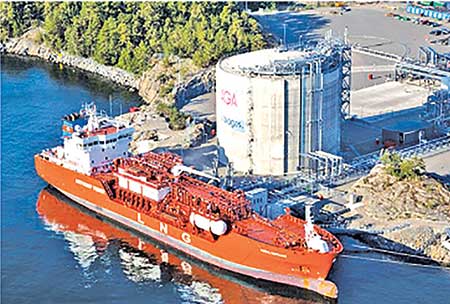 The hasty move to import million tones of Liquefied Natural Gas (LNG) may push the country to implausible financial crunch as the decision was not based on scientific data.
"We are expecting to feed 1000mmcfd LNG into national grid by 2018 and another 500mmcfd between 2019 and 2020. Now we have heard that the Anwara-Fouzdarhat pipeline is yet to be ready to take and supply the LNG to the national grid. It is unfortunate" a frustrated senior official of the Energy division told the Daily Observer on Tuesday.
According to the sources in the Energy Division, the Karnaphuli Gas Distribution Company is able to take around 350 mmcf gas right now. So what would be the fate of another 150 mmcf gas as the pipeline (Anwara-Fouzdarhat pipeline) is yet to be commissioned. Not only that what will happen with the other amount of LNG which is set to come by December 2018.
The government is planning to import 1,000mmcfd LNG in the current fiscal year to meet the growing demand of energy. In its future plan, the government has set a target to import around 4,600 mmcf LNG for meeting the domestic demand, but it has no exact data or investment plan through which it could substantiate its plan in proper manner, the official added.
"Someone should be held accountable for it. This is unpardonable...lack of coordination among the agencies is the root cause of it. Energy and power sector is the worst sufferer of this misconduct in public sector," former energy adviser Dr M Tamim said.
Bangladesh will need Tk 28,000 crore a year for LNG import only for the first one consignment, an official concerned said. He said LNG import issue is not a matter of joke, it's a mammoth task. The government had taken up the issue ten years back and now it has been said that the Petrobangla has no exact plan or project oriented demand plan in hand right now�what a big joke! I can't believe it, the former energy adviser said.
To ensure required amount of energy supply from next year, Energy Division has taken up a massive plan to import LNG as the state owned Petrobangla supplies approximately 2,750 million cubic feet of natural gas a day from domestic gas fields against the demand for 3,500 million cubic feet.
According to the Petrobangla, the demand for natural gas, which accounts for more than 70 per cent of Bangladesh's energy fuel consumption, is expected to continue growing steadily to close to 7 bcfd by 2040, while production is expected to peak above 3.5 bcfd by 2023.
"Now we have started to get pains of the whole gamut when we set to inject the first consignment of LNG into the country in April 2018. This is adverse for us as for the last few years we heard that there is a huge demand of gas but now the Karnaphuli Gas Distribution Company told us that they could able to take only half of this consignment," another official of the Energy Division said.
"There is no proper demand sheet of Petrobangla or Energy Ministry. They apprised us that there is bottlenecks in gas transmission and distribution line and we need huge money to develop a huge structure to load and offload the imported LNG. We need to do the most crucial job to do a market study of LNG market�who cares about it," Dr Tamim said.
According to the Energy division, it expects to add 500mmcfd of LNG in April 2018 and another 500mmcfd in October 2018. However, it plans to consume at least 2000mmcfd of imported LNG gas by installing four separate floating storage and re-gasification unit (FSRU) between April, 2018 and June, 2020.
The government is also expected to import small scale liquefied natural gas (LNG) up to 450 mmcf per day through installing three floating storage and re-gasification unit (FSRU) at three points. At least 15 companies have offered to sell bulk liquefied natural gas (LNG) to the government as the power, energy and mineral resources ministry has chalked out plans to meet the current crisis through gas imports.
The country is currently producing 2,700 MMCF of gas per day, but the demand exceeds 3,500 MMCF. After five years, the demand for gas will double. Petrobangla is also planning to set up at least two onshore LNG terminals, each with a capacity of 7.5 million mt/year, by 2025. The company signed an MOU with India's Petronet in December to build one on Kutubdia Island and issued an international tender in April seeking bids for the construction of the other.
It has also started works to select suitable locations for five more land-based LNG import terminals having 7.5 million mt/y capacities each and already assigned firms to carry out feasibility studies to select suitable locations.
Besides, one Japanese firm -- Tokyo Gas Engineering Solution Corporation -- and two Chinese firms -- China Huanqiu Contracting & Engineering Corporation and China CAMC Engineering Co Ltd -- will conduct feasibility study for five land-based LNG terminals at separate locations including Moheshkhali, Payra and Kutubdia.
At present the country's remaining natural gas reserve stands at 13.28 trillion cubic feet (TCF) pushing the government to take the comparatively costly move on LNG import as well as setting up LNG based plant.
"We have a plan to consume bulk LNG until getting large quantity of gas reserve in the gas fields," said state minister for power and energy Nasrul Hamid.
Meanwhile, the authorities have taken a move to use money from Tk 70 billion Energy Security Fund to meet the import cost of liquefied natural gas (LNG), but the price of LNG is volatile like oil. So, government needs to be more cautious to sign LNG contract with foreign company as there are many countries in the world who became bankrupt, paying huge bill.
Loading...
Loading...
Also read



Editor : Iqbal Sobhan Chowdhury
Published by the Editor on behalf of the Observer Ltd. from Globe Printers, 24/A, New Eskaton Road, Ramna, Dhaka.
Editorial, News and Commercial Offices : Aziz Bhaban (2nd floor), 93, Motijheel C/A, Dhaka-1000.
Phone: PABX- 41053001-06; Advertisement: 41053012; 01793317829, 01550707291, E-mail: [email protected], [email protected] Online: email: [email protected] 41053014; 01550707297 Advertisement: 01550707296
Published by the Editor on behalf of the Observer Ltd. from Globe Printers, 24/A, New Eskaton Road, Ramna, Dhaka.
Editorial, News and Commercial Offices : Aziz Bhaban (2nd floor), 93, Motijheel C/A, Dhaka-1000.
Phone: PABX- 41053001-06; Advertisement: 41053012; 01793317829, 01550707291, E-mail: [email protected], [email protected] Online: email: [email protected] 41053014; 01550707297 Advertisement: 01550707296


