



| HEADLINE |

|
Exclusive interview of the Turkish Ambassador Devrim Ozturk
Published : Friday, 9 March, 2018 at 12:00 AM
Shahriar Feroze


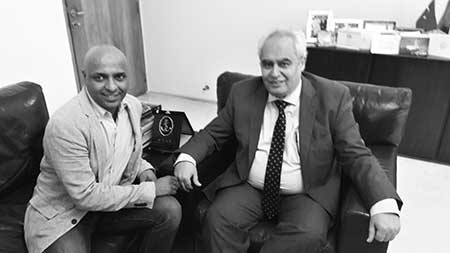
Shahriar Feroze with Turkish Ambassador Devrim Ozturk.
Daily Observer: The cultural and historical tie between Turkey and Bangladesh is age old. What are you currently doing to give it a boost? What programmes are you arranging for the year 2018 in this regard?
Turkish Ambassador: As you have stated clearly, the brotherly bonds between our peoples date prior to the independence of Bangladesh. Geographically speaking, we have a huge distance between our countries but the mutual affection between Turkish and Bengali people has remained eternal and unhindered. The Turkish people still remembers the support of Bengali Muslims during our Liberation War, with gratitude. The heroic victory of the Turkish nation for liberation with the leadership of our Great Leader Mustafa Kemal Ataturk was also celebrated on this soil. The respect and admiration for Ataturk in Bangladesh is reflected in the epic poem "Kamal Pasha", written by Kazi Nazrul Islam, National Poet of Bangladesh. Besides, as you already know one major avenue in Dhaka and another one in Chittagong have been named as "Kamal Ataturk Avenue". We also have two boulevards named after Bangabandhu Sheikh Mujibur Rahman in Ankara and Izmir.
This spirit of brotherhood will never fade away. When treacherous terrorist infiltrated in our armed forces tried to perpetrate a coup against our democratically elected government on 15 July 2016, Prime Minister Sheikh Hasina sent a very meaningful solidarity message to our President Recep Tayyip Erdogan. We are grateful for this timely support.
Of course, the common cultural and religious values, as well as the social bonds between our peoples constitute the main basis of our brotherly relations.We are committed to keep and further develop this relationship in many aspects. In this manner, we attach great importance to sustain regular cultural activities between our relevant institutions with full pace. Last year we have hosted many students from the Bangladesh Children's Academy in Turkey, on the occasion of the April 23 Children's Festival held by our national broadcasting institute, TRT.
We also do our best to create opportunities for Bengali people to learn more about Turkish culture because we know that culture and art have always been an integral part of diplomacy. Considering the global interest in the Turkish cuisine, we have co-hosted a "Turkish Culinary Week" in Dhaka in November 2017. As you know, another historical cultural bond between our peoples is Sufism. Hazrat Shahjalal, one of the students of Mawlana Jalaladdin Rumi in the thirteenth century, was the prominent religious figure during the spread of Islam in Bangladesh through Sufism, which has been a spiritual bond between Anatolia and Bengal. Recently, we have participated in the second "International Sufi Fest" with an enchanting group of whirling dervishes. This festival was a great opportunity both in terms of presenting our own Sufi legacy toa very passionate Bengali audience and learning more about the cultural dimension of Bengali Sufism. We will continue to organise and take part in similar events in the upcoming period.
D O: Despite a glitch in diplomatic relations in 2016, Bangladesh and Turkey's relations have remained stable since Turkey's recognition of independent Bangladesh in 1974. Do you believe it's getting better? If yes, why do you think so?
T A: Our relationship with Bangladesh has always been special and close, I am confident that it will continue to get better. First of all, high level contacts and mutual visits have reached its peak in the last six months. President Erdogan has met with President Abdul Hamid on many occasions. One was in Istanbul, on the sidelines of the OIC Extraordinary Summit. He also met with Prime Minister Hasina in New York.
First Lady Emine Erdogan, Foreign Minister Mevlut Cavusoglu and Family & Social Policies Minister Fatma Betul Sayan Kaya visited Bangladesh on 7 September 2017. This was truly a historic day, as it was one of the first high level visits to Cox's Bazar in the first days of the recent Rohingya influx after 25 August 2017. Our Prime Minister Binali Y?ld?r?m has also paid an official visit to Bangladesh on 18-20 December 2017. Along with fruitful bilateral meetings with President Abdul Hamid and Prime Minister Hasina, he also met with Rohingya refugees in Cox's Bazar and examined our humanitarian efforts on the field. Additionally, Deputy Prime Minister Recep Akdag and Minister of Culture & Tourism Numan Kurtulmus also visited Bangladesh. Likewise, we hosted the Disaster Management & Relief Minister Mofazzal Hossain Chowdhury Maya and Minister of Planning Mustafa Kamal in Turkey. As you can see clearly, even the name of the Honourable Minister is a sign of our social interaction, as it is homage to our Great Leader Mustafa Kemal Ataturk.
Discussions in these high level contacts have mostly revolved around the Rohingya crisis. But we believe that this new impetus will help us to further develop our bilateral relations in all fields. We immensely appreciate the commitment of Bangladesh to democracy, human rights, rule of law, social rights, gender equality, free market economy and cultural diversity. And we wholeheartedly welcome the recent steady economic growth and development trend in this country.
Bangladesh has triumphed as the fastest growing economy of the Asia-Pacific region in 2017, and I am confident that it will be even stronger with less negative effects of regional crises. Both our countries face similar challenges and problems: You have the Rohingya crisis and you host more than 1 million refugees in an overcrowded population, we also have a refugee crisis; you have been actively fighting against terrorism, we are also facing many terrorist threats to the well-being of our people from our borders.
As you know, we have been fighting a number of terrorist organisations that present risks and threats to our national security for a long time. Successfully concluding the "Operation Euphrates Shield" last year, we cleared our borders with Syria from DEASH, liberated an area of 2.015 km2 and established a safe haven free of terror, enabling the displaced Syrians to return. However, the terrorist threat from Syria targeting our borders has not yet ended.
The threat posed by the PKK/KCK/PYD-YPG terrorist elements deployed in the Afrin region of Syria is heightened due to the recent increase in the number of harassment fires and attacks to our people's safety and security. These terrorists have organized numerous attacks to our border provinces, killing and injuring many of our citizens. They even targeted a mosque, in which people were praying at the time. Therefore, we have launched the "Operation Olive Branch" on 20 January 2018 to ensure our border security and neutralize terrorists in Afrin.
The operation is carried out on the basis of international law in accordance with our right to self-defence, as outlined in Article 51 of the UN Charter and relevant Security Council resolutions, and in full respect of Syria's territorial integrity. The Turkish Armed Forces has taken all necessary precautions to avoid collateral damage to the civilian population. In doing so, we will save the brotherly people of Syria from the oppression and cruelty of these terrorists. In addition to that, we will enable the Syrian refugees in Turkey, who were forced to flee their homes in Afrin by terrorists, to voluntarily return to their towns liberated by Turkey. We will continue this operation until terrorists are wiped out of the region. And the world will witness that our efforts will also contribute to the territorial integrity and unity of Syria.
The black propaganda run by the terrorist elements in the field has been proven to be based on fake news and predated irrelevant photos. Having said that, some global media outlets continue to play into the hands of terrorist by spreading fake news. On this occasion, I kindly request all Bangladeshi journalists to be more vigilant about this disinformation campaign with visual material shot in different times and locations, claiming that civilians are killed.
D O: The Turkish government has taken a clear stance by standing beside Bangladesh on the Rohingya crisis. Following the delay of refugee repatriation and amid a number of unsettled issues - does the Turkish government intend to engage in ensuring safe and sustainable return of the Rohingyas to Myanmar?
T A: As you put it clearly, Turkey has been the staunchest supporter of Bangladesh regarding the Rohingya crisis. Prime Minister Hasina and her government, as well as the people of Bangladesh, are displaying an indispensable humanitarian virtue and resolve for helping these stateless poor people. Our leaders have repeatedly emphasized that the suffering of the Rohingya people should not be important only for Bangladesh or Muslim countries.
It is a humanitarian tragedy and should be a concern for the international community, as a whole. In our own capacity, we are deeply engaged with this issue, both in terms of lasting political solution and humanitarian assistance to the refugees. We have been tremendously active on the field with the invaluable efforts of our humanitarian officials and volunteers, both from public institutions and NGO's. Our state development agency T?KA, our national disaster management authority AFAD, the Turkish Red Crescent, the Turkish Diyanet Foundation and countless NGO's from Turkey have been involved in many humanitarian activities, from nutrition to health and education, in cooperation with the government of Bangladesh and the relevant UN agencies. Additionally, we have set up a field hospital in Cox's Bazar, which is operated by Turkish doctors and nurses. And we are planning to open a second field hospital, as well as health centres around the camps. We are also working on a housing project for the Rohingyas.
Because of the chaos and turmoil during the influx, many refugees had to settle in inconvenient shacks and sheds. To this end, we welcome the initiative of the Bangladeshi government to renew the existing sheds with durable shelters and modular houses, in order to provide better living conditions for the refugees. Our disaster management authority AFAD has proposed a project to the Bangladeshi authorities. At the moment, we are trying to finalise a common project for all parties, including the relevant UN agencies. Whilst this project is determined, we will start building new houses for the refugees.
As I said earlier, a lasting solution to the Rohingya crisis is a priority, both for us and the international community. And clearly, this is only possible with safe and dignified return of Rohingyas to Myanmar. There is no other solution to this tragedy. In this vein, we welcome the agreement reached between Bangladesh and Myanmar on repatriation. Having said that, as many rational people point out, this Arrangement encompasses seriousgaps in terms of the rights and freedoms of the Rohingyas.
I believe that the international community must put more pressure on Myanmar for the civic and human rights of these people. On the other hand, the repatriation process, alas, is moving far slower than what was planned in November 2017.We are closely following the developments in this realm.
I can assure your readers that Turkey is ready to play a part in this process. If we are expected to be part of this whole repatriation deal, we are ready to share our humanitarian and technical capacity both with Bangladesh and Myanmar.
(To be continued.....)
The interviewer is Assistant Editor of the Daily Observer
Loading...
Loading...
Also read



Editor : Iqbal Sobhan Chowdhury
Published by the Editor on behalf of the Observer Ltd. from Globe Printers, 24/A, New Eskaton Road, Ramna, Dhaka.
Editorial, News and Commercial Offices : Aziz Bhaban (2nd floor), 93, Motijheel C/A, Dhaka-1000.
Phone: PABX- 41053001-06; Advertisement: 41053012; 01793317829, 01550707291, E-mail: [email protected], [email protected] Online: email: [email protected] 41053014; 01550707297 Advertisement: 01550707296
Published by the Editor on behalf of the Observer Ltd. from Globe Printers, 24/A, New Eskaton Road, Ramna, Dhaka.
Editorial, News and Commercial Offices : Aziz Bhaban (2nd floor), 93, Motijheel C/A, Dhaka-1000.
Phone: PABX- 41053001-06; Advertisement: 41053012; 01793317829, 01550707291, E-mail: [email protected], [email protected] Online: email: [email protected] 41053014; 01550707297 Advertisement: 01550707296


