



| HEADLINE |

|
Chasing Count Dracula!!! - 2
Published : Saturday, 10 March, 2018 at 12:00 AM
Shahriar Feroze


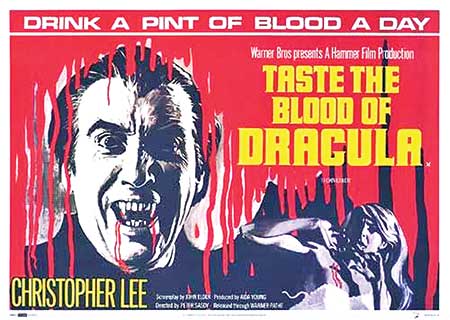 It's amazing that how the entire vampire industry, in and out of Romania, has grown just out of one blended character of facts and fiction. But apart from being the birthplace of Vlad Dracul, the fortified walled town Sighisoara is a living magic by itself. Built in the 12th century by Saxon colonists, the citadel steeply rises above before ending at a hilltop church. Here time stands still.
The centre point of this medieval township is the Clock tower. Also known as the Council Tower built in the second half of the 14th century and expanded in the 16th century. The four small corner turrets on top of the tower are proudly guarding a massive clock in the middle.
In the 17th century, the two-plate clock, with figurines carved from linden wood, was set at the top of the tower, with one dial looking over the Lower Town (Orasul de Jos), and the other facing the citadel. The figurines, moved by the clock's mechanism, each represent a different character. On the citadel side Inoticed the Peace holding an olive branch, accompanied by a doll-like drummer, beating the hours on his bronze drum; above them are Justice, with a set of scales, and Law, wielding a sword, accompanied by two angels representing Day and Night.
Every morning at 6 am, the angel symbolizing the day appears, marking the beginning of the working day and at 6 pm, the angel symbolizing the night comes out carrying two burning candles, marking the end of the working day. The dial overlooking the Lower City features a set of seven figurines, each representing the pagan gods who personified the days of the week: Diane (Monday), Mars (Tuesday), Mercury (Wednesday), Jupiter (Thursday), Venus (Friday), Saturn (Saturday)and the Sun (Sunday).
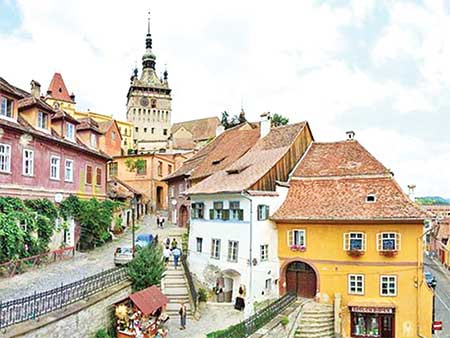 The spire of the tower ends in a small golden sphere. At the top, there is a meteorological cock, which, turned around by air currents, forecasts the weather. This intricate two-plate clock has been working continuously since the middle Ages. Preserve the heritage and will pay back with manifold dividends. From the top of the Clock Tower, visitors can clearly look down on the red-tiled roofs of the Old Town and see intact 16th century Saxon houses lining the narrow cobblestone streets. Today, merchants and craftsmen still go about their business, as they did centuries ago.
During the daytime the pathway to the church is crowded with nearby hilltop school students and buzzing tourists so this adventurer chose to climb the top after six in the evening. Not by taking the scholar's steps, a covered wooden stairway with nearly 180 steps, but via an offbeat road, an uneven stoney path rarely used by tourists.
A little before 7 I got out of the hotel took and took a left turn in the lights of the dimly lit neon lamps. The winter had set in. It was below 10 degrees. Squeezing the muffler tight around my neck, I walked straight in the direction of Dracula's birthplace. The citadel quarter was nearly empty. Bypassing the the Count's birthplace, a small 14th century two storey building, I walked through the clock tower's archway. Went down and up again through the circling pathway. The mind was shrouded with gothic Romanian scenes painted by Stoker some 150 years ago and in about 20 minutes reached the main entrance gate to the church.
It was closed from inside but another private entry on the far left at the back of the church was still open. I circled around the distance, entered and walked straight to the adjacent graveyard. Built on top of the hill the tombs gradually declined along the crag of the hill. I spotted an empty bench facing a row of century's old tombs and an oak tree and sat on it, turned on my mobile phone and touched at the Dracula icon. The first chapter of the e-book opened and just then the sound of a bird's wings flapped. I looked on top. A soft wind blew. I saw nothing. It was Pin drop silence.
This nostalgic writer has just done what he always wanted to do as a ten year old: re-read Count Dracula in the midst of ruins inside a medieval Romanian cemetery. The dark night and surrounding gothic edifices of tombs surrounding me on that frosty night cloaked my mind with a creepy feeling. The impractical fear of the Count to be resting in one of them did in fact come to mind. Or perhaps, his coffin is now empty while its occupant is busy hunting for new prey.
This writer had done the same with a George Orwell novel in the Burmese town of Mowlamine, and if god wills, he looks forward to do the same with an Ian Fleming novel at Goldeneye, in Jamaica. However, a practical advice to my readers is, that those of you who are inspired by this experience should come down to the citadel well before nine since most of the restaurants in this medieval town closes down by ten during the off seasons.
Walking my way down a different but a lengthy path, I stopped in front of Vlad Dracul's birth place once more and asked myself - had he only known what the world is doing with his tailored image of a blood thirsty Count? Ranging from, pens, post cards, dolls, t-shirts, mugs, CDs to almost everything with a link to Dracula are sold in the souvenir shops in Romania. I am pretty much sure - Vlad Dracul would have been shocked at the buying and selling of consumer goods linking him. A visitor needs to pay five Rons just to be in the room where he was born adjacent to a small bar.
Sighisoara, however, is only the beginning to follow the tracks of the Count but the real meeting takes place probably the day after tomorrow at his supposed residence - Bran castle? I am without a clue what events would follow me there.
(To be continued.......)
The writer is Assistant Editor, The Daily Observer
Loading...
Loading...



Editor : Iqbal Sobhan Chowdhury
Published by the Editor on behalf of the Observer Ltd. from Globe Printers, 24/A, New Eskaton Road, Ramna, Dhaka.
Editorial, News and Commercial Offices : Aziz Bhaban (2nd floor), 93, Motijheel C/A, Dhaka-1000.
Phone: PABX- 41053001-06; Advertisement: 41053012; 01793317829, 01550707291, E-mail: [email protected], [email protected] Online: email: [email protected] 41053014; 01550707297 Advertisement: 01550707296
Published by the Editor on behalf of the Observer Ltd. from Globe Printers, 24/A, New Eskaton Road, Ramna, Dhaka.
Editorial, News and Commercial Offices : Aziz Bhaban (2nd floor), 93, Motijheel C/A, Dhaka-1000.
Phone: PABX- 41053001-06; Advertisement: 41053012; 01793317829, 01550707291, E-mail: [email protected], [email protected] Online: email: [email protected] 41053014; 01550707297 Advertisement: 01550707296


