



| HEADLINE |

|
Militant outfits operating through dark web
Published : Wednesday, 25 April, 2018 at 12:00 AM
Mamunur Rashid


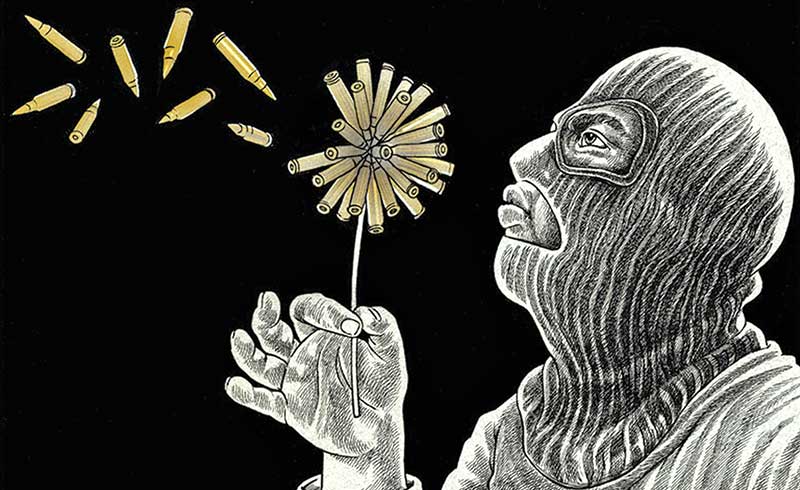 Militant outfits which had been operating under used dark web are now not only active, but regrouping for further assaults as the year draws near to close - leaving the country still under threats of heightened militancy.
Militant outfits are taking full advantage of thedark web, the darkest corners of the internet. The dark web is the vast expanse of the internet which can't be accessed by conventional search engines such as Google and Yahoo.
Law enforcers continued their anti-militancy operations across the country following the government's vow to show "zero tolerance" against terrorism and militancy. Some experts say the militants' activities in the country grewafter the Gulshan café attack in Dhaka on July 1, 2016 and the fight to curb the social menace also gained a momentum. In some 21 major anti-militancy operations in nine districts, at least 70 suspected militants were killed.
Foyzur Rahman Faizul carried out an attempt to kill eminent academic Prof Zafar Iqbal during a program at Shahjalal University of Science and Technology (SUST) in Sylhet on March 4. The CTTC investigator said Foyzur appears to be a trained operative and most possibly he is linked to Ansar al-Islam. Primarily,it was suspected that Foyzur was involved with some radical group and motivated by the use of the internet.
Ansarullah Bangla Team (ABT), Ansar al-Islam began gaining strength in 2013-14 and started selecting targets by monitoring social media and hacked them to death.
RAB 9 Chief Lt Col Ali Haidar Azad said: "During the interrogation, Faizur told us that he attacked Prof Zafar Iqbal because the professor was an enemy of Islam."
Sources said different militantgroups through using modern technology have been collecting activists from different parts of the country. Thecommercial encryption on mobile devices may prevent law enforcement agencies from intercepting communications between groups of militants.
Extremists of all kinds are increasingly using social media to recruit, radicalize and raise funds, RAB sources said.
 A high official of RAB told The Daily Observer that terrorists are now able to hide their identities using encryption tools which were once only available to government agencies.Here we breakdown some of what terrorists are doing on popular social media platforms.
"The Dark Web is a perfect alternative as it is inaccessible to most but navigable for the initiated few - and it is completely anonymous," he said.The deep web - anything not searchable by Google - "is kind of like an iceberg". "Only about 30% of it is actually visible, and some say it is around 1,000 times larger than the web we use every day," he added.
The Bangladesh government keeps denying the presence of IS in this country though it has claimed responsibility for recent attacks killing two foreigners and about half a dozen bloggers, teachers, publishers and progressive thinkers, who the killers term as atheists. They are also targeting preachers and anyone who would oppose their views.
Runaway activists of different banned militant outfits, including JMB, Huji, Ansarullah Bangla Team and HizbutTahrir, are now reportedly regrouping to carry out subversive acts in the country.
The fugitives of these militant outfits are getting united under used dark webs and planning to destabilize the country to make Bangladesh an Islamic state, detective sources said.
Being informed of their secret activities, the law enforcement agencies have become alert and launched a massive hunt for these activists.
Meritorious students of different colleges and universities, including Dhaka University (DU) and Bangladesh University of Engineering and Technology (BUET) are reportedly getting involved in militant activities, intelligence sources said.
Police also confirmed targeting of various innocent and meritorious students of different colleges and universities by the front-ranking leaders of the militant organization.
In the face of massive operations by the law enforcers, including RAB, its active members have continued their activities in the capital and elsewhere in the country secretly, a RAB official said.
As part of its anti-militant actions, RAB personnel are closely monitoring their secret activities so that they cannot carry out any subversive act in the capital and elsewhere in the country, RAB director (media) Mufti Mahmud said.
Most extreme and violent criminals, it must be said, are not internet-savvy. Yet they employ sophisticated hackers who create step-by-step instructions on how to evade detection, hide in plain sight and bury themselves in some deep crevices of the dark web. As technology continues to bound forward, collaboration has never been easier below the surface-level internet. Nor has the sale of supplies for terror groups.
As well as helping the terrorists arm themselves for physical attacks, the dark web, naturally, facilitates cyber-warfare. Hackers create manuals that are adaptable to any skill level, in different languages, along with written or video tutorials on anonymity and supporting technologies. These dumbed-down instructions are available in the dark web markets and are also printed and distributed physically amongst terrorists.
All these present a huge challenge to law enforcement around the globe while they attempt to stay ahead of the terrorists. On the dark web, how do you find those who do not want to be found? It takes technology, it takes patience, and it takes a lot of strategy to get inside the ploys that may endanger many innocent lives.
Accessing the terrorists and other radical virtual homes on the dark web is no easy task. They are not in search engines, and they operate under such obscure names and locations that it is nearly impossible to identify them without any leads. While intelligence operatives may be able to get on the ground floor of the terrorist communications, there is often a hierarchical structure in the dark web presence with dissimilar access levels, sites, and contents - which significantly complicates the good guys' task.
Though the number of drives and its deadly nature were similar to those in 2016, some experts say, with the gradual weakening of global terrorism and nearly diminished stronghold of the Islamic State (IS) in Syria, Bangladesh's domestic militancy activities showed a downward trend last year.
Though law enforcers claim that they have been successful in fighting and keeping militancy under control, many relatives of the suspected militants who were killed in such operations alleged that they had been picked up by law enforcers in plainclothes many days before their bodies were found after a raid or operation.And it is not over yet, as militancy and terrorism cannot be eliminated by force alone.
The writer is working with The Daily Observer
Loading...
Loading...
Also read

Editor : Iqbal Sobhan Chowdhury
Published by the Editor on behalf of the Observer Ltd. from Globe Printers, 24/A, New Eskaton Road, Ramna, Dhaka.
Editorial, News and Commercial Offices : Aziz Bhaban (2nd floor), 93, Motijheel C/A, Dhaka-1000.
Phone: PABX- 41053001-06; Advertisement: 41053012; 01793317829, 01550707291, E-mail: [email protected], [email protected] Online: email: [email protected] 41053014; 01550707297 Advertisement: 01550707296
Published by the Editor on behalf of the Observer Ltd. from Globe Printers, 24/A, New Eskaton Road, Ramna, Dhaka.
Editorial, News and Commercial Offices : Aziz Bhaban (2nd floor), 93, Motijheel C/A, Dhaka-1000.
Phone: PABX- 41053001-06; Advertisement: 41053012; 01793317829, 01550707291, E-mail: [email protected], [email protected] Online: email: [email protected] 41053014; 01550707297 Advertisement: 01550707296


