The rapid and phenomenal developments of renewable energy in many countries render support to the belief that the world is approaching a cross road of transition from conventional (oil gas coal) energy use for power generation to one with newly innovated renewable like solar, wind and biomass - to mention only the common ones. There are two reasons for such notion: firstly the advances in solar and wind and other renewable technologies have been and will continue to be fast moving, thus lowering the cost and becoming logistically more acceptable, and secondly the green lobby has successfully influenced the governments worldwide to be more proactive toward the campaign for renewable replacing fossil fuels .
In mid 1990s renown energy experts predicted that oil, gas and coal will remain the predominant fuel for power generation until 2030, these will give way to natural gas becoming the universal fuel in 2050, the battle between fossil fuels and renewable (solar and wind) for dominance over world energy market will begin in earnest by 2060 and the battle will clearly swing in favour of renewable by 2070. The scientists are beginning to believe that this will happen in a timeframe earlier than forecasted above. In other words, we are likely to see the solar, wind and other renewable overtaking oil gas and coal for energy earlier than suggested before.
In Germany, the installed capacity of solar power has grown to about 40 thousand megawatt (MW) and that of wind power to 50 thousand MW; also the country targets that power generation capacity through renewable sources would reach 50% in 2050. China has become the world's largest solar power market. Its solar power capacity has reached 100 thousand MW. China power generation capacity by renewable (hydro, solar, wind) has reached 24% of total capacity. India has 30% of its power generation through renewable among which the contribution from solar and wind is 18%. Installed solar power capacity in India has reached 20 thousand MW with one solar park of 1000 MW capacity (Andhra Pradesh), one of the largest in the world. The country has an ambitious target of achieving 100 thousand MW from solar by 2022. Compare the above with the total solar power generation capacity of only 270 MW in Bangladesh and it is obvious that we are nowhere near the fast pace of renewable energy developments occurring worldwide.
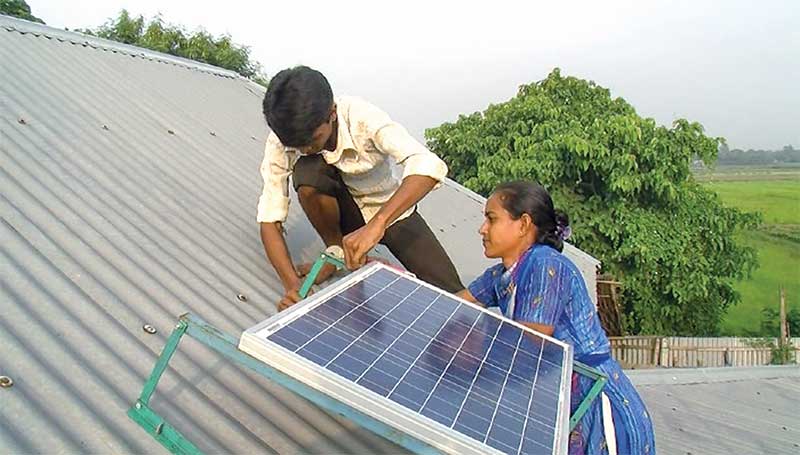
Bangladesh has a success story in developing off grid roof top solar power known as solar home system (SHS) which has given limited electricity to a large number of people living in rather remote off grid area who would not have electricity otherwise. More than 4 million SMS installed domestically have uplifted the standard of living of a large number of impoverish people by providing small scale power at their homes. In fact, Bangladesh has topped a global list of countries that have installed the highest number of SMS. But in the context of national power demand and generation, the contribution of SMS is tiny, a mere 255 megawatt, which is only 2% of the total power generation capacity in the country. In the solar industry worldwide large scale solar power generation essentially means on grid solar (grid connected).
According to the government plan renewable sources should provide about 10% of the total power generation capacity by 2021 meaning 2400 MW power generation from renewable source The prospect of wind power (presently total installed capacity is 2 MW), biomass power (present installed capacity 1 MW) or new hydro power have been limited in Bangladesh and therefore, growth of renewable energy in Bangladesh will rely mainly on the development of on grid (grid connected) solar power. At present the on grid solar power generation capacity amounts to about 15 MW (Sreda 2018) including one well publicized running solar park with 3 MW capacity built on a 8 acres of land in Sarishabari in Jamalpur district.
With such low scale of development it would be impractical to believe that the growth of solar power would reach anything near the projected target by 2021. To date, the government has approved proposals for establishing 19 on grid solar power park submitted by different private companies. Individually the proposed solar parks have generation capacity ranging from 5 MW to 200 MW and the cumulative power generation of all these installations would amount to 1070 MW. Among these, only six companies have so far reached final stage of negotiations by signing power purchase agreement (PPA) and Implementation agreement with the government. According to the prevailing regulation, a company has to complete the construction and start power generation within one and a half years from signing the PPA and IA. Unfortunately none of the companies could complete construction and starts power generation till date although the above time line has passed. From the above discussion it appears that the projected development of the on grid solar has so far failed to provide a realistic hope and Bangladesh falls far behind most of the other countries in promoting solar energy.
What holds Bangladesh back from developing solar power?
Realistically there are a number of reasons that are restricting expected growth of on grid solar. One of the major challenges is the difficulty of acquiring land. As per the government rule, no agricultural land can be used for solar power project. Bangladesh is a densely populated fertile agricultural land and non agricultural unused lands are not easily available enough. A 100 MW solar park for example would require about 300 acres of land. It is expected that the efficiency of the solar panel will increase in future through new technological advances thus requiring lesser area for generating per unit of power. But until that happens, acquiring land will be a major problem for rapid expansion of on grid solar in Bangladesh.
Another drawback in developing on grid solar in Bangladesh is lack of governmental incentive. The companies which are engaged in negotiations and implementation of solar park opine that solar industry in Bangladesh is still in an immature and infant stage and requires incentives from the local authorities. A major point in this is fixing the tariff of the produced power. Over the last few years the cost of solar power generation and therefore the tariff offered has moved progressively downward as seen in India and China for example. In India, solar power was offered a tariff of 19 cent (Taka 15.80) per unit in 2010 and this has come down to 5 cent (Tk. 4) in 2017. Nevertheless, will it be logical to take the Indian experience directly to fix a tariff in Bangladesh at this moment may become an issue for a number of reasons.
Firstly there are abundant areas left barren in India comparatively easy to procure (both in cost and logistic considerations) for solar park developments, including large span of desserts. This is not so in Bangladesh. Also the facts that the average sun shine time is 5.5 to 6.5 hour per day in India compared to that of 4 to 4.5 hours per day in Bangladesh. Furthermore India has by now achieved a solar generation capacity of 20 thousand MW and thus boasts a well trained and qualified work force of its own, whereas Bangladesh has to depend essentially on foreign experts for development of solar parks.
All the above factors let India generate solar power at lesser cost than that of Bangladesh. The organisations engaged in building solar power plants in Bangladesh opine that unless incentive in solar power tariff is given, their effort to develop solar industry would not be economically feasible. It appears that the companies consider 9 cent per unit tariff offered by the government too low a price to built a solar plant and make a profit. Ideally the government negotiators should be good at offering tariff which is biased towards the people and not towards the companies. But solar power industry in Bangladesh is yet to stand on its feet and at an initial stage it needs incentive to grow to a reasonable strength. Tariff incentive is perhaps a vital area which makes a company decide its future in Bangladesh.
The world will change for a better future through rapid growth of renewable energy in not so distant future. The use of traditional fuels oil gas and coal will gradually decrease to be replaced by solar winds and other renewable until a time when the formers will find their place in history book. Bangladesh does not have an option to remain isolated from the rest of the world which would embrace a future with smarter and cleaner renewable energy. For Bangladesh, the challenges in developing renewable may be high, but it is the government which should extend its hand to help it grow in the initial stage.
The writer is a Professor, and Energy expert





