All readings of human history have to allow for the possibility of a negative outcome. It haunts us in the zombie movie, the disaster movie, in the post-apocalytic wasteland of films such as The Road or Elysium. But why should we not form a picture of the ideal life, built out of abundant information, non-hierarchical work and the dissociation of work from wages beyond the politics of capitalism?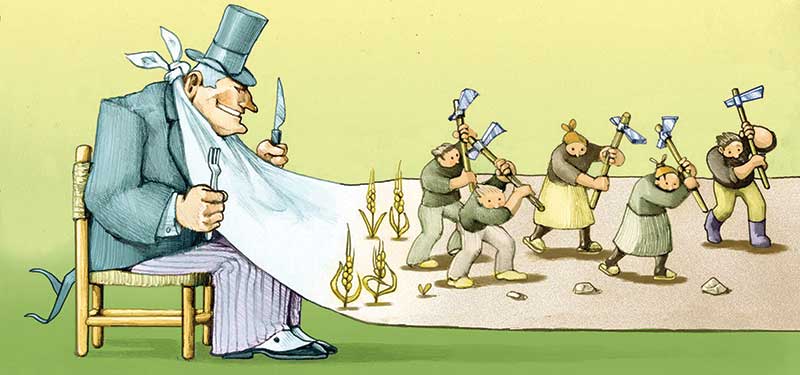
After a run of nearly one thousand years, quipped the French philosopher and writer Voltaire, the fading Holy Roman Empire was neither holy nor Roman nor an empire. Today, some two and a half centuries later, the problem, to paraphrase Voltaire, is that the fading liberal world order is neither liberal nor worldwide nor orderly but just capitalist.
To that end, the democratic countries set out to create an international system that was liberal in the sense that it was to be based on the rule of law and respect for countries' sovereignty and territorial integrity. Human rights were to be protected. All this was to be applied to the entire planet; at the same time, participation was open to all and voluntary. Institutions were built to promote peace (the United Nations), economic development (the World Bank) and trade and investment (the International Monetary Fund and what years later became the World Trade Organization).
The liberal world order appeared to be more robust than ever with the end of the Cold War and the collapse of the Soviet Union. But today, a quarter-century later, its future is in doubt. Indeed, its three components - liberalism, universality, and the preservation of order itself - are being challenged as never before in its 70-year history by capitalism itself.
Liberalism is in retreat. Democracies are feeling the effects of growing populism and capitalism is aiding them. Parties of the political extremes have gained ground in Europe. The vote in the United Kingdom in favour of leaving the EU attested to the loss of elite influence. Even the US is experiencing unprecedented attacks from its own president on the country's media, courts, and law-enforcement institutions. Authoritarian systems, including China, Russia, and Turkey, have become even more top-heavy. Countries such as Hungary and Poland seem uninterested in the fate of their young democracies.
In this context, is it utopian to believe we're on the verge of an evolution beyond capitalism? We live in a world in which gay men and women can marry, and in which contraception has, within the space of 50 years, made the average working-class woman freer than the craziest libertine of the Bloomsbury era. Why do we, then, find it so hard to imagine economic freedom from capitalism?
All readings of human history have to allow for the possibility of a negative outcome. It haunts us in the zombie movie, the disaster movie, in the post-apocalytic wasteland of films such as The Road or Elysium. But why should we not form a picture of the ideal life, built out of abundant information, non-hierarchical work and the dissociation of work from wages beyond the politics of capitalism?
There are several reasons why all this is happening, and why now. The rise of populism is in part a response to stagnating incomes and job loss, owing mostly to new technologies but widely attributed to imports and immigrants. Nationalism is a tool increasingly used by leaders to bolster their authority, especially amid difficult economic and political conditions. And global institutions have failed to adapt to new power balances and technologies.
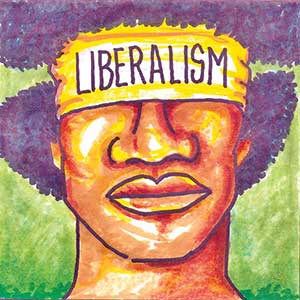
Over the past 25 years it has been the left's project that has collapsed. The market destroyed the plan; individualism replaced collectivism and solidarity; the hugely expanded workforce looks like a "proletariat", but no longer thinks or behaves as it once did.
If you lived through all this, and disliked capitalism, it was traumatic. But in the process technology has created a new route out, which the remnants of the old left - and all other forces influenced by it - have either to embrace or die. Capitalism, it turns out, will not be abolished by forced-march techniques. It will be abolished by creating something more dynamic that exists, at first, almost unseen
within the old system, but which will break through, reshaping the economy around new values and behaviours. Paul Mason called this postcapitalism.
As with the end of feudalism 500 years ago, capitalism's replacement by postcapitalism will be accelerated by external shocks and shaped by the emergence of a new kind of human being. And it has started.
Postcapitalism is possible because of three major changes information technology has brought about in the past 25 years. First, it has reduced the need for work, blurred the edges between work and free time and loosened the relationship between work and wages. The coming wave of automation, currently stalled because our social infrastructure cannot bear the consequences, will hugely diminish the amount of work needed - not just to subsist but to provide a decent life for all.
Second, information is corroding the market's ability to form prices correctly. That is because markets are based on scarcity while information is abundant. The system's defence mechanism is to form monopolies - the giant tech companies - on a scale not seen in the past 200 years, yet they cannot last. By building business models and share valuations based on the capture and privatisation of all socially produced information, such firms are constructing a fragile corporate edifice at odds with the most basic need of humanity, which is to use ideas freely.
Third, we're seeing the spontaneous rise of collaborative production: goods, services and organisations are appearing that no longer respond to the dictates of the market and the managerial hierarchy. The biggest information product in the world - Wikipedia - is made by volunteers for free, abolishing the Encyclopedia business and depriving the advertising industry of an estimated USD 3bn a year in revenue.
Almost unnoticed, in the niches and hollows of the market system, whole swaths of economic life are beginning to move to a different rhythm. Parallel currencies, time banks, cooperatives and self-managed spaces have proliferated, barely noticed by the economics profession, and often as a direct result of the shattering of the old structures in the post-2008 world economic crisis.

New forms of ownership, new forms of lending, new legal contracts: a whole business subculture has emerged over the past 10 years, which the media has dubbed the "sharing economy". Buzzwords such as the "commons" and "peer-production" are thrown around, but few have bothered to ask what this development means for capitalism itself.
Meanwhile in the absence of any alternative model, the conditions for another crisis are being assembled. Real wages have fallen or remained stagnant in Japan, the southern Eurozone, the US and UK. The shadow banking system has been reassembled, and is now bigger than it was in 2008. New rules demanding banks hold more reserves have been watered down or delayed. Meanwhile, flushed with free money, the 1 per cent has got richer.
Neoliberalism, then, has morphed into a system programmed to inflict recurrent catastrophic failures. Worse than that, it has broken the 200-year pattern of industrial capitalism wherein an economic crisis spurs new forms of technological innovation that benefit everybody.
That is because neoliberalism was the first economic model in 200 years the upswing of which was premised on the suppression of wages and smashing the social power and resilience of the working class. If we review the take-off periods studied by long-cycle theorists - the 1850s in Europe, the 1900s and 1950s across the globe - it was the strength of organised labour that forced entrepreneurs and corporations to stop trying to revive outdated business models through wage cuts, and to innovate their way to a new form of capitalism.
The great technological advance of the early 21st century consists not only of new objects and processes, but of old ones made intelligent. The knowledge content of products is becoming more valuable than the physical things that are used to produce them. But it is a value measured as usefulness, not exchange or asset value. In the 1990s economists and technologists began to have the same thought at once: that this new role for information was creating a new, "third" kind of capitalism - as different from industrial capitalism as industrial capitalism was to the merchant and slave capitalism of the 17th and 18th centuries. But they have struggled to describe the dynamics of the new "cognitive" capitalism. And for a reason. Its dynamics are profoundly non-capitalist.
During and right after the second world war, economists viewed information simply as a "public good". The US government even decreed that no profit should be made out of patents, only from the production process itself. Then we began to understand intellectual property. In 1962, Kenneth Arrow, the guru of mainstream economics, said that in a free market economy the purpose of inventing things is to create intellectual property rights. He noted: "precisely to the extent that it is successful there is an underutilisation of information."
There is, alongside the world of monopolised information and surveillance created by corporations and governments, a different dynamic growing up around information: information as a social good, free at the point of use, incapable of being owned or exploited or priced. I've surveyed the attempts by economists and business gurus to build a framework to understand the dynamics of an economy based on abundant, socially-held information.
But it was actually imagined by one 19th-century economist in the era of the telegraph and the steam engine. His name? Karl Marx.
The scene is Kentish Town, London, February 1858, sometime around 4am. Marx is a wanted man in Germany and is hard at work scribbling thought-experiments and notes-to-self. When they finally get to see what Marx is writing on this night, the left intellectuals of the 1960s will admit that it "challenges every serious interpretation of Marx yet conceived". It is called "The Fragment on Machines".
In the "Fragment" Marx imagines an economy in which the main role of machines is to produce, and the main role of people is to supervise them. He was clear that, in such an economy, the main productive force would be information. The productive power of such machines as the automated cotton-spinning machine, the telegraph and the steam locomotive did not depend on the amount of labour it took to produce them but on the state of social knowledge. Organisation and knowledge, in other words, made a bigger contribution to productive power than the work of making and running the machines.
Given what Marxism was to become - a theory of exploitation based on the theft of labour time - this is a revolutionary statement. It suggests that, once knowledge becomes a productive force in its own right, outweighing the actual labour spent creating a machine, the big question becomes not one of "wages versus profits" but who controls what Marx called the "power of knowledge".
In an economy where machines do most of the work, the nature of the knowledge locked inside the machines must, he writes, be "social". In a final late-night thought experiment Marx imagined the end point of this trajectory: the creation of an "ideal machine", which lasts forever and costs nothing. A machine that could be built for nothing would, he said, add no value at all to the production process and rapidly, over several accounting periods, reduce the price, profit and labour costs of everything else it touched.
Once you understand that information is physical, and that software is a machine, and that storage, bandwidth and processing power are collapsing in price at exponential rates, the value of Marx's thinking becomes clear. We are surrounded by machines that cost nothing and could, if we wanted them to, last forever.
In these musings, not published until the mid-20th century, Marx imagined information coming to be stored and shared in something called a "general intellect" - which was the mind of everybody on Earth connected by social knowledge, in which every upgrade benefits everybody. In short, he had imagined something close to the information economy in which we live. And, he wrote, its existence would "blow capitalism sky high".
A combination of all these factors took a set of people who had been marginalised under feudalism - humanists, scientists, craftsmen, lawyers, radical preachers and bohemian playwrights such as Shakespeare - and put them at the head of a social transformation. At key moments, though tentatively at first, the state switched from hindering the change to promoting it. Today, the thing that is corroding capitalism, barely rationalised by mainstream economics, is information. Most laws concerning information define the right of corporations to hoard it and the right of states to access it, irrespective of the human rights of citizens. The equivalent of the printing press and the scientific method is information technology and its spill over into all other technologies, from genetics to healthcare to agriculture to the movies, where it is quickly reducing costs.
Once you understand the transition in this way, the need is not for a supercomputed Five Year Plan - but a project, the aim of which should be to expand those technologies, business models and behaviours that dissolve market forces, socialise knowledge, eradicate the need for work and push the economy towards abundance. It is Project Zero - because its aims are a zero-carbon-energy system; the production of machines, products and services with zero marginal costs; and the reduction of necessary work time as close as possible to zero.
The power of imagination will become critical. In an information society, no thought, debate or dream is wasted - whether conceived in a tent camp, prison cell or the table football space of a startup company.
As with virtual manufacturing, in the transition to postcapitalism the work done at the design stage can reduce mistakes in the implementation stage. And the design of the postcapitalist world, as with software, can be modular. Different people can work on it in different places, at different speeds, with relative autonomy from each other. If I could summon one thing into existence for free it would be a global institution that modelled capitalism correctly: an open source model of the whole economy; official, grey and black. Every experiment run through it would enrich it; it would be open source and with as many data points as the most complex climate models.
The main contradiction today is between the possibility of free, abundant goods and information; and a system of monopolies, banks and governments trying to keep things private, scarce and commercial. Everything comes down to the struggle between the network and the hierarchy: between old forms of society moulded around capitalism and new forms of society that prefigure what comes next.
We need more than just a bunch of utopian dreams and small-scale horizontal projects. We need a project based on reason, evidence and testable designs, that cuts with the grain of history and is sustainable by the planet. And we need to get on with it.
But we also need to internalise these thoughts. It is easy for some to conflate urbanisation and progress and to believe this is how to 'develop'. But societies do not 'evolve' in a unilinear way. Policy makers merely look to prosperous countries and see the bulk of their populations living in cities with a small percentage working in (heavily subsidised and an unsustainable system of) agriculture. This is what 'we' must do, politicians then say, spurred on by World Bank directives.
The route to capitalism and urbanisation was not 'natural' in Europe and involved the unforeseen outcomes of conflicts and struggles between peasants, landowners, the emerging class of industrialists and the state. The outcomes of these struggles resulted in different routes to modernity and levels of urbanisation.
In the book 'The Invention of Capitalism', economic historian Michael Perelmen lays bare the iron fist behind the invisible hand which whipped the English peasantry in a workforce willing to accept factory wage labour. In his article Yasha Lavene noted that English peasants didn't want to give up their rural communal lifestyle, leave their land and go work for below-subsistence wages in dangerous factories being set up by a new, rich class of industrial capitalists.
A series of laws and measures were designed to push peasants out of the old and into the new by destroying their traditional means of self-support. Perelman outlines the many different policies through which peasants were forced off the land, not least the destruction of the access to common land by fencing off the commons.
Early capitalists and their cheerleaders complained how peasants were too independent and comfortable to be properly exploited. Indeed, many prominent figures advocated for their impoverishment, so they would leave their land and work for low pay in factories. But the new form may provide new possibilities for all, and an improved life in post-capitalism world.
Asif Bin Ali moves between journalism (over 50 articles and reviews), and research. He is working with The Daily Observer and this writing is widely influenced by Paul Mason writings.