



| HEADLINE |

|
Consensus eludes UNSC team for strong action against Myanmar
Published : Monday, 30 April, 2018 at 12:00 AM
Shahnaj Begum


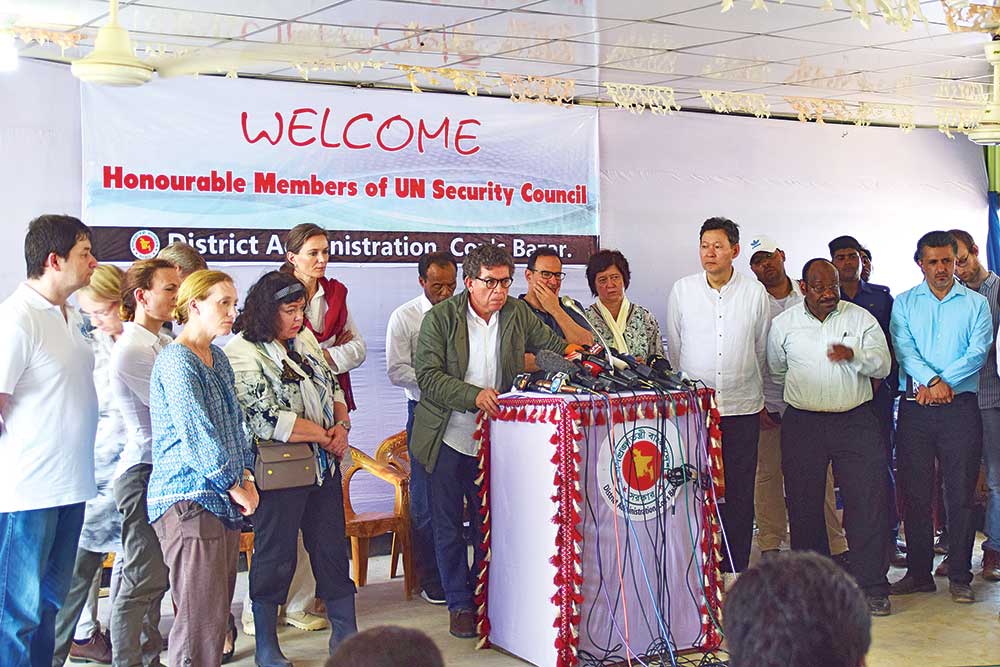
United Nations Security Council members meet the press after visiting Rohingya refugee camps at Ukhia in Chittagong Hill Tracts on Sunday. photo: AFP
Bangladesh hoped that the visit of the delegation might pave the way for a sustainable solution to the decades-old Rohingya crisis. "They repeated the same thing that we have witnessed for the last one year, the visiting team just echoed the UNSC's full committee's decision," a senior official of the Foreign Ministry told the Daily Observer.
According to the sources, Peru's Ambassador to the UN and delegation leader Gustavo Adolfo Meza Cuadra Velasqez, United Kingdom's Permanent Representative to the United Nations Karen Pierce, Permanent Representative of the State of Kuwait to the United Nations Mansour Ayyad Al-Otaibi spoke with the media after the visit.
Kuwaiti, Russian and Chinese representatives, however, categorically said: "The issues are security, drug and examining local and international radical forces activity here and international support for implementing Annan Commission's report by the Myanmar government."
Meanwhile, UN Resident Coordinator in Dhaka Mia Seppo in a tweet termed the visit of UNSC team to Bangladesh a historic one. During their interaction at different levels, the delegation members assured all of taking effective steps to help resolve the Rohingya crisis. "The trip is a continuous process of the UNSC to address the critical problem. It's a stage and nothing more than that but what we achieved from here that is a notion of UNSC... they will visit Myanmar and will analysis the comparative scenario in their own way," former ambassador Humayun Kabir told the Daily Observer.
He said: "Now our task is to continue to sit with the Myanmar and international community for bi-lateral and multilateral diplomacy to dissolve the issue."
State Minister for Foreign Affairs Shahrair Alam said the UNSC team agreed on broader issues, including the fact that the solution lies with Myanmar as problem is in Myanmar, but there has been no consensus yet on stronger action against Myanmar.
"They agreed to work closely with Bangladesh government in protecting border areas and security issues," a senior member of Bangladesh delegation.
"The UNSC team is touched by the stories of Rohingyas and realised that the root cause of Rohingya crisis lies in Myanmar," State Minister Shahriar Alam said.
Ahead of the visit, Ali Riaz, an international analyst, categorically said Bangladesh needs to provide "strong and unassailable evidence" backed up by documents to make its case before the UN Security Council delegation. Unfortunately the documents presented by the Bangladesh's side have failed to convince the UNSC delegation. It has just touched them.
Loading...
Loading...
Also read



Editor : Iqbal Sobhan Chowdhury
Published by the Editor on behalf of the Observer Ltd. from Globe Printers, 24/A, New Eskaton Road, Ramna, Dhaka.
Editorial, News and Commercial Offices : Aziz Bhaban (2nd floor), 93, Motijheel C/A, Dhaka-1000.
Phone: PABX- 41053001-06; Advertisement: 41053012; 01793317829, 01550707291, E-mail: [email protected], [email protected] Online: email: [email protected] 41053014; 01550707297 Advertisement: 01550707296
Published by the Editor on behalf of the Observer Ltd. from Globe Printers, 24/A, New Eskaton Road, Ramna, Dhaka.
Editorial, News and Commercial Offices : Aziz Bhaban (2nd floor), 93, Motijheel C/A, Dhaka-1000.
Phone: PABX- 41053001-06; Advertisement: 41053012; 01793317829, 01550707291, E-mail: [email protected], [email protected] Online: email: [email protected] 41053014; 01550707297 Advertisement: 01550707296


