



| HEADLINE |

|
Living with the ghosts of Plassey!
Published : Saturday, 23 June, 2018 at 12:00 AM
Shahriar Feroze


Shahriar Feroze
Today, details of the battle may be inconsequential, but the nagging question as to why our countrymen conspired against their own while paving the path for the British rule over India still has resonance. The main reasons were: succumbing to temptations of power and wealth, absence of patriotism and profound flaws within the Mughal system of administration.
The political reality of Bangladesh since 1971 has often been riddled with uncertain future -- carefully engineered by certain individuals to get a stranglehold on power. Coups, counter coups, clandestine plotting; greed for capturing power fuelled numerous military uprisings in the late 70's and 80's, resulting in deaths, disappearances and kangaroo trials.
More specifically, since the last decade any form of political dissent is ruthlessly crushed in the name of rampant jailing of political opponents and prohibiting of gatherings. A new form of killing with full impunity took its roots by the name of extra-judicial killings. Elections have become mere charades under the banner of fulfilling 'democratic and constitutional needs'.
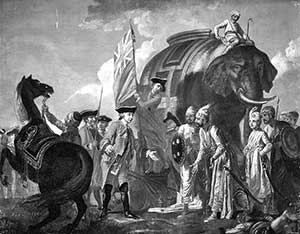
An oil-on-canvas painting depicting the meeting of Mir Jafar and Robert Clive after the Battle of Plassey by Francis Hayman, 1762.
Our rulers of today, understandably, don't have to travel from far to undertake all the thorny challenges to remain in power. In the likes of the rhetoric brown sahibs, they yet continue to depend on applying cunning and wicked techniques. During the Company and crown's rule wealth was surely looted and transferred to England. The same continues to happen in the name of illegal capital outflow and looting of public banks. The British violently suppressed expressions of patriotism and free-speech. And today patriotism seems to be standing on a new foundation based on party-specific loyalty and extreme populism. We need newer legal mechanisms like the Digital Security Act to restrict freedom of speech. A blogger, writer or a journalist automatically disappears without a trace. To cut a long story short, all elements of colonial rule keeps thriving within the boundaries of an independent and sovereign. My last point in line, having learnt all the impiety of the British what's the good that we learnt from them?
Their imperialistic political ideology had surely caused severe damage to the countries of the British Empire but not to the nation Britain itself. While their colonies neared the verge of collapse -- the Britons guaranteed the most effective form of democracy for themselves. Though destructive for others but they ensured to remain always best for their country and people. Could our rulers ensure that?
When it comes to rule or governance, we are told to be following the essentially British Westminster type of government but could any of our presidents or prime ministers were able to hold at least one free, fair, and non-controversial national election since restoring democracy in 1991. We not only made a mockery of the parliamentary democracy, our politicians had distorted and abused for remaining in power for life.
However, up until now, Plassey stands out as a classical example of how military superiority becomes impotent in the face of wicked palace politics and betrayal caused by an external force. More to it, it stands out as a model on how to manipulate the people in power so to establish and legitimise an illegal regime.
The moral of the story -- vice within is the worst enemy. Sadly, so many years later, these rancid elements continue to thrive in today's Bangladesh. The ghosts of Plassey are seen and heard every day, though they appear in different faces, they are here and they are there, and they live nearby this writer.
The Daily Observer
Loading...
Loading...
Also read



Editor : Iqbal Sobhan Chowdhury
Published by the Editor on behalf of the Observer Ltd. from Globe Printers, 24/A, New Eskaton Road, Ramna, Dhaka.
Editorial, News and Commercial Offices : Aziz Bhaban (2nd floor), 93, Motijheel C/A, Dhaka-1000.
Phone: PABX- 41053001-06; Advertisement: 41053012; 01793317829, 01550707291, E-mail: [email protected], [email protected] Online: email: [email protected] 41053014; 01550707297 Advertisement: 01550707296
Published by the Editor on behalf of the Observer Ltd. from Globe Printers, 24/A, New Eskaton Road, Ramna, Dhaka.
Editorial, News and Commercial Offices : Aziz Bhaban (2nd floor), 93, Motijheel C/A, Dhaka-1000.
Phone: PABX- 41053001-06; Advertisement: 41053012; 01793317829, 01550707291, E-mail: [email protected], [email protected] Online: email: [email protected] 41053014; 01550707297 Advertisement: 01550707296


