



| HEADLINE |

|
Northern Cyprus: An agony of no acceptance
Published : Friday, 27 July, 2018 at 12:00 AM
Shahriar Feroze


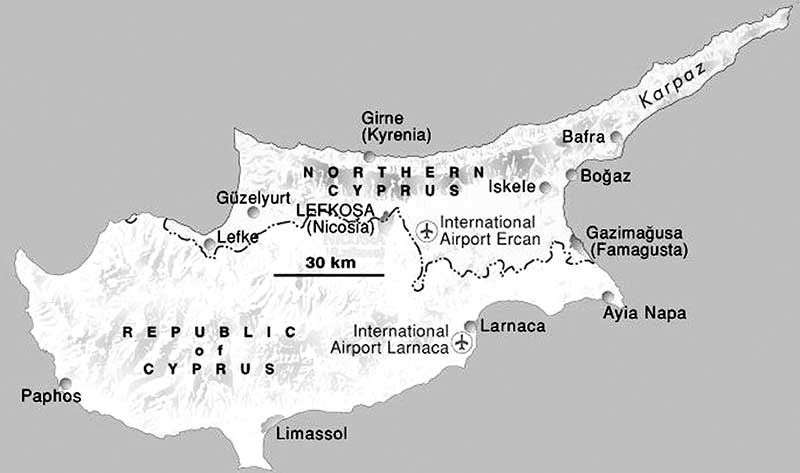 It's a sad tale of an unending agony of Turk Cypriots, if not the entire Cyprus.
 Yes, the Turkish Republic of Northern Cyprus (TRNC) is yet far away from being internationally recognised as an independent and sovereign entity. But wait, this no acceptance or no official diplomatic recognition by UN member states, however you may brand it, hasn't actually turned one third of Cyprus into a failed nation state. It is a partially recognised state that comprises the north-eastern portion of the island of Cyprus recognised only by the Republic of Turkey.
Despite the age-old disagreement over the independence of the TRNC between Turkey and Greece there is no sign of death and destruction when the UN ceasefire took effect in mid August. There is no sign of poverty, hunger or oppression at any corner in northern Cyprus. The only pain remains with the recognition factor.
As far as this journalist came to travel and acquire firsthand knowledge during his brief trip to the TRNC - he saw a peaceful and prosperous island nation - its people friendly and hospitable.
The TRNC uses the Turkish lira as its currency, though you can use the Euro almost anywhere. The economy is primarily dominated by the services sector which includes the public sector, trade, tourism and education. Designer brand stores are aplenty. The economy operates on a free-market basis, with a significant portion of administration costs funded by Turkey.
TRNC's GDP per capita, as of 2014, stands at $ 15,109, and the GDP was $4.039 billion. The economy grew by 4.9% in 2014 and 2.8% in 2013, meaning that Northern Cyprus is growing faster than the Republic of Cyprus. Yet, the pain of remaining globally unrecognised prevails over all.
The agony is visible among its politicians and bureaucrats.
Whereas some of the burning global issues, such as unresolved Kashmir and Palestine issues incorporate poverty, militancy, geopolitical interests , territorial military conflicts , recognition and non-recognition of UN members - the TRNC is an easily understandable manmade puzzle.
According to this writer's understanding, it can be solved anytime but unfortunately it won't be. It's right on this point the TRNC President, Mustafa Akinci was answering a sensitive question placed by this writer, and he specifically mentioned the methodology of the negotiation must be changed.
I am, however, unable to offer a more appropriate and fruitful methodology in this regard, but in the long run TRNC has to formulate that much sought after methodology for itself.
 Arranging dialogues are surely essential in order to resolve any form of domestic and international disputes. But if those dialogues are arranged on the foundations of a fait accompli, there is no point participating in those forums.
 Negotiations around the Cyprus dispute are continuing for 44 years between the leaders of the two communities to 'reach a settlement of its problem by ending the island's division and restoring peace'. UN has been actively engaged in the process.
Referring to the latest visit to the island of the UN Secretary General's temporary UN Envoy to Cyprus Jane Holl Lute, the President said that her visit should not be misevaluated. He said that the Cyprus negotiations process was not starting again and that after the collapse of the Crans-Montana talks the UN Secretary General Antonio Guterres had asked for the sides to return to their countries and evaluate the outcome of the summit. Frankly speaking, sufficient numbers of negotiations have taken place. All their outcomes have been evaluated and there is little need for further evaluation.
Nevertheless, the dispute may still remain a deadlock, but the TRNC is not doing badly. Several battles were fought in the past between the Turk and the Greek military but the last official battle dates back as far as mid August of 1974 when the ceasefire effectively took place. The guns from both sides fell silent, and yet it's the unrelenting anguish of international community's non-recognition of the TRNC which haunts like a demon every hour.
Along with Turkish assistance, TRNC politicians and policy makers have to run the extra mile to get official recognition from the rest of the world - they will have to resort to an out-of-the-box solution. In tuned with my limited understanding, the geographic location of Cyprus is a crucial matter for the EU and Western powers, and when this writer asked his second question to President Akinci about sharing regional and strategic interests in the Mediterranean his answer was not too easy to grasp. His Excellency had said it was 'possible to discuss, negotiate and share geopolitical and strategic interests'.
Rather lawfully, he stressed on the issue for sharing government authority or power sharing formula, but when it comes to sharing of geopolitical and strategic interests, at least this writer doesn't believe that Greek part of Cyprus would want to make an attempt to share that supremacy any time soon. There are far too many stake holders, regional and international players in this game.
The visiting journalists' delegation team's meeting with the cordial and smiling President Ackinci lasted for over an hour and it was learnt that the bottom of the eastern Mediterranean showed potentials of huge reserves of hydrocarbon properties. Whatever, some time a natural blessing might turn out to be a curse and it is most probable that the Greek part would want to have exclusive rights to explore the minerals without having the TRNC as a stakeholder.
But the reality of TRNC is even much harsher than us. Turkey is its only ally and the UN has efficiently isolated the northern Cyprus from the rest of the world, many would surely disagree with me - Yet, how amazing, there are thousands of international students studying at the international universities located in an unrecognised territory. The tourism sector continues to boost despite the tourists entering the North Cyprus through an illegal port of entry. The pains of being non-recognised couldn't demoralise or deflate the progress of the freedom loving Turk-Cypriots.
Perhaps the biggest lesson I took from my recent visit to Northern Cyprus this July - in the face of all hardships and no acceptance if a community remains united in achieving a greater goal - it can achieve it. It may not come anytime soon, but it will come. I believe the Turk-Cypriots have the same belief. The pain they are enduring for international recognition will surely come.
"Surely, with hardship comes ease"(Qur'an 94: 5-6)
And the Turk-Cypriots know it.
The writer is Assistant Editor, The Daily Observer
Loading...
Loading...
Also read



Editor : Iqbal Sobhan Chowdhury
Published by the Editor on behalf of the Observer Ltd. from Globe Printers, 24/A, New Eskaton Road, Ramna, Dhaka.
Editorial, News and Commercial Offices : Aziz Bhaban (2nd floor), 93, Motijheel C/A, Dhaka-1000.
Phone: PABX- 41053001-06; Advertisement: 41053012; 01793317829, 01550707291, E-mail: [email protected], [email protected] Online: email: [email protected] 41053014; 01550707297 Advertisement: 01550707296
Published by the Editor on behalf of the Observer Ltd. from Globe Printers, 24/A, New Eskaton Road, Ramna, Dhaka.
Editorial, News and Commercial Offices : Aziz Bhaban (2nd floor), 93, Motijheel C/A, Dhaka-1000.
Phone: PABX- 41053001-06; Advertisement: 41053012; 01793317829, 01550707291, E-mail: [email protected], [email protected] Online: email: [email protected] 41053014; 01550707297 Advertisement: 01550707296


