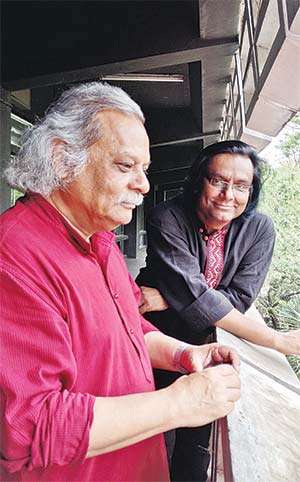
Mustapha Khalid Palash with Professor Shamsul Wares
In
1947, with the end of colonial rule and the partition of India, there
was a general enthusiasm amongst the people of this region to rebuild
their respective countries. In the field of architecture, during fifties
and sixties (in the then East Pakistan) Muzharul Islam almost single
handedly, not only reconciled with the cultural wounds caused by the
colonizers but was also able to establish a strong foundation for a
liberal, progressive and modernist architecture. After the liberation
war was won and Bangladesh was born in 1971, there was a decade long
pause for all physical development. Meanwhile during eighties, nineties
and onward, due to the development of a new economy, commercialism and a
new consumerist society, major building activity shifted from the
public to the private enterprises. Cheap buildings began to be built by
the developers for profit and archaic buildings by the nuveau riches
displaying their wealth unsubtly. As a result in the overall spectrum of
the new architecture, the idealist fervour, formal vigour, cultural
sensitivity and material expressiveness once orchestrated by Muzharul
Islam with a humanist vision gradually became lost.
In this "build
more" situation, where quantity flourished at the cost of quality,
buildings began to be erected in every corner of Dhaka city making it
highly dense, congested and ugly. But within this unholy euphoria, there
has been rebels, a few architects, young and old, who continued to
provide resistance against this matter of fact bulk production of the
building industry in order to express their social and aesthetic concern
as well as their passion and creativity with considerable success.
Radisson Bay View Hotel (Chittagong)
In
the early years of the new millennium, there came three new tall
buildings designed by Mustapha Khalid Palash that changed the skyline of
Dhaka with some sense and sensibility. Peoples Insurance, a 20-storey
circular building in Motijheel, Dhaka completed in 2003 is stacked with
floor plates having circular ribbon windows of varied widths, in order
to achieve not only a pleasing exterior form but also to negotiate with
the sun. When eight-storey Basundhara City, a shopping complex with a
20-storey office tower on a 4.60 acre plot at Panthapath, Dhaka designed
by Palash was completed one year later, it immediately became a
landmark of the city with a grand civic presence. The enormous street
fa�ade of the building complex was broken down in order to scale down,
into a few blocks with preceding and receding planes and lines
incorporating the play of light and shade. In the absence of any
decorative element, great importance was laid to proportion. This
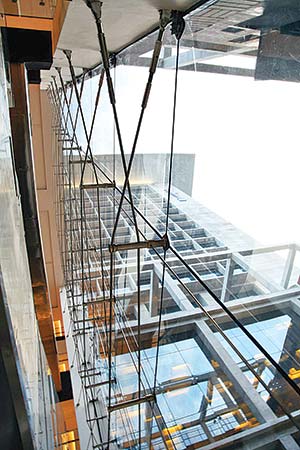
centrally air-conditioned complex with lavish circulation space, atrium
loft and ample day light, although lacks adequate landscape has not only
turned it into a pleasant place for eating, shopping and entertainment
but also into a civic space for the mass people. During the same time
when geometrically organized slick and smart UTC, an office tower
adjacent to the Basundhara City with an impressive and inviting flight
of steps connecting the street was completed, in no time, Palash became
the most coveted architect of the city. After these three buildings
(Peoples Insurance, Basundhara and UTC), architect Palash did not have
to look backward. In the case of 27-storey Westin Hotel in Gulshan,
completed in 2009, Palash worked within a strong geometric order on a
relatively very tight site. While in the case of 9-storey Grameen Phone
building in Basundhara, Dhaka, completed one year later in 2010, Palash
disciplined the U-shaped building in order to create an introvert court
facing the street and a number of open to sky terraces at various
levels. A circular water body within the court area with water
centripetally moving towards the centre has created a unique ambiance
for this energy conscious, high-tech building. Today Palash, a house
hold name, is the most prolific architect of the country producing
corporate offices, five star hotels, housing complexes, and shopping
malls and bit by bit civilizing the urban context of our cities. The
writer is an eminent architect and art critic.
Published by the Editor on behalf of the Observer Ltd. from Globe Printers, 24/A, New Eskaton Road, Ramna, Dhaka.
Editorial, News and Commercial Offices : Aziz Bhaban (2nd floor), 93, Motijheel C/A, Dhaka-1000. Phone: PABX- 41053001-06; Online: 41053014; Advertisement: 41053012.
E-mail: district@dailyobserverbd.com, news@dailyobserverbd.com, advertisement@dailyobserverbd.com, For Online Edition: mailobserverbd@gmail.com