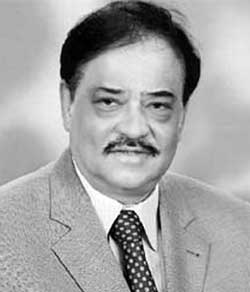
It was especially on account of my father's eagerness that our ties with our village home became more intimate and enduring. This happened particularly during the period of our first residence in Azimpur. Baba's career and work mainly confined him and all of us to cities and towns but, in the heart of his heart, he had an abiding love for rural Bengal. That is why, perhaps, after the end of his career as government official at the age of 60, my father BM Rahman returned 'home'--his village. It was a quiet and shady place--the village Kushumpur in Icchapur union of Sirajdikhan upazila in Munshiganj (Bikrampur). The villages of Bengal were dear to him. He saw the face of eternal Bengal not only in his own serene and staid Kushumpur but also in the far corner of rural Mymensingh where he spent his childhood. He regarded rural Bengal as an inseparable part of his personality and lively source of everlasting inspiration of the soul.
It was as a result of baba's profound love and irresistible attraction that rural Bengal came to occupy an important element in the many-coloured backdrops of our lives. The process started during our childhood in Azimpur. During school holidays and particularly during long summer vacations, he would take us all to our village home. At that time, it was full of life. Sprawling over a few acres of land, it was shaded by a large number of mango, blackberry and jackfruit trees. It also had three large ponds of crystal-clear water in its south, west and northeast corners.
There were several spacious courtyards surrounded by a number of structures with roofs of corrugated iron sheets. The yards served as wide platforms for drying paddy, jute, mustard, red chillies and mango-paste and the like in their respective seasons. Apart from Uncle Habibur Rahman and aunty Anwara Rahman and their children, baba's cousins and their children made life in our rural extended family lively and vibrant.
The undisputed guardian of this teeming family was our grandfather Jasimuddin Bhuiyan, a tall man with muscular physique and solemn personality, who served as a mighty police officer under the British Raj during the first three decades of the twentieth century. On account of severe rheumatism, he, however, had to go on early retirement. Baba used to proudly tell us, 'Your dada (grandpa) has been a pensioner for full three decades!'
Dada combined his insufficient pension with modest earnings from the land the family owned, and help from his sons' earnings, to meet the considerable needs of the large joint family. He died in 1963 at the age of 83. A few months before his demise, dada held my six-month-old elder son Nipu lovingly in his lap. That occasion was a rare get-together of four generations in our village home.
We occasionally went to spent time in our village which was so full of life. The main reason why we were taken to the village was not only to enjoy holidays away from Dhaka but something else. Baba's principal objective was to make us have an intimate encounter with life in rural environment. He succeeded in his mission. As a result of his painstaking efforts, we were exposed to novel experiences of life and nature during varied seasons of Bengal. Thus, we saw the Kal Baishakhi (nor'wester) sweeping through wide, open meadows and wreaking havoc in the orchards.We also watched with eager interest how the swift flowing waters in the rainy season filled up the canals, swamps, ponds and rivers to the brim, and heard the rainwater playing xylophone on the tin roofs of our village home.
We also saw barren paddy lands scorching in the searing hot sun of early summer. We further got the opportunity to watch the tranquil and transparent waters in ponds and larger water bodies during dewy autumn; water lilies bloom in disarming smile in the crystal clear of water of lakes, white swans swim across staid waters sketching short-lived lines of passage. During autumn and late autumn the enchanting beauty of the eternal Bengali village captivated us in breathless joy. Again, during sun-warmed winters scrolling fields aglow with yellow mustard flowers decked the wide stretches of Bikrampur in unparalleled natural beauty.
We came close not only to nature but also to simple village folks. Elderly and respected Idris Talukder was not only a guardian of the neighbouring Talukder household but also of the entire village. In our childhood, he was at the prime of his youth. I remember the day when while drinking water from the tube-well in the Talukder homestead, he chanced to see me. Looking at me he said, 'Aren't you the grandson of Mr Jasimuddin Bhuyan?' As I nodded affirmatively, he asked me in English. 'What is your name?' I mobilised all the English language in my command and smartly replied, 'My name is Shelley.' Hearing my instant reply, he was immensely pleased. Many years after this incident, Idris Talukder would refer happily to that exchange in English between us.
As a result of frequent visits to our village home with baba, our ties with relatives there were further cemented. Among the kin were visually-challenged Jamu kaka (uncle Jamiruddin), boba kaka (uncle Bazlur Rahman who had speech impairment), aunty, mother of Tukku'da and Nantu'da, and another aunty, who was the mother of Togo'da, sister Kiron and their younger brother Nantu, and their father, uncle Shamsu. There were also our favourites of the Talukder clan, Anu'da and Bonu'da.
There were also the inhabitants of the not-too-distant Mianzi household referred to in colloquial distortion as the 'Majhibari': Makhanda, Shantuda, Khanida, Mona bhai (later after being married to sister Kiron, Mona dula bhai). Among those who were contemporaries or students of the same class were Abdur Rab Choudhury, later a pioneer businessman and former president of the Dhaka Chamber of Commerce and Industries. Dalu (Anisul Islam Lashkar), later a bank official and businessman, Dilu (GM Delwar), in later life director general of the Bangladesh Postal Department, and Mohammad Jalaluddin who later became the chief of the Aeroflot office in Dhaka.
My friendship and intimacy with all of them deepened as a result of frequent visits to the village during childhood and adolescence. In dry and cool winters our days in the village became joyful with games of football and cricket played with makeshift bats and rubber balls. There were also rural games: dariabanda and hadudu. All these games and plays brought us closer not only to immediate cousins such as Siraj, Pintu and Khashru but also the contemporaries in our own village and adjacent ones. The author, founder Chairman of Centre for Development Research, Bangladesh (CDRB) and Editor quarterly "Asian Affairs" was a former teacher of political science in Dhaka University(1964-1967) and former member of the erstwhile Civil Service of Pakistan (CSP) (1967-1980) and former non-partisan technocrat Cabinet Minister of Bangladesh (1990).
Published by the Editor on behalf of the Observer Ltd. from Globe Printers, 24/A, New Eskaton Road, Ramna, Dhaka.
Editorial, News and Commercial Offices : Aziz Bhaban (2nd floor), 93, Motijheel C/A, Dhaka-1000. Phone: PABX- 41053001-06; Online: 41053014; Advertisement: 41053012.
E-mail: district@dailyobserverbd.com, news@dailyobserverbd.com, advertisement@dailyobserverbd.com, For Online Edition: mailobserverbd@gmail.com