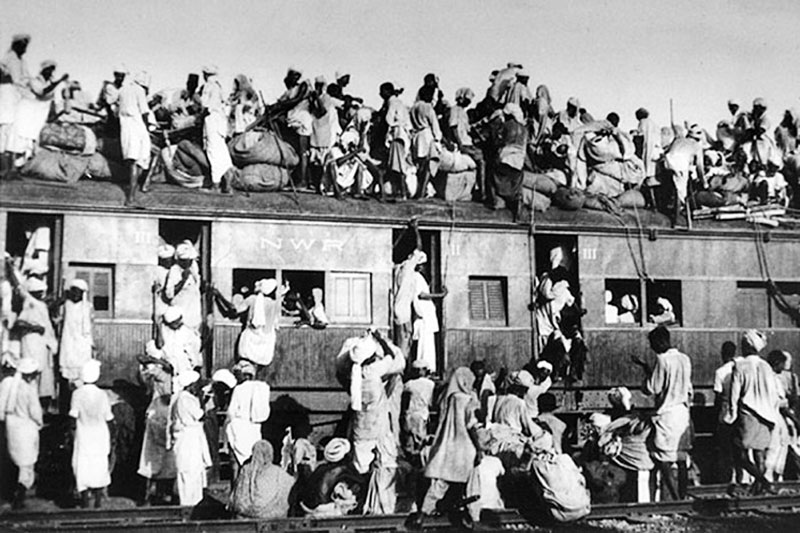
The Independence of India in 1947 which stood witness to the largest exodus in history has the stories of the partition survivors primarily related to their mode of transport across the border. For the major part of the last year, I engaged myself in collecting partition stories of the survivors in West Bengal. Their tales of woe mostly weaved around the narrations of travel. In this regard we cannot forget the famous picture of the train by photojournalist Margaret Bourke-White with men sitting atop and Khushwant Singh's novel 'Train to Pakistan'.
Trains, steamers, launches and boats comprise of the transportations availed by the migrants which evoke the picaresque riverine landscapes of erstwhile East Pakistan in any person listening to these life-narrations. During the nineteenth and the early-twentieth centuries, discoveries in engines enabled intercontinental travel which helped the basic transportation in the Eastern border of Independent India compelling overloaded trains to deliver the refugees in Kolkata for habitation and those that awaited their turn for relocation would find temporary shelter in the Sealdah Train Station.
Mr Rathin Das Gupta a retired Indian Air Force personnel of the age seventy-six, now a resident of Birati, India recounts his awe on seeing and boarding the train for the first time while coming from Manikgunj, Dhaka to Kolkata, India. He remembers his travel on the launch across Padma before he boarded the overpopulated train. Till that day he had not seen such a metallic giant heaving in front of him like monsters from 'Thakuma-r Jhuli' in a desperate tone he had urged his father to not put him on that locomotive. The welcome at Sealdah from Dhaka was not an appealing one for him; scattered with men, dirt and diseases Partition was a frightful revelation for the child of four.
Before Partition several over-night trains connected Kolkata, Goalanda, Dhaka and Narayanganj. The pre-partition attraction in Railways was the Darjeeling Express which ran across Kolkata and Siliguri through Gede-Darshana and Chilahati-Haldibari. There were three primary rail services existent between India and erstwhile East Pakistan till 1965- East Bengal Mail, East Bengal Express and the Barishal Express. The Indo-Pakistani Conflict of 1965 following the operation Gibaltar designed to infiltrate Jammu and Kashmir, India to initiate a rebellion against the Indian rule amounted in the closure of these passenger trains.
The independence of East Pakistan as the nation-state of Bangladesh after the Bangladesh Liberation War resulted in the re-establishment of the rail links between India and Bangladesh in 2008. The international passenger train service between West Bengal, India and Bangladesh through the "box-fencing" on either side of the no man's land in both the nations is called the Maitree Express meaning the friendship express in English. The second train service between both the nations called Bandhan Express (translateable into relationship express) was initiated in 2017.
Both the trains aim at achieving between both the nations what their names suggest. Years after the political re-mapping of India and Bangladesh the stream of migrants flow both ways through these accessible trains to establish better, secured connections on both sides of the border.
Amrita Das Gupta has completed her MPhil from Jadavpur University
Published by the Editor on behalf of the Observer Ltd. from Globe Printers, 24/A, New Eskaton Road, Ramna, Dhaka.
Editorial, News and Commercial Offices : Aziz Bhaban (2nd floor), 93, Motijheel C/A, Dhaka-1000. Phone: PABX- 41053001-06; Online: 41053014; Advertisement: 41053012.
E-mail: district@dailyobserverbd.com, news@dailyobserverbd.com, advertisement@dailyobserverbd.com, For Online Edition: mailobserverbd@gmail.com




 Mr Rathin Das Gupta a retired Indian Air Force personnel of the age seventy-six, now a resident of Birati, India recounts his awe on seeing and boarding the train for the first time while coming from Manikgunj, Dhaka to Kolkata, India. He remembers his travel on the launch across Padma before he boarded the overpopulated train. Till that day he had not seen such a metallic giant heaving in front of him like monsters from 'Thakuma-r Jhuli' in a desperate tone he had urged his father to not put him on that locomotive. The welcome at Sealdah from Dhaka was not an appealing one for him; scattered with men, dirt and diseases Partition was a frightful revelation for the child of four.