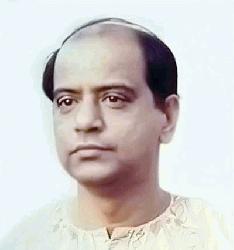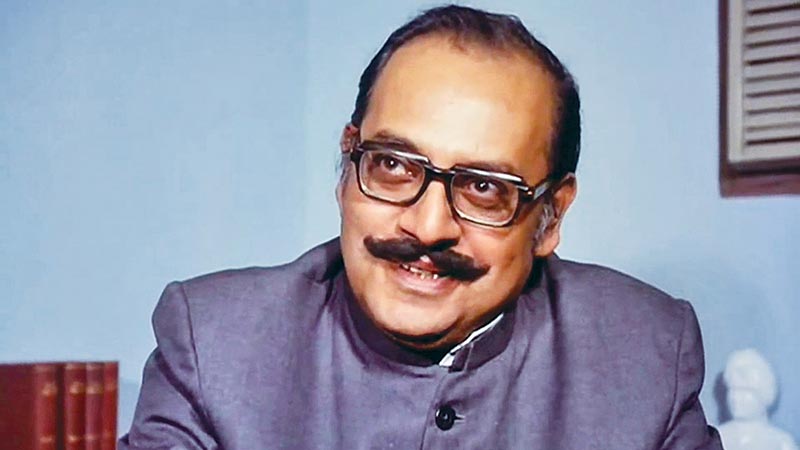
Utpal Dutta was an Indian actor, director, and writer-playwright. He was primarily an actor in Bengali theatre, where he became a pioneering figure in Modern Indian theatre, when he founded the "Little Theatre Group" in 1949. This group enacted many English, Shakespearean and Brecht plays, in a period now known as the "Epic theatre" period, before it immersed itself completely in highly political and radical theatre. His plays became an apt vehicle for the expression of his Marxist ideologies, visible in socio-political plays such as Kallol, Manusher Adhikar, Louha Manob, Tiner Toloar and Maha-Bidroha. He also acted in over 100 Bengali and Hindi films in a career spanning 40 years, and remains most known for his roles in films such as Mrinal Sen's Bhuvan Shome, Satyajit Ray's Agantuk, Gautam Ghose's Padma Nadir Majhi and Hrishikesh Mukherjee's breezy Hindi comedies such as Gol Maal and Rang Birangi. He also did a small role of a sculptor in a detective show called Byomkesh Bakshi on Doordarshan in the early 90s, shortly before his death. The episode was called 'Seemant Heera'.
His father was Girijaranjan Dutta. Utpal Dutt was born on March 29 in 1929 in a Hindu Kayastha family in Barisal. He studied initially at St. Edmund's School, Shillong, and later completed his Matriculation in 1945 from St. Xavier's Collegiate School, Kolkata. In 1949, he graduated with English Literature Honours from St. Xavier's College, Calcutta, University of Calcutta.
Though he was active primarily in Bengali theatre, he started his career in English theatre. As a teenager in the 1940s, he developed his passion and craft in English theatre, which resulted in the establishment of "The Shakespeareans" in 1947. Its first performance was a powerful production of Shakespeare's Richard III, with Dutt playing the king. This so impressed Geoffrey Kendal and Laura Kendal, who led the itinerant "Shakespeareana Theatre Company", that they immediately hired him, and he did two year-long tours with them across India and Pakistan, enacting Shakespeare's plays, first 1947-49 and later 1953-54; and was acclaimed for his passionate portrayal of Othello. After the Kendals left India for the first time in 1949, Utpal Dutt renamed his group the "Little Theatre Group" (LTG), and over the next three years, continued to perform and produce plays by Ibsen, Shaw, Tagore, Gorky and Konstantin Simonov. The group later decided to stage exclusively Bengali plays and to eventually evolve into a production company that would produce several Bengali movies. He also remained an active member of Gananatya Sangha, which performed through rural areas of West Bengal.
He was also a founding member of Indian People's Theatre Association (IPTA), an organization known for its leftist leaning, but left it after a couple of years, when he started his theatre group. He wrote and directed what he called "Epic Theatre", a term he borrowed from Bertolt Brecht, to bring about discussion and change in Bengal. His Brecht Society, formed in 1948, was presided by Satyajit Ray. He became one of the most influential personalities in the Group Theatre movement. While accepting Brecht's belief of the audience being "co-authors" of the theatre, he rejected orthodoxies of "Epic theatre" as being impractical in India. He also remained a teacher of English at the South Point School in Kolkata.
Soon he would turn to his native Bengali, producing translations of several Shakespearean tragedies and the works of Russian classicists into Bengali. Starting in 1954, he wrote and directed controversial Bengali political plays, and also Maxim Gorky's Lower Depths in Bengali in 1957. In 1959, the LTG secured the lease of Minerva Theatre, Kolkata, where most notably Angar (Coal) (1959), based on the exploitation of coal-miners was showcased. For the next decade the group staged several plays here, with him as an impresario, and he still is remembered as one of the last pioneering actor-managers of Indian theatre. He also formed groups like Arjo Opera and Bibek Yatra Samaj.
Meanwhile, his transition to films happened while performing the role of Othello, when famous filmmaker Madhu Bose happened to be watching, and gave him the lead in his film Michael Madhusudan (1950), based on the life of the revolutionary Indian poet Michael Madhusudan Dutt. Later, he himself wrote a play on the fragmented colonial psyche of Michael Madhusudan Dutt, and the ambivalence of swaying between "colonial" admiration and "anti-colonial" revolt. He went on to act in many Bengali films, including many films by Satyajit Ray.[2]
Dutt was also an extremely famous comic actor in Hindi cinema, though he acted in only a handful of Hindi films. He acted in comedy movies, the most notable ones being Guddi, Gol Maal, Naram Garam, Rang Birangi and Shaukeen. He received Filmfare Best Comedian Award for Golmaal, Naram Garam and Rang Birangi. In Bengali cinema, he appeared in Bhuvan Shome, (for which he was awarded the National Film Award for Best Actor), Ek Adhuri Kahani and Chorus, all by Mrinal Sen; Agantuk, Jana Aranya, Joi Baba Felunath and Hirak Rajar Deshe, by Satyajit Ray; Paar and Padma Nadir Majhi, by Gautam Ghose; Bombay Talkie, The Guru, and Shakespeare Wallah, by James Ivory; Jukti Takko Aar Gappo, by Ritwik Ghatak; Guddi, Gol Maal and Kotwal Saab by Hrishikesh Mukherjee; Shaukeen, Priyatama and Hamari Bahu Alka directed by Basu Chatterjee and Amanush, Anand Ashram and Barsat Ki Ek Raat by Shakti Samanta.
Utpal Dutt also played the main villain characters in some of the major successful Amitabh Bachchan starrers such as The Great Gambler and Inquilaab (film). In fact, Utpal Dutt was the Hero (main lead) in Amitabh Bachchan's maiden venture Saat Hindustani. He balanced successful parallel careers as an extremely serious theatre playwright and director in Bengal alongside doing hilariously comic roles in Hindi cinema. He is the greatest dramatist in progressive Bengali theatre of the 20th century.
Dutt was also a lifelong Marxist and an active supporter of the Communist Party of India (Marxist), and his leftist "Revolutionary Theatre" was a phenomenon in the contemporary Bengali theatre. He staged many street dramas in favour of the Communist Party. He was jailed by the Congress government in West Bengal in 1965 and detained for several months, as the then state government feared that the subversive message of his play Kallol (Sound of the Waves), (based on the Royal Indian Navy Mutiny of 1946, which ran packed shows at Calcutta's Minerva Theatre), might provoke anti-government protests in West Bengal. The play turned out to be his longest-running play at the Minerva. Manusher Adhikare (Of People's Rights) in 1968, staged as a documentary drama, was a new genre in Bengali theatre before, though it turned out to be his last production of the group at the Minerva, as they soon left the theatre. Thereafter, the group was given the name the "People's Little Theatre"; as it took on yet another new direction, his work came closer to the people, and this phase played an important role in popularizing Indian street theatre, as he started performing at street-corners or "poster" plays, in open spaces, without any aid or embellishment, before enormous crowds. The year also marked his transition into Jatra or Yatra Pala, a Bengali folk drama form, performed largely across rural West Bengal. He started writing Jatra scripts, produced and acted in them, even formed his own Jatra troupe. His jatra political dramas were often produced on open-air stages and symbolized his commitment to communist ideology, and today form his lasting legacy.
The Last Lear, the 2007 English film based on his play Aajker Shahjahan, on an eccentric Shakespearean actor, and directed for the screen by Rituparno Ghosh, later won the National Film Award for Best Feature Film in English.
He received National Film Award for Best Actor in 1970 and three Filmfare Best Comedian Awards. In 1990, the Sangeet Natak Akademi, India's National Academy of Music, Dance and Theatre, awarded him its highest award, the Sangeet Natak Akademi Fellowship for lifetime contribution to theatre.
The writer is a freelance contributor.