



| HEADLINE |

|
A pure abstract expressionist in our art milieu
9th Death Anniversary of Mohammad Kibria
Published : Tuesday, 9 June, 2020 at 12:00 AM
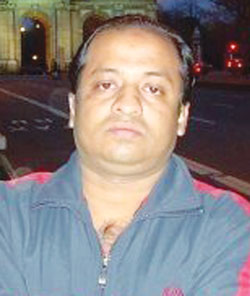
Takir Hossain


Takir Hossain
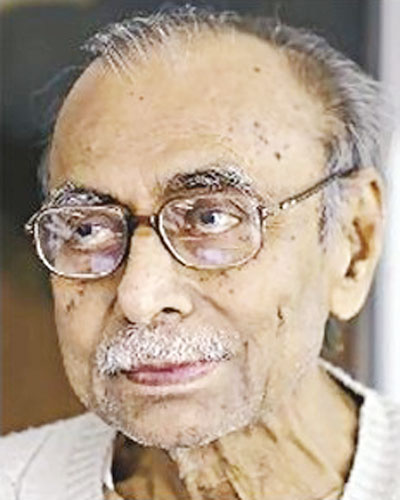
Mohammad Kibria is considered an iconic figure in contemporary art, as he introduced modern paintings where compositions, colours and forms are major features. He meticulously blended the essential elements of paintings. His paintings can be explained in many ways where one can find the touch of mysticism; some can get the taste of harmony, melancholy or despair. His mode of expression (in paintings) had been changed a number of times, but the painter successfully established his personal trademark through all his creations. His style is unquestionably unique, individualised and expressive. In his paintings, one feels the lament of a lonely soul, an underlying sorrow or a feeling of bareness.
Kibria was born in Birbhum in 1929 and he graduated from the Government School of Art, Calcutta (now Kolkata) in 1950. Kibria started out as a figurative artist in the 1950s. Kibria moved to Dacca (now Dhaka) in 1951 where he started his career as an art teacher at the Nawabpur High School. In 1954, he joined as a teacher at the Government College of Arts and Crafts (currently the Faculty of Fine Arts, University of Dhaka).
The breakthrough in Kibria's career came when he earned a scholarship to study at the Tokyo University of Fine Arts and Music in Japan in 1959. While in Tokyo, he visited museums for the very first time and experienced the works of the great masters. Paul Klee's compositional elements and Giacometti's elongated human forms inspired him. Francisco Goya's paintings from his 'black period' had a similar effect on Kibria.
 During the four year course in Tokyo, Kibria studied painting under Takeshi Hayashi; etching under Tetsuro Komai and Lithograph under KazuWakita. Kibria studied the techniques of woodcut in the studio of the artist, Hideo Hagiwara. The special arrangement to work under Hagiwara was made by the Japanese Ministry of Education.
 During his stay in Japan, the artist was learning the details of two major genre of printmaking -- lithograph and wood cut. He also concentrated on the use of space and its varied aspects. The artist meticulously created space that denoted solitude and serenity. His colours seem more subdued and lucid. In the course of time, his works matured further in terms of the inner structure of forms and objects.
Kibria was known for his compositions and he worked in several mediums, applying different techniques. His printmaking was very delicate, prolonged and technique based. Emotions, yearnings, contemplation and liberty were aptly addressed through his etchings and lithographs. He used minimization in his printmaking. Due to the influence of his Japanese guru Hideo Hagiwara (in printmaking), Kibria's etchings and lithographs reflect elements of Japanese subtlety and technique.
Some of his etchings at the exhibition denote a big flat space with some dotted minute forms. Kibria had simplified and enhanced the abstract image that constructs a visual reference to his reminiscences, imaginings and thoughts.
His paintings' colours, forms, textures and overall composition truly articulate his visions where quietude, simplicity and subtlety blended collectively. A number of oil paintings (untitled) create an impression of being absolutely alone. Some of his oil paintings are relatively more appealing for their smooth and soft compositions. Blue, black, ash, grey, orange and brown have been primarily used in his works.
Dynamically active till the end of his life, the artist's preference for colours, compositions and textural patterns had a significant impact on the Dhaka art scene. A number of painters have been greatly influenced by Kibria, which could be regarded as "Kibria Schooling".
For his life-long attachment to art, the legendary painter-printmaker received EkusheyPadak, Shadhinota Padak and many other prestigious awards. After his retirement in 1997, Dhaka University selected him as a professor emeritus in 2008. He died in 2011.
The writer is an art critic and cultural curator
Loading...
Loading...
Also read



Editor : Iqbal Sobhan Chowdhury
Published by the Editor on behalf of the Observer Ltd. from Globe Printers, 24/A, New Eskaton Road, Ramna, Dhaka.
Editorial, News and Commercial Offices : Aziz Bhaban (2nd floor), 93, Motijheel C/A, Dhaka-1000.
Phone: PABX- 41053001-06; Advertisement: 41053012; 01793317829, 01550707291, E-mail: [email protected], [email protected] Online: email: [email protected] 41053014; 01550707297 Advertisement: 01550707296
Published by the Editor on behalf of the Observer Ltd. from Globe Printers, 24/A, New Eskaton Road, Ramna, Dhaka.
Editorial, News and Commercial Offices : Aziz Bhaban (2nd floor), 93, Motijheel C/A, Dhaka-1000.
Phone: PABX- 41053001-06; Advertisement: 41053012; 01793317829, 01550707291, E-mail: [email protected], [email protected] Online: email: [email protected] 41053014; 01550707297 Advertisement: 01550707296


