



| HEADLINE |

|
98th Birth Anniversary of Safiuddin Ahmed
A eulogium to a printmaker-painter
Published : Wednesday, 24 June, 2020 at 12:00 AM
Takir Hossain


Takir Hossain
Safiuddin's art has mainly focused on rural panorama, pastoral life, landscapes, memories of 1971, Language Movement, floods and other natural calamities as well as Santal life. Safiuddin was a friend and colleague of Shilpacharya Zainul Abedin, and one of the founders of Dacca Art College (now the Faculty of Fine Arts, DU). From 1948 to 1979, he served as head of the department of printmaking at the institution.
Safiuddin was particularly known for his woodcut engravings. He devoted much time to a single piece of painting and print. Black is the predominant aspect in his works. From the beginning, the maestro had experimented with black and its mysterious tones, tenors and layers of colour. Most of his colours look muted and the message has always been one of peace and harmony. His paintings are technique-oriented as well. His lines have created a distinct language where one can learn about his perseverance, longing and devotion to art.
From the commencing of his career, Safiuddin's creative process has been impulsive, touching, scrupulous and detailed. It should be mentioned that the artist firstly concentrates on his theme and then he pours his labour to other technical aspects. In his professional life, the painter is very much wary of his grist of the mill and its philosophical and cerebral aspects. Previously, the painter gave more importance to his subject than its technical aspect. During that time he used impasto layers, in which the materials intertwine with other stuffs. Besides gripping the subject, he was occupied with thick colour where he created the character with help from superbly used spatula and brush on his canvas.
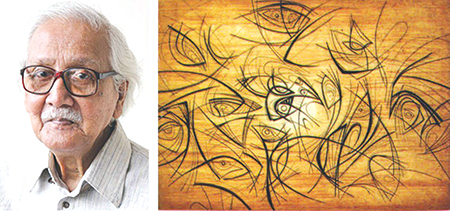 Safiuddin is very meticulous about creating the ground of the canvas. To create the background for his paintings, the artist layers eight to ten times before making a level satisfactory enough for plunging deep into his subject easily. He has created varied kinds of moon, half-moon sized forms, dots, tiny round and oval sized forms with different shades. Some of his canvases are engrossed with vague forms and compositions. Sometimes the painter applies colours directly -- piling them up faintly thick, and at times thin -- on the canvas, and tries to create an image that is dynamic and has appealing texture and sensuous tones. The backgrounds of most of his compositions are occupied by abstract forms, soothing colours and soft tones. Some works include engraved ambiguous forms while others are populated by scribbles and amorphous forms. Safiuddin invests considerable time on each painting. The most significant feature of his paintings is that the surfaces of his paintings appear to us in same tone in every spaces of his painting.
Safiuddin was born in 1922 in Calcutta (now Kolkata), India. He was a student of Calcutta Government School of Art and graduated from the institute in 1942. After Partition in 1947, Safiuddin left Calcutta for Dhaka, where he found himself caught up in a movement to set up the first art institute in the then East Pakistan.
Some of his outstanding achievements as a young artist included the President's Gold Medal (1945) by Academy of Fine Arts, Calcutta; first prize in the category of black and white in International Contemporary Art Exhibition, New Delhi (1946); first prize in the category of black and white (etching and drawing) in Inter-Asian Art Exhibition in New Delhi (1947) and Patna Maharaja's Gold Medal (1947). He was a proud recipient of the Ekushey Padak and Shadhinota Puroshkar.
The writer is an art critic and journalist
Loading...
Loading...
Also read



Editor : Iqbal Sobhan Chowdhury
Published by the Editor on behalf of the Observer Ltd. from Globe Printers, 24/A, New Eskaton Road, Ramna, Dhaka.
Editorial, News and Commercial Offices : Aziz Bhaban (2nd floor), 93, Motijheel C/A, Dhaka-1000.
Phone: PABX- 41053001-06; Advertisement: 41053012; 01793317829, 01550707291, E-mail: [email protected], [email protected] Online: email: [email protected] 41053014; 01550707297 Advertisement: 01550707296
Published by the Editor on behalf of the Observer Ltd. from Globe Printers, 24/A, New Eskaton Road, Ramna, Dhaka.
Editorial, News and Commercial Offices : Aziz Bhaban (2nd floor), 93, Motijheel C/A, Dhaka-1000.
Phone: PABX- 41053001-06; Advertisement: 41053012; 01793317829, 01550707291, E-mail: [email protected], [email protected] Online: email: [email protected] 41053014; 01550707297 Advertisement: 01550707296


