As a guardian of Bengali writers, Syed Ali Ahsan (26 March 1920 - 25 June 2002) was a shadow for contemporary poets, writers and intellectuals-- who were united to establish something unique that Bengali literature had never experienced before. The extraordinary creativity through his diverse journey always surprises the readers of all time. He was a renowned poet, literary critic, administrator, researcher, educator, speaker, editor, and translator. He was considered as an accomplished artisan in the materials of experience that was achieved through his brilliant literary works, tastes, realizations, inventions, and presentations.
The language he used to write prose was praiseworthy as it was well organized, rhythmic, and easy to understand. As his writing characteristics were attractive, so were these fascinating to follow. He was an art-conscious poet who had a keen eye on the relevance and variation of modern poetry. He felt more comfortable in prose rhymes where his interests, attitudes, and considerations were displayed in the forms of words, ornaments, and metaphors. He applied modern artistic techniques that beautified the Bengali literature forever.
The versatility of the words and his fundamental creation made him special. The words used in his poems contained a high frequency that still heightens readers. The contents of his poems were derived from his heart, and it quickly attracted everyone's attention. His expression of meditation, impersonality, and sophistication influenced his thinking-that has become inevitable in the history of Bengali literature. So, he was not just a poet; instead, a poet of poets in many eyes.
In the 40s, he was heavily influenced by poet Farrukh Ahmed regarding poetry. Farrukh was able to create his genre through stories in Puthi literature-which was a special class of Bengali literature composed of a mixture of Arabic, Urdu, Persian, and Hindi languages between the 19th and 20th century. It attracted many contemporary poets, and Ali Ahsan also tried to follow that move. He wanted to use Arabic-Persian words the way Farrukh used.
He initially tried to use those in his poems; but soon realized that the way Farrukh did, he was not feeling comfortable in the same style anymore. As a result, he became a poet in his own style and succeeded in doing so. And, he easily established his stage in Bengali poetry as a distinguished modern poet. Ali Ahsan's poem "Amar Purbo Bangla'' is one of the best patriotic poems in the Bengali literature.
In the aesthetic field, it was difficult to find a second one like him, at least in the latter times of Buddhadeb Bosu. Many called Mohit Lal Majumder a "Kind of Dr Johnson'' for aesthetic reasons. Similarly, if Buddhadeb Bosu and Syed Ali Ahsan are considered as equivalent to TS Eliot and Ezra Pound, it is not inferior. Instead, they were more advanced in "comparative criticism." Thus, in the literary world of Bengali criticism, Syed Ali Ahsan will always be considered in the infinite inevitability.
The effects of Rabindranath and Nazrul is observed in his writing, even though he additionally experienced a hard time during famine-stricken and social deprivation of World War II. The consciousness of the Pakistan movement and the prevalence of contemporary conditions greatly influenced his thinking. In addition, his poems and elitist tendencies gave him a specialty of poetry. Therefore, in his poetry, patriotism, heritage, love of nature, and infinite love for people were identified.
Although primarily known as a poet, Ali Ahsan showed his remarkable achievements in prose composition-that dealt with contemplative, research, literature, biographic, art, and literary criticism, and so on. His prose style, narration, and tone were brilliant in characteristics-which was as catchy as his poems. To others, it was exemplary. Additionally, the contents of his prose were also very much different and exciting. This is how his diversity in writing and research made our literary world very wide and colorful.
Reading his book "Alawaler Padmavati," Sunitikumar Chattopadhyay commented, "This is such a basic research work that no one else could succeed in this way." Syed Ali Ahsan wrote books on Madhusudan and Rabindranath, and at the same time, he gave a thorough explanation of modern literature by using comparative methods in Bengali literature. Probably, that is way, Munir Chowdhury dedicated his comparative criticism to Syed Ali Ahsan, mentioning how Ali Ahsan inspired him to search for a similar practice by setting up the most profoundly constructive literary criticism-which was the first in-depth insight into writers in that era. These words were genuine and proper recognition for great Ali Ahsan.
In addition to meditative and research works, Ali Ahsan authored novels, autobiographical works, travel stories, and even books for children. His remarkable works on art and sculpture amazed not only his readers but also the experts who were specialized in the field. Besides, he had numerous articles and books on culinary arts and other subjects. His profound talents and experiences on such diverse subjects suggest that he was undoubtedly an extraordinary human being, just as he was as a writer.
In his career, he successfully served in many institutions. He was appointed advisor to the president in charge of the Ministry of Education, Culture, Sports, and Religion of the Government from 1977 to 1978. He served as an advisor to the Literary Branch of the Nobel Committee in Sweden from 1976 to 1982. He was ordained as the National Professor of Bangladesh in 1989 and was appointed chairman of the University Grants Commission that year. He served as the Vice-Chancellor of Jahangirnagar University, Rajshahi University, and Darul Ihsan University. He also worked as the Director-General of the Bangla Academy. Despite having so many achievements, surprisingly, what made his career magnificently immortal was his superb writing style which was fascinating and heart-touching.
This extraordinarily creative man with rare talent enriched the Bengali literature through his multidimensional contributions and achievements. National Professor Abdur Razzak said, "His aesthetic sense is very keen." The famous poet Prabodhchandra Sen commented, "Sahityacharya Syed Ali Ahsan." Mulk Raj Anand said, "Ali Ahsan is great, not I am. It may take another 200 years for people like him to be born in South Asia." These comments make his readers think about him once again.
The writer was a Fulbright TEA Fellow, Montana State University, USA. He writes on contemporary issues, education, and literature.
Published by the Editor on behalf of the Observer Ltd. from Globe Printers, 24/A, New Eskaton Road, Ramna, Dhaka.
Editorial, News and Commercial Offices : Aziz Bhaban (2nd floor), 93, Motijheel C/A, Dhaka-1000. Phone: PABX- 41053001-06; Online: 41053014; Advertisement: 41053012.
E-mail: district@dailyobserverbd.com, news@dailyobserverbd.com, advertisement@dailyobserverbd.com, For Online Edition: mailobserverbd@gmail.com



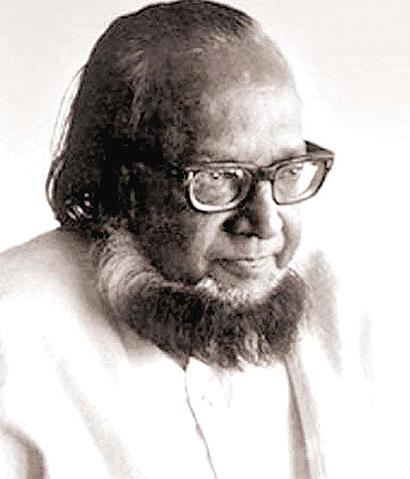 Reading his book "Alawaler Padmavati," Sunitikumar Chattopadhyay commented, "This is such a basic research work that no one else could succeed in this way." Syed Ali Ahsan wrote books on Madhusudan and Rabindranath, and at the same time, he gave a thorough explanation of modern literature by using comparative methods in Bengali literature. Probably, that is way, Munir Chowdhury dedicated his comparative criticism to Syed Ali Ahsan, mentioning how Ali Ahsan inspired him to search for a similar practice by setting up the most profoundly constructive literary criticism-which was the first in-depth insight into writers in that era. These words were genuine and proper recognition for great Ali Ahsan.