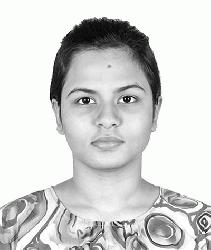
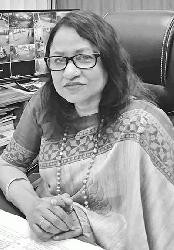
Professor Dr Nasreen Ahmad is the second and longest-serving female Pro-Vice Chancellor (Academic) of the University of Dhaka. While she has been the renowned personality in Bangladesh, she has another identity to be proud of.
Dr Nasreen takes pride in her active involvement with the Swadhin Bangla Betar Kendra at Mujibnagar in 1971, the famous Bengali broadcasting centre established by the freedom fighters, as its English newscaster. She read the English news regularly as "Zareen Ahmad" along with taking part in other programs.
Thus she was actively involved in our liberation war, through which we got our country Bangladesh.
From the very beginning of her student life, Professor Nasreen actively engaged in many social works. She was elected as the Common-room Secretary of Dhaka University Central Students' Union (DUCSU) in the academic year 1969-70-a remarkable feat for a woman at that time. As a student leader, she actively participated in the mass upsurge of 1969 and organised cultural movements against the dictatorial regime of Ayub Khan.
Dr. Nasreen said her mother Begum Badrunnessa Ahmed was her inspiration to actively engage in mass movement in student life. She got her mother's support in a time when Dictator Ayub Khan Government issued warning for the family's of government officer to prevent their sons and daughters from taking part in any movement.
Taking part in movement actively before the Independence war and being elected as the Common-room Secretary of DUCSU made her adamant to get an Independent Bangladesh.
Those activities however acted as the prelude for her to join the Swadhin Bangla Betar Kendra.
"I was just proud to be the part of Swadhin Bangla Betar Kendra, which was the trusted media for the people at that time. Since the media in Bangladesh during that period was controlled by government, no one could keep faith. People only trusted Akasbani, BBC and Swadhin Bangla Betar Kendra," Dr. Nasreen said.
Swadhin Bangla Betar Kendra was pivotal in motivating the people during that crunch time. The general people were keenly waiting for the news of the Swadhin Bangla Betar Kendra. As she read news to let the people know about the condition of the country and the activities of freedom fighters, Dr Nasreen had the first-hand experience about the liberation war.
"Just before December, we remained tensed about what would happen," she said, sharing her experience of those tumultuous days.
"When December starts, we understood we came closer slowly to achieve the independence gradually. We got further boost up when Bhutan recognized Bangladesh as a country on December 4 and then India recognized us. Thereafter we were all but sure we were going to achieve the independence."
"When freedom fighters and Indian soldiers entered into the Bangladesh on December 14 or 15 and left Pakistani soldiers in a point of no return, we all are expecting that it's the time to seal the deal."
Born in July 1949 in Calcutta, Professor Nasreen Ahmad had been educated in Dhaka all through. Having completed her Senior Cambridge in 1965 from Viquarunnesa Noon School and Higher Secondary School Certificate Examination from Holy Cross College (1966), she completed her Honours and Masters in Geography from the Department of Geography (1970-71) and Master of Demography (1982) from the Institute of Statistical Research and Training, DU. She was awarded Doctor of Philosophy from the Department of Geography and Environment, DU, for her thesis on "Determinants of Landlessness in Rural Bangladesh." Prof. Ahmad's interests lies in Population Geography, Climatology and Agroclimatology.
Starting her career as a teacher of Geography in Begum Budrunnessa Govt. Girls College in April, 1974, Prof. Ahmad joined the University of Dhaka as an Assistant Professor in February, 1984, was Associate Professor (1993) and finally Professor (2000) in the Department of Geography. Prior to her appointment as the Pro-Vice Chancellor (Academic) in June 2012, she carried out various academic and administrative responsibilities of the University. She was the Project Director and founder provost of Begum Fazilatunnesa Mujib Hall (2001-2005), the elected Dean of the Faculty of Earth and Environmental Sciences (2010-2012) and Chairperson of Dept. of Geography & Environment, DU (2011-2012). She has been elected to the Senate a number of times and has also been an elected member of the teacher's association, DUTA.
"News reading in Swadhin Bangla Betar Kendra was something that I am proud of myself and I could contribute to the war of independent," she said.
"When we sensed we were very close to our victory, we started broadcasting messages to the Pakistani soldiers asking them 'surrender, you have no way to escape' in the midst of the news and programmes. The feeling is beyond imagination. I can't make you understand what I was going through," she said.
"When we nearly won the war then Swadhin Bangla Betar Kendra started announcing the surrender of the enemy forces. It was like I myself was ordering them to surrender," she boasted.
Finally on 16 December 1971, the Pakistan army surrendered to the Mukti Bahini at the Race Course Maidan (now Suhrawardy Udyan) in Dhaka, which led to the victory of Bangladesh in the liberation war in just nine months.