



| HEADLINE |

|
EU says hours left for a Brexit deal, UK says 'see sense'
Published : Saturday, 19 December, 2020 at 10:33 PM
Observer Online Desk


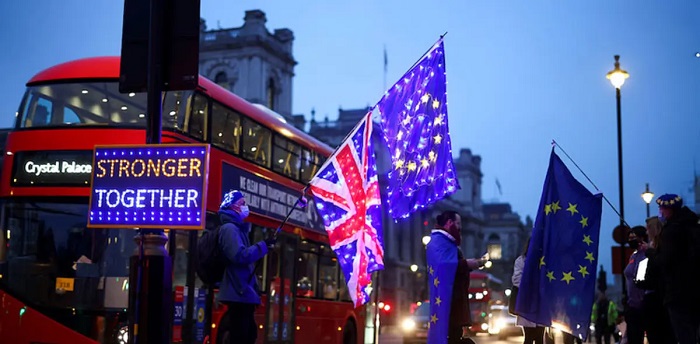
The European Union said on Friday there were just
hours left to strike a Brexit trade deal while Britain called on the
bloc to see sense as the two sides race to prevent a turbulent finale to
the Brexit crisis at the end of the month.
Both
London and Brussels are demanding the other compromise amid a flurry of
often conflicting messages that, variously, a deal is possible, a deal
is in serious trouble or that a deal is imminent.
Several hours after EU chief negotiator Michel Barnier told London that there were just hours left to navigate a “very narrow” path towards a deal, Johnson said the British door was open but that the EU should see sense and compromise.
“It’s the moment of truth,” Barnier told the European Parliament in Brussels. “There is a chance of getting an agreement but the path to such an agreement is very narrow.”
Johnson said Britain would keep talking but that he would not compromise on taking back control of its laws and its fishing waters - which he sees as the fundamental point of leaving the EU.
“Our door is open, we’ll keep talking but I have to say things are looking difficult,” Johnson told reporters. “We hope that our EU friends will see sense and come to the table with something themselves - because that’s really where we are.”
A British source said talks were due to continue on Saturday.
Britain formally left the EU on Jan. 31 after its 2016 referendum but since then, it has been in a transition period under which rules on trade, travel and business remain unchanged. That period ends on Dec. 31.
An accord would ensure that the goods trade which makes up half of annual EU-UK commerce, worth nearly a trillion dollars in all, would remain free of tariffs and quotas.
Sterling, which has oscillated to the beat of Brexit news for five years, fell as low as $1.3472 GBP=D3 on Friday and was last down 0.6% at $1.3508.
Some EU diplomats think the rhetoric indicates an agreement is being hashed out in Brussels, though Britain has cautioned that it could take until after Christmas to get a deal - if there is one at all.
‘HOURS LEFT’
Britain says the talks are stuck on two issues - the so-called level playing field and fishing - and has repeatedly said the EU has to budge or there will be no deal.
“We have very little time remaining, just a few hours to work through these negotiations in a useful fashion if we want this agreement to enter into force on the first of January,” Barnier said.
While Barnier said the sides were striving for an agreement, he said the 27-nation bloc would not sign a deal that undercut its cherished single market of 450 million consumers.
Johnson, the face of the 2016 Brexit campaign, will ultimately have to decide whether to accept the narrow deal on offer from the EU or risk the economic chaos - and applause from hardline Brexiteers - that walking away would trigger.
EU powers are concerned London wants the best of both worlds - preferential access to EU markets but with the advantage of setting its own rules.
Several hours after EU chief negotiator Michel Barnier told London that there were just hours left to navigate a “very narrow” path towards a deal, Johnson said the British door was open but that the EU should see sense and compromise.
“It’s the moment of truth,” Barnier told the European Parliament in Brussels. “There is a chance of getting an agreement but the path to such an agreement is very narrow.”
Johnson said Britain would keep talking but that he would not compromise on taking back control of its laws and its fishing waters - which he sees as the fundamental point of leaving the EU.
“Our door is open, we’ll keep talking but I have to say things are looking difficult,” Johnson told reporters. “We hope that our EU friends will see sense and come to the table with something themselves - because that’s really where we are.”
A British source said talks were due to continue on Saturday.
Britain formally left the EU on Jan. 31 after its 2016 referendum but since then, it has been in a transition period under which rules on trade, travel and business remain unchanged. That period ends on Dec. 31.
An accord would ensure that the goods trade which makes up half of annual EU-UK commerce, worth nearly a trillion dollars in all, would remain free of tariffs and quotas.
Sterling, which has oscillated to the beat of Brexit news for five years, fell as low as $1.3472 GBP=D3 on Friday and was last down 0.6% at $1.3508.
Some EU diplomats think the rhetoric indicates an agreement is being hashed out in Brussels, though Britain has cautioned that it could take until after Christmas to get a deal - if there is one at all.
‘HOURS LEFT’
Britain says the talks are stuck on two issues - the so-called level playing field and fishing - and has repeatedly said the EU has to budge or there will be no deal.
“We have very little time remaining, just a few hours to work through these negotiations in a useful fashion if we want this agreement to enter into force on the first of January,” Barnier said.
While Barnier said the sides were striving for an agreement, he said the 27-nation bloc would not sign a deal that undercut its cherished single market of 450 million consumers.
Johnson, the face of the 2016 Brexit campaign, will ultimately have to decide whether to accept the narrow deal on offer from the EU or risk the economic chaos - and applause from hardline Brexiteers - that walking away would trigger.
EU powers are concerned London wants the best of both worlds - preferential access to EU markets but with the advantage of setting its own rules.
Barnier
said the EU needed to be able to impose trade barriers in the event the
UK changes its regulations to offer substandard goods on the bloc’s
market.
For fisheries, he said the bloc also wanted to be free to retaliate by curbing EU market access to UK fish products should Britain squeeze European vessels out of its waters.
Johnson portrays Brexit as a chance to build a fully independent British economy that would be much more agile than its competitors, and so does not want to be tied into the EU’s orbit and its rules for years to come.
While Britain will keep talking as long as there is a chance of a deal, Johnson said, “we’ve also got to recognise that the UK’s got to be able to control its own laws, it’s what people voted for, and we’ve also got to be able to control our waters and fishing rights”.
Failure to agree a deal on goods trade would send shockwaves through financial markets, hurt European economies, snarl borders and disrupt supply chains.
For fisheries, he said the bloc also wanted to be free to retaliate by curbing EU market access to UK fish products should Britain squeeze European vessels out of its waters.
Johnson portrays Brexit as a chance to build a fully independent British economy that would be much more agile than its competitors, and so does not want to be tied into the EU’s orbit and its rules for years to come.
While Britain will keep talking as long as there is a chance of a deal, Johnson said, “we’ve also got to recognise that the UK’s got to be able to control its own laws, it’s what people voted for, and we’ve also got to be able to control our waters and fishing rights”.
Failure to agree a deal on goods trade would send shockwaves through financial markets, hurt European economies, snarl borders and disrupt supply chains.
Reuters/ALM
Loading...
Loading...
Also read







Editor : Iqbal Sobhan Chowdhury
Published by the Editor on behalf of the Observer Ltd. from Globe Printers, 24/A, New Eskaton Road, Ramna, Dhaka.
Editorial, News and Commercial Offices : Aziz Bhaban (2nd floor), 93, Motijheel C/A, Dhaka-1000.
Phone: PABX- 41053001-06; Advertisement: 41053012; 01793317829, 01550707291, E-mail: [email protected], [email protected] Online: email: [email protected] 41053014; 01550707297 Advertisement: 01550707296
Published by the Editor on behalf of the Observer Ltd. from Globe Printers, 24/A, New Eskaton Road, Ramna, Dhaka.
Editorial, News and Commercial Offices : Aziz Bhaban (2nd floor), 93, Motijheel C/A, Dhaka-1000.
Phone: PABX- 41053001-06; Advertisement: 41053012; 01793317829, 01550707291, E-mail: [email protected], [email protected] Online: email: [email protected] 41053014; 01550707297 Advertisement: 01550707296


