



| HEADLINE |

|
Experimental Satkara farming in Panchagarh
Published : Saturday, 26 December, 2020 at 12:00 AM
Our Correspondent


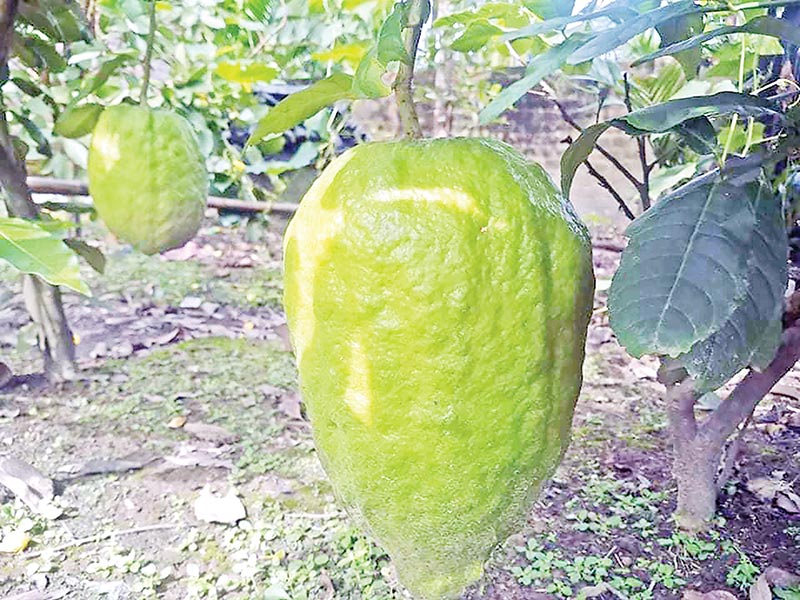 TENTULIA, PANCHAGARH, Dec 25: Commercial farming of "Satkara" (Citrus macroptera), a semi-wild variety of citrus fruit native to Sylhet region, has been experimented in Panchagarh.
This fruit is rich in medicinal and nutritional values. It can be consumed as a resistant to corona. Like lemon, it contains huge vitamins.
Its scientific name is Citrus macroptera. In English it is called Melanesian papeda or wild orange or cabuyao. It is a member of Rutaceae family.
Satkara tree grows up to about 20 to 25 feet. It blooms in Falgun and gives fruit in Jaistha and Ashar.
A recent visit to Siddiqui Tea Estate at Chaklahat in Panchagarh found many medicinal and fruity plants of indigenous and foreign varieties including Satkara, Avocado, Persimmon, and Rambutan.
Satkara cuts cholesterol, increases taste and boosts immunity in human body. It resists the spread of cancer, arthritis and organ pains. It contains huge antioxidant.
Satkara is attractive for smell as well. It is used in cooking vegetables, beef and fish.
Proprietor of Siddiqui Tea Estate and also American immigrant Mizanur Rahman Sidiqui Ranzu said, he has planted satkara on an experimental basis. It is cultivable in the soil of Panchagarh.
Satkara is the traditional cash fruit of Sylhet. Many in Sylhet are farming Satkara and selling at Tk 800 per haali (four pieces). Every year, they are also fetching huge foreign currency by exporting the fruit to England.
So, it is possible to commercially cultivate Satkara in Panchagarh, he added.
Loading...
Loading...
Also read






Editor : Iqbal Sobhan Chowdhury
Published by the Editor on behalf of the Observer Ltd. from Globe Printers, 24/A, New Eskaton Road, Ramna, Dhaka.
Editorial, News and Commercial Offices : Aziz Bhaban (2nd floor), 93, Motijheel C/A, Dhaka-1000.
Phone: PABX- 41053001-06; Advertisement: 41053012; 01793317829, 01550707291, E-mail: [email protected], [email protected] Online: email: [email protected] 41053014; 01550707297 Advertisement: 01550707296
Published by the Editor on behalf of the Observer Ltd. from Globe Printers, 24/A, New Eskaton Road, Ramna, Dhaka.
Editorial, News and Commercial Offices : Aziz Bhaban (2nd floor), 93, Motijheel C/A, Dhaka-1000.
Phone: PABX- 41053001-06; Advertisement: 41053012; 01793317829, 01550707291, E-mail: [email protected], [email protected] Online: email: [email protected] 41053014; 01550707297 Advertisement: 01550707296


