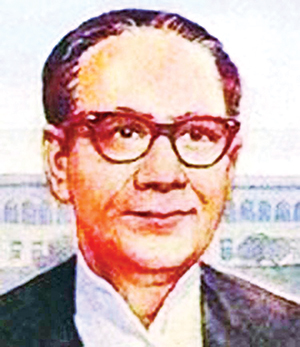
Syed Mahbub Murshed was born a hundred and ten years ago on January 11, 1911. He passed away on April 3, 1979. He is best remembered as a jurist, and later on as a public figure in the movement for the restoration of democracy in 1969. Yet he was a man of many parts, among which were his outstanding oratorical skills. Apart from his years on the bench (early 1955-to late '67), he never held any public office nor formed any political party.
What will best sum up his personality? Perhaps his dislike for the convenient and conventional truth; his unswerving support for the downtrodden; his love of what was right, however inconvenient. John Kenneth Galbraith once stated: "To the adherents of the institutional truth there is nothing more inconvenient, nothing that so contributes to discomfort, than open, persistent articulate assertion of what is real." Thrasymachus said: "I declare that justice is nothing else than that which is advantageous to the stronger." To Justice Murshed, this was the very antithesis of this rhetorical statement towards the beginning of Plato's Republic, which forms the basis of the subsequent dialectic on the nature of truth.
November 16, 1967, marked the resignation of the late Justice Syed Mahbub Murshed, who had been Chief Justice of the East Pakistan High Court from early 1964 to late1967. President Ayub's diary for January 6, 1973, says: "Justice Murshed has a brilliant, intelligent, literary bent of mind and aptitude for language, but he is impulsive and unstable."
Despite these aspersions, it is widely accepted that his resignation was over the issue of an independent judiciary, something for which Ayub's patience had diminished following his re-election in 1965. Murshed had just become too inconvenient to a ruler who was becoming increasingly autocratic. In 1963, one of his judgments in a case, which is described in brief as the "Minister's case," ensured that the legislative and executive functions of the state would remain separate, and that cabinet minister's could not sit in the national assembly.
This judgment was upheld in the Supreme Court. Others were to follow, including a celebrated judgment concerning the relationship between the federal and provincial administrations of the country. Ayub had not wanted Murshed to become Chief Justice of the East Pakistan High Court in 1964, despite the fact that Murshed was the senior-most judge and it was his turn to become chief justice. But at the time, he relented, and let precedent take its course. Murshed struck the teeth of the Martail Law government in early 1959 when he in his judgement invalidated the EPDO order which debarred many prominent eastern wing politicians.
Ayub, of course, was a different man following his election victory over Miss Jinnah in 1965, and the war with India in the same year. Murshed decided to resign before resisting a regime that was becoming increasingly autocratic. He was expected to run against Ayub in the 1970 presidential elections. However, a mass movement against Ayub gathered momentum in late 1968, to which Murshed added his voice. A report in Time magazine stated: "The opposition cause was also boosted by widely respected Syed Mahbub Murshed, former Chief Justice of the East Pakistan High Court, who told the nation that 'we are not destined to perish in ignominy if we put up a determined and united resistance to evil.'
These events are not merely mundane facts in the history of Bangladesh and Pakistan, but have a strong resonance for the present. Ensuring the separation of powers between the executive and the legislature requires an independent judiciary, and judges like Murshed, to fearlessly exercise these principles. Let us not forget that despotism is not simply confined to absolute monarchies or dictatorships, but can also feature in flawed democracies, even when rulers happen to be elected.
Some other examples of Murshed's life were his manifold social, cultural and political activities. A master in oratory Murshed would hold his audience spellbound whether written or speaking extempore he would captivate the listening gathering by his eloquent speeches. Being a humanitarian all his life the famine that griped Bengal in the early Forties of the last century and the communal riots in 1946 moved him to found the Anjuman Mofidul Islam. As a sitting Judge in the Fifties he worked relentlessly as Chairman of the Red Cross. Murshed also fought for our cultural freedom as he organised Tagore Century in all over East Pakistan what is now Bangladesh, despite the obstacles he faced from the then Pakistani military leadership.
In the political arena also Murshed's activities will remain unparalleled. As a young Barrister in 1942 Murshed's article "Quo Vadis Quaid-e-Azam criticising Mr Jinnah and defending his Uncle Mr Fazlul Haque that appeared in the "Statesman" of Calcutta created a stir in Bengal. After the partition of the Sub-Continent in 1947, Murshed was among the persons who put into motion the process that culminated in the Nehru-Liaquat pact. He was drawn into the vortex of the Language Movement and along with his uncle the Sher-e-Bangla broke Section 144 in 1952.
In early 1954, before becoming a Judge, Murshed along with Abul Mansoor Ahmed drafted the Manifesto or 21 points for the Jukta Front government led by his uncle Sher-e-Bangla Fazlul Haque. This is what enabled Murshed to put the final varnish to the six points which then Sheikh Mujib fought and was jailed for. In the same year in 1966, Mazharul Haque Baki the then President of the Chhatra League and Mr Serajul Alam Khan recalled that no one dared but Chief Justice Murshed to Chair their annual conference where Murshed also like then Sheikh Mujibur Rahman gave a clarion call for provisional autonomy.
On his resignation as Chief Justice among the first thing Murshed did was to organise the defence of the Agartala Conspiracy Case. It is mainly on account of him that Sheikh Mujib did not have to come out on parole and all others were set free unconditionally. Murshed's active participation in the mass upsurge in 1969 further earned him respect. The prevailing agitation that Justice Murshed created with the then High Court Bar and Lawyers on account of the Constitutional hiatus in March 1971 that went to such an extreme that no Judge was willing to give oath General Tikka Khan the Governor designate in March 1971. His refusal to collaborate with the Pakistani military authorities during our War of Liberation is also recorded.
Another significant matter was during the Round Table Conference in 1969 while President Ayub Khan was virtually in his knees and in addition to the dissolution of the one unit in the western wing; Justice Murshed demanded one man one vote. Prior to this, in the National Assembly, there was a parity of 150 seats each for both the Eastern and Western wing. Since Murshed's one man one vote was accepted, the Eastern wing got 169 out of 300 seats.
Thus he paved the way that whoever won the majority in the Eastern wing would form the National Government. Hence, Justice Murshed is living history. I can only conclude by saying about him the same passage he wrote about his uncle the Sher-e-Bangla, "In life and in death, he was a king without the trappings of a monarch, for he had built an empire in the hearts of his fellowmen."
Dr Syed Mansoob Murshed is a
Professor of Economics in International Institute of
Social Studies, The Hague





