



| HEADLINE |

|
Women’s contribution to Language Movement
Published : Saturday, 19 February, 2022 at 12:00 AM
Women\'s Own Desk


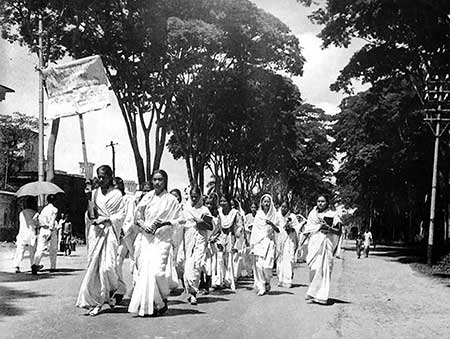 The Language Movement is an ineradicable incident in the history of the Bengali nation and Bangla language as it led to our independence and give us a country in the world map. It took decades of effort, sacrifice and endurance of our forefathers to bring Bangla to the doorstep of 1952. While we knew the names of Salam, Barkat, Rafique Jabbar and several others for sacrificing their lives for the language, the women were not so behind. Indeed their sacrifice also was immense.
Women, unlike today, did not have freedom of movement back then. Their lives were saddled with many barriers. The practice of general education was very limited for the women who came from conservative Muslim families. They were mainly taught Urdu, Arabic, and Persian languages. Surprisingly, soon after the establishment of the new state, a wave of renaissance hit the Muslim girls across the country. The female enrolment rate in schools and colleges began increasing. Parents became more interested in providing their girls with the opportunities of higher education. This eventually resulted in an increasing number of female students at DU. The number of Muslim female students there was very insignificant before an independent country was established.
The Language Movement reached its peak between 1947 and 1951 when the number of female students at DU was around 80. These girls played a glorious role in the movement by joining shoulder to shoulder with their male counterparts. Dr Safia Khatun was the general secretary of Dhaka University Women Hall Union in 1951-52, and she became the vice president of the union in 1952-53. Under her leadership, female students of the university went to schools and colleges and encouraged students there to take part in the movement.
The female students of this period who made their place in the history are Sufia Khatun (daughter of Justice Ibrahim), Shamsun Nahar, Rawshan Ara Bachchu, Sara Taifoor, Kazi Amina, Mahfil Ara, Khurshidi Khanam, and Halima Khatun.
Anwara Khatun was a prominent figure among those who were not a part of DU but were involved with the Tamaddun Majlish. She was a member of the provincial council and a distinguished member of the Rashtrabhasha Sangram Parishad formed in 1952. Gaibandha's Doulatunnesa, a member of the provincial council in 1954, was another trailblazer. Names of Nadera Begum, Hamida Khatun, Nurjahan Murshid, Afsari Khanam, Ranu Mukherjee and Lili Haque also shine through in the history of the Language Movement. Begum Sufia Kamal and Nurjahan Murshid led a rally protesting the brutality of February 21.
Loading...
Loading...
Also read



Editor : Iqbal Sobhan Chowdhury
Published by the Editor on behalf of the Observer Ltd. from Globe Printers, 24/A, New Eskaton Road, Ramna, Dhaka.
Editorial, News and Commercial Offices : Aziz Bhaban (2nd floor), 93, Motijheel C/A, Dhaka-1000.
Phone: PABX- 41053001-06; Advertisement: 41053012; 01793317829, 01550707291, E-mail: [email protected], [email protected] Online: email: [email protected] 41053014; 01550707297 Advertisement: 01550707296
Published by the Editor on behalf of the Observer Ltd. from Globe Printers, 24/A, New Eskaton Road, Ramna, Dhaka.
Editorial, News and Commercial Offices : Aziz Bhaban (2nd floor), 93, Motijheel C/A, Dhaka-1000.
Phone: PABX- 41053001-06; Advertisement: 41053012; 01793317829, 01550707291, E-mail: [email protected], [email protected] Online: email: [email protected] 41053014; 01550707297 Advertisement: 01550707296


