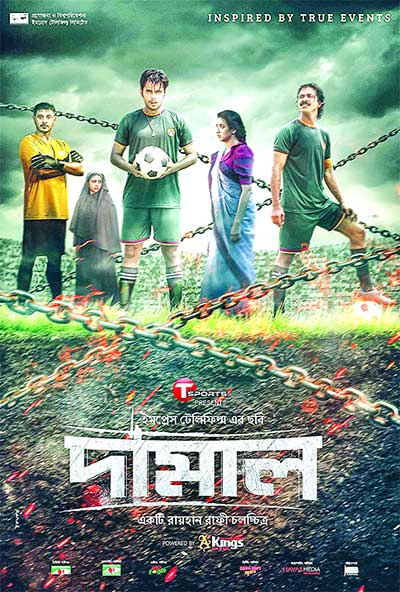
If you are just any other cinema goer, Damal, the film inspired by the Shadheen Bangla Football team of 1971, will seem almost flawless. But if you are a footballer or have played the game with some passion, the flaws in the movie will be hard to ignore. A few other anachronisms, like the watch worn by Shariful Razz, radio which is an early 80s model, are not too big a flaw either.
Football of fury: The story is not too complex: several young people who love football and dream to become professionals are thrown into the vortex of the liberation war where their love for sport is thrown aside to avenge the brutal crackdown on March 25 and the following persecution.
In between, there's love which is mainly for cinematic thrill because the romance shown in the movie is incongruous to the social norms of the seventies. At that time, having clandestine meetings, late night trysts were unheard of.
The mixing of young men and women, especially in the rural setting was not only implausible but highly discouraged.
Swinging sixties may have triggered a sexual revolution in the West, the East was still dominated by puritanism.
The movie is made in 2022 so, artistic licence is essential, otherwise, crowd pulling will be tough.
After all, only football won't sell tickets!
The boys and their lovers are torn apart by the political turbulence although the men are united because their footballing skills are needed to raise awareness across India about the liberation movement in East Pakistan and use the proceeds of the games to buy food, medicine for freedom fighters.
A noble cause indeed, with the players devoting themselves to transforming into gladiators in boots. They unite under a coach to practice everyday.
The poster of the film shows two protagonists holding a Deer football, which only came to Bangladesh in the early 80s. The label of the ball should have been taken off!
An inspiration from Escape to Victory: It's a tough job to make a football centric film because unless the main characters are players, they will not be convincing in the football scenes. Siam Ahmed can set the dance floor alight but he ain't a football player! Muscle building is one thing, flexibility in movement on the field is something totally different. This will not be discernible to the general viewer but the deficiency will be evident to those who have played the game.
Also, no footballer ever goes around holding/bouncing the ball in the hands, unless s/he is the goalkeeper.
The ending of the film has an uncanny resemblance to that of the 1981 film Escape to Victory, starring Michael Caine, Sylvester Stallone and Max von Sydow.
But more importantly, that film also featured Pele, Bobby More, Osvaldo Ardiles, Paul Van Himst, Mike Summerbee, Hallvar Thoressen and the full Ipswich Town team.
This was done to make the footballing scenes credible. Even, Michael Caine had a stunt double football player who played in the playing scenes.
There was so much attention given to accuracy that Pele, shown as a prisoner, was identified as a footballer from Trinidad and not Brazil because the latter joined the war against the axis powers after 1943 and the movie was set in the early years of WW2.
Former England goalkeeper Gordon Banks was hired to coach Sylvester Stallone the basics of goal keeping as he had a crucial role in the end.
Damal uses football players to depict the rival teams but should have used someone professional in scenes of Siam.
Shariful Razz's passes and moves seemed more credible.
The movie showed the Mohonbagan team playing the Shadhin Bangla side, wearing jerseys, which are not the traditional maroon and green. Mohunbagan, especially till the late 90s, never played in any other jersey.
The players depicting Indian sides were mostly in turf boots, which came to the sub continent about a decade ago.
Forgive me, many of the turf shoes were actually released in the last three years.
I said earlier, these will only be apparent to a football player and not the general viewer.
To come to the other characters, it's very formulaic - a lecherous, ruthless, army officer, scheming collaborators, a woman who avenges the cruel slaughtering of her father in law.
Resonating with women's football: The story is told in flashback by the coach to a group of women football players, who, faced with social and economic hurdles, decide to hang up their boots. The tale of the Shadhin Bangla team, the steely resolve of the women players are linked to the real life SAFF winning moment of the Bangladesh women's team. The underlying message seems to be: women can also be gladiators and just like the freedom fighter footballers, bring glory for the nation.
Full marks for the overarching message of women empowerment.
Since December is around the corner, the spirit of independence comes early with the movie. If the flaws are overlooked, one gets a decent film.
Portraying the past is challenging: An appalling sense of history plus a negligent approach to the preservation of historical items make portrayal of the past almost impossible in local movies.
Buildings are torn down, old cars are sold off as scrap, items of daily use of the past cannot be found and therefore, one has to go to remote jungles, old railway colony buildings, abandoned rail buggies or houses outside Dhaka to shoot period movies.
For instance, let's say a film maker wants to show Dhaka of the late 70s or 80s. Since independent houses are rare, the shooting has to be done in some district town. But the presentation will never be fully credible since props from that period are not available. Say, getting five cars form the 70s, a few motor cycles or creating a social environment from that period will pose a grave challenge to the film maker.
As a result, movie makers use what they can obtain, which is often an anachronism. Any movie dealing with a time frame of the past should have a historian and sociologist as advisers to make the depiction as accurate as possible. The end verdict: Damal is an enjoyable film! It certainly gets the adrenaline pumping!
Pradosh Mitra is a social observer and a film buff!





