



| HEADLINE |

|
Tribal Quota Series-1
Ethnic minorities of plain land districts a deprived lot
Published : Wednesday, 7 December, 2022 at 12:00 AM
Mamunur Rashid


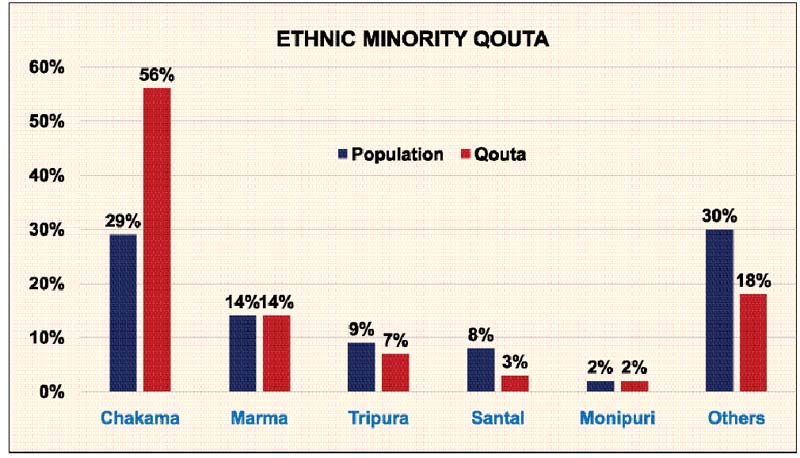 Ethnic minorities living in the plain land in the country are totally deprived of admission to higher education and government job facilities in the existing tribal quota system in Bangladesh. There are 50 ethnic minorities in Bangladesh, half of that population live in plain land districts and other half in three hill districts of Chattogram Hill Tracts (CHT).
The government provisioned 5 per cent quota for tribal and ethnic minorities in the admission to higher educational institutions and government jobs with a view to upholding the article 29 (3) of Bangladesh constitution. The aim of this provision was to uplift the socio-economic condition of backward ethnic minorities and ensure equal development of all citizens.
As per Census-2022, some 44 per cent of the ethnic minorities are plain landers, but they enjoy only 20 per cent opportunity in medical colleges and different universities admission through tribal/ethnic minority quota. On the other hand, 80 per cent quota beneficiaries are from ethnic minorities living in Chattogram Hill Tracts (CHT) districts, according to a recent study.
Rabindranath Sharan, the central president of "Jatiya Adhibasi Parishad" and a leader of Santal, told the Daily Observer, "We are seriously deprived of higher education and government jobs in the existing quota system of the country". A logical and equal distribution of tribal quota need to be ensured. Ethnic communities in plain land districts feel unrepresented and ignored by the political system also, he added.
According to the recent census 2022, there are around 50 ethnic minorities in the country and their total number is 1,650,159. Out of this figure, 56 per cent (9,20,217) ethnic minority people are living in three districts of Chattogram Hill Tracts (CHT) and the rest 44 per cent (729,942) ethnic minority people are living in other districts, mainly in Rajshahi, Rangpur, Dinajpur, Mymensingh and Sylhet.
Earlier, 5 per cent quota were reserved for all ethnic minorities in all category of government jobs. After the quota reform movement in 2018, the government abolished quota in Class I and Class II government jobs. Presently only merit is considered for these two Classes of government jobs. Due to this reason, tribal students formed a number of few human chains and demanded to reinstitute the quota system.
Chattogram Hill Tracts Agreement commonly known as CHT Peace Accord was signed in 1997 and it opened a big jobs field for the ethnic minorities of CHT. According to the Peace Accord a separate ministry (Ministry of CHT Affairs), CHT Development Board, CHT Regional Council, Hill District Councils are established, where the job and other opportunities are more for the ethnic minorities of CHT. There is no such provision for ethnic minorities in the other districts of Bangladesh.
According to Population Census 2022, at least 1,842,815 people are living in Rangamati, Bandarban and Khagrachhari districts of CHT. Among them 50 per cent (922,598) are Bangalees, Chakma is 25 per cent (466.695), Marma, 11.5 per cent (213,752), Tripura, 6 per cent (114,230), Mro 2.8 per cent (52.455), Tanchangya 2.5 per cent (45,972) and other 2.5 per cent (27,113).
12 ethnic minorities and Bangalee people are living in the three districts of Chattogram Hill Tracts. They are Chakma, Marma, Tripura, Mro, Bawm, Pangkhu, Khyang, Khumi, Chak, Lushai, Rakhaine, Tanchangya and Bangalee. Bangalee people of these three districts have no quota in jobs and higher education despite of being a backward and under privileged community. Currently CHT Bangalee literacy rate is 23 per cent whereas Chakma has 73 per cent and other tribes have 45 per cent.
Chakma, Marma and Tripura are getting around 80 per cent quota in admission of government medical colleges and universities whereas other under privileged ethnic minorities gets less than 20 per cent.
The ethnic minorities from the plain districts of the country are Santals, Oraons, Mundas, Mahalis, Pahans, Barmans, Koras, Mushors, Garos and Hajongs who are mostly living in Rajshahi, Rangpur, Mymensingh and Sylhet Divisions.
Remlian Pangkhu, a member of Rangamati Hill District Council, told this correspondent that as Pangkhu is not only ethnic minority but also defunct ethnic minority now. They are seriously deprived of higher education admission and also job facilities by the quota system. A majority (80 per cent) of the quota are taken by Chakma, Marma and Tripura tribes.
Sabbir Ahamed, the President of Parbotya Nagorik Parishad, Rangamati District Committee told this correspondent that Bangalee community of these hill districts are neglected in any higher education admission and government job, though they represent half of the total population of hill districts. He urged to create quota provision for Bangalee who are living in hill districts and are seriously underprivileged.
Dr Mahfuz Parvez, a professor of Chattogram University, said discrimination can be seen in quota among the marginalized ethnic groups of plain districts and hill districts. Santal is getting only 3 per cent quota where the group constitutes 9 per cent of the total ethnic minority. Garo, Monipuri, Hajong are also seriously deprived by the existing quota system. The government should consider equal and logical distribution of ethnic minority quota to ensure constitutional obligation.
Loading...
Loading...
Also read



Editor : Iqbal Sobhan Chowdhury
Published by the Editor on behalf of the Observer Ltd. from Globe Printers, 24/A, New Eskaton Road, Ramna, Dhaka.
Editorial, News and Commercial Offices : Aziz Bhaban (2nd floor), 93, Motijheel C/A, Dhaka-1000.
Phone: PABX- 41053001-06; Advertisement: 41053012; 01793317829, 01550707291, E-mail: [email protected], [email protected] Online: email: [email protected] 41053014; 01550707297 Advertisement: 01550707296
Published by the Editor on behalf of the Observer Ltd. from Globe Printers, 24/A, New Eskaton Road, Ramna, Dhaka.
Editorial, News and Commercial Offices : Aziz Bhaban (2nd floor), 93, Motijheel C/A, Dhaka-1000.
Phone: PABX- 41053001-06; Advertisement: 41053012; 01793317829, 01550707291, E-mail: [email protected], [email protected] Online: email: [email protected] 41053014; 01550707297 Advertisement: 01550707296


