



| HEADLINE |

|
Fraternal appeal of Christmas
Published : Sunday, 25 December, 2022 at 12:00 AM
Anika Fatima


 It is now widely acknowledged that Christmas has become a global festival. While often coloured by local customs and interpretations, it is an event celebrated across every continent and in almost every country around the world. While, in part, this can be accounted for by the legacy of Western colonialism and the presence of a converted Christian population, the isomorphic pressures exerted by a global economic system also play a significant role.
Across the Asia-Pacific region, one would be hardly pressed not to notice what time of year it is. Houses, shopping centers and public buildings are increasingly adorned by Christmas lights, decorations and even, in some instances, artificial snow and ice in an attempt to recreate an idealised northern mid-winter scene. At the same time, Santa Claus, or at least something approximating the festive gift giver, has become a ubiquitous figure on posters, television advertisements, in the shops and on the streets.
The traditional Christmas narrative, the Nativity of Jesus, delineated in the New Testament says that Jesus was born in Bethlehem, in accordance with messianic prophecies. When Joseph and Mary arrived in the city, the inn had no room and so they were offered a stable where the Christ Child was soon born, with angels proclaiming this news to shepherds who then further disseminated the information.
Although the month and date of Jesus' birth are unknown, the church in the early fourth century fixed the date as December 25. This corresponds to the date of the solstice on the Roman calendar. Most Christians celebrate on December 25 in the Gregorian calendar, which has been adopted almost universally in the civil calendars used in countries throughout the world. However, some Eastern Christian Churches celebrate Christmas on December 25 of the older Julian calendar, which currently corresponds to a January date in the Gregorian calendar. For Christians, believing that God came into the world in the form of man to atone for the sins of humanity, rather than knowing Jesus' exact birth date, is considered to be the primary purpose in celebrating Christmas.
The celebratory customs associated in various countries with Christmas have a mix of pre-Christian, Christian, and secular themes and origins. Popular modern customs of the holiday include gift giving, completing an Advent calendar or Advent wreath, Christmas music and carolling, lighting a Christingle, viewing a Nativity play, an exchange of Christmas cards, church services, a special meal, pulling Christmas crackers and the display of various Christmas decorations, including Christmas trees, Christmas lights, nativity scenes, garlands, wreaths, mistletoe, and holly. In addition, several closely related and often interchangeable figures, known as Santa Claus, Father Christmas, Saint Nicholas, and Christ kind, are associated with bringing gifts to children during the Christmas season and have their own body of traditions and lore. Because gift-giving and many other aspects of the Christmas festival involve heightened economic activity, the holiday has become a significant event and a key sales period for retailers and businesses. The economic impact of Christmas has grown steadily over the past few centuries in many regions of the world.
At Christmas, Christians all over the world celebrate the birth of Jesus Christ. Traditional Christmas decoration often can be admired and festive celebrations can be joined in most countries, even in many of the countries where Christianity is not the religion of the majority of people like Bangladesh. Christmas all over the world is celebrated on Christmas Day, the 25th of December. Some countries however have different Christmas traditions and Christmas traditions and celebrations take place over a longer period of time.
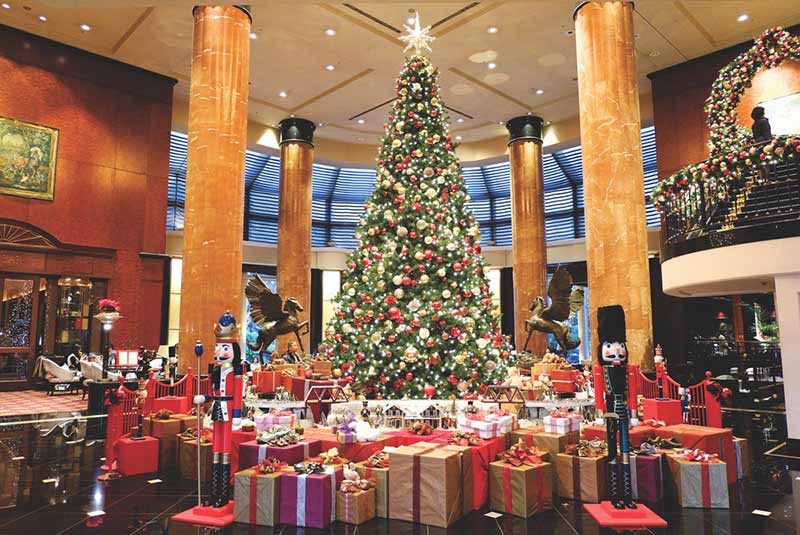 Bangladesh is also carried away with festive appeal of Christmas to a large extent. The eternal touch of Christianity reflects Jesus lesson of humanity, love and fraternity. The people celebrate the birth of Jesus on this day. Though the celebration of Christmas varies from county to country, the religious spirit remains the same. Thus, all around the world, people have taken the celebration of the birth of Jesus and made a Christmas that fits with the culture of their own country.
Christmas is a happy, festive time filled with great spiritual significance. The moment is marked by carolling, feasting, and gift sharing along with the prayers and wishes. Although Christians only form a small minority of the population in Bangladesh, her long history as a British colony has seen many traditions remain. This includes keeping Christmas Day as a public holiday.
Despite this, irrespective of once view and faith, it is a celebration that is only likely to grow in popularity. Like a giant snowball, it picks up customs and practices from around the world as it rolls from country to country. As once Roman, then German, Scandinavian and British traditions intermingled with ideas from the Americas only to be spread with Empire, both political and economic, so today new ways of thinking about and doing Christmas are emerging in China, Japan, Singapore and many other countries. These are ideas and practices that will themselves eventually play their part in defining the character of the global Christmas, which itself will no doubt reflect the quality of the bond between not only people but nations and regions. It would be nice to think that these will be relationships built on the ideals of peace and goodwill to all and, if they are, perhaps we might have something to thank Christmas for after all.
Anika Fatima, Editorial Assistant, the Daily Observer
Loading...
Loading...
Also read



Editor : Iqbal Sobhan Chowdhury
Published by the Editor on behalf of the Observer Ltd. from Globe Printers, 24/A, New Eskaton Road, Ramna, Dhaka.
Editorial, News and Commercial Offices : Aziz Bhaban (2nd floor), 93, Motijheel C/A, Dhaka-1000.
Phone: PABX- 41053001-06; Advertisement: 41053012; 01793317829, 01550707291, E-mail: [email protected], [email protected] Online: email: [email protected] 41053014; 01550707297 Advertisement: 01550707296
Published by the Editor on behalf of the Observer Ltd. from Globe Printers, 24/A, New Eskaton Road, Ramna, Dhaka.
Editorial, News and Commercial Offices : Aziz Bhaban (2nd floor), 93, Motijheel C/A, Dhaka-1000.
Phone: PABX- 41053001-06; Advertisement: 41053012; 01793317829, 01550707291, E-mail: [email protected], [email protected] Online: email: [email protected] 41053014; 01550707297 Advertisement: 01550707296


