



| HEADLINE |

|
Grow relationship with nature & environment
Published : Thursday, 16 March, 2023 at 12:00 AM
Anika Fatima


 The climate change emergency has brought forward the need to rethink how we humans interact with the environment. Should we be allowed to extract natural resources from the earth to accommodate our energy needs? Should we cut down forests to plant vegetables or raise cattle? Should we use plastic packages and then throw them away in the sea? While technological advances provide sustainable ways to tackle such matters, any reply we give to these questions is also largely determined by how we understand our relation to nature. For any progress to be made around climate change, we have to re-address how we perceive this relation.
I say 're-address' because even though climate change is a modern-day problem - perhaps even the defining issue of our times - philosophers have been questioning how humans relate to nature for quite some time.
Scientific practice, being directly occupied with understanding nature, represents an extremely informative source to understand not only the practical ways humans interact with nature, but also the accepted norms that guide and restrict this relation. In particular, there is one scientific event that is taken to have greatly determined how humans treat the environment today: the Scientific Revolution.
Prior to the Scientific Revolution, the most dominant image of nature in Western culture (and also beyond) represented the earth as a living organism, with organs of different functions all serving the whole. For example, Leonardo da Vinci referred to rivers as the veins of earth, circulating like the blood system from the mountains to the seas. Nature was also often identified with a mother; one that nourishes humans and one that humans have the duty to respect.
With the scientific revolution all this changed radically. Francis Bacon spelled out a new ethical system where nature was no longer perceived as a living being to be revered or respected, but rather as a machine to be manipulated and taken advantage of for the benefit of humankind. Nature became a configuration of passive lifeless matter; something people should dominate via technology. It became morally permissible - if not expected - to take advantage of natural resources to achieve economic, social and scientific progress. The expression of this mentality can be found in early chemistry as well.
So, let's be clear- this pandemic has a world-shattering phenomenon of massive proportions. Not only has it infected hundreds of thousands of people across the planet, killing more than 40,000 of them, but it's brought the global economy to a virtual standstill, potentially crushing millions of businesses, large and small, while putting tens of millions, or possibly hundreds of millions, of people out of work.
It goes without saying that one cannot live without nature. Nature has a great deal to teach. Every landscape is a gift given by nature.
Our relationship with nature has historically been one of imbalance and overuse. Nearly every step in human history has unfortunately been accompanied by a leap in environmental degradation. With advancements in technology and agriculture though, humans began to find more efficient ways of sustaining themselves. These advancements allowed for more permanent settlements, which led to rapid population growth and a distancing from nature.
As society evolved, populations grew and more and more resources were required to fuel the expansion. With breakthroughs in agriculture, settlements became more permanent and cities began to take shape. This shift to city life inadvertently led to a distancing from nature. While many people were still in-tune with nature on a subsistent level, the need for more and more resources began to change our regard for nature.
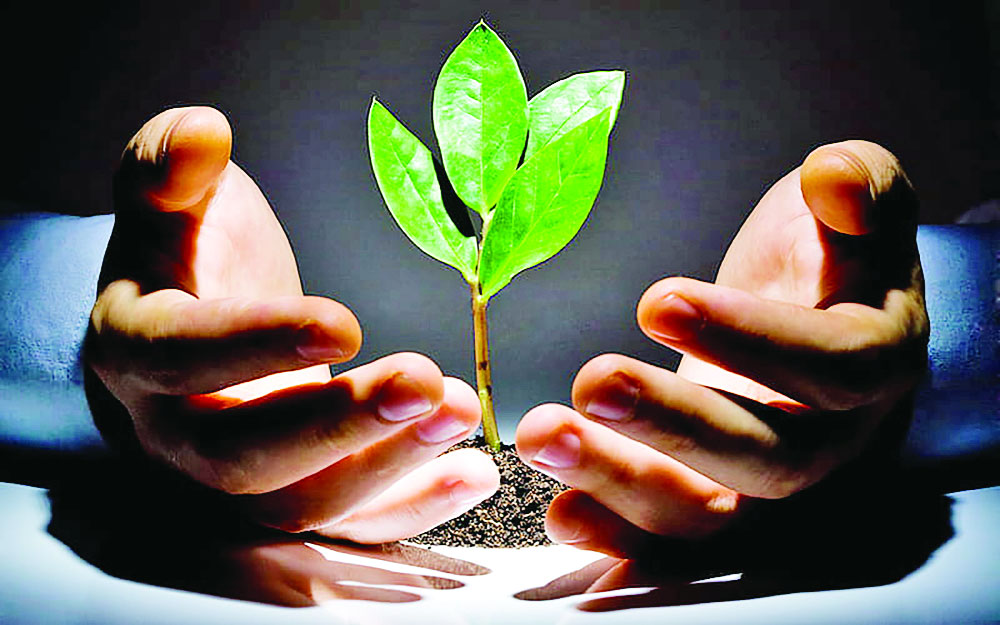
Although our distancing from nature began several thousand years ago with advancements in agriculture and social order, it is the age of industry to which we owe our modern regard for nature. The growth of cities allowed for a separation between people and nature and our obsession with convenience and efficiency beckoned a new perspective on the environment. With technological advancements, nature became something we were no longer apart of and entirely subject to, but something that we could control and profit off of. The growth of industry enabled humans to truly dominate the landscape and disrupt the natural systems that have been in place for billions of years.
As we have removed ourselves further and further from nature, we have developed a willing ignorance of our role and relationship within it. With the growth of cities and trade, we have moved from a subsistent, sustainable economy to one of greed and exploitation. Humans have always had an impact on the environment, but with the age of industry, that impact has been ultra-magnified. Population growth has been exponentiated, cities have become the primary place of residence, and the majority of the world is now out of touch with the workings of nature.
Although every species plays a unique role in the biosphere and inherently has its own impact, not every species has the cognitive ability to measure their influence or the capacity to change it. Humans are unique in that respect, which is the root of the problem. We are capable of understanding our influence over nature, but we tend to ignore the Earth's reaction to our presence. I am not saying that we purposefully degrade nature, but that environmental degradation is an inherent trait of our population's perpetual progression. We know we are crippling the environment. We have the ability to do something about it. Therefore, we should make change where change is necessary.
We all play a vital role in nature just like everything else. What separates us from nature though, is the ability to understand our place within it. This cognitive capacity of ours has historically been the cause of a perceived division between man and nature. However, in order to achieve a sustainable future in which humans assume a more natural role and have less of an impact, it is imperative that we reconsider our role and relationship with nature. A change in the way we regard nature has obvious political, economic, and social repercussions, but our cognitive ability obliges us to re-evaluate our position in the world rather than continue to degrade it.
There are a number of ways in which we can begin to reconsider our relationship with nature, but all of which require an enormous effort. Through a universal education curriculum, it is possible to encourage people everywhere to consider themselves as part of a larger picture. By teaching people about the environment, evolution, and ecology, we can provide them with the tools for change. In order to bring about necessary change, it is critical that people take action. Through a universal environmental education program, it is possible to galvanize people into forming new ideas and opinions of the world and to understand their place within it.
Education program would go a long way in encouraging change in how we view each other and our environment. Changing attitudes are a primary component in achieving a sustainable future - one in which nature is allowed to run its course without human intervention. In order for the Earth to retain its balance, it is important that we not overstep our bounds as a species. This requires a universal effort to re-evaluate our relationship with nature and make adjustments as needed.
Our role within nature should be one of subsistence rather than commercialization. We have exploited the communities for too long and the consequences of doing so are everywhere. As everything is related to everything, we have no right to infringe on the livelihood of any other species. In fact, our cognitive ability and understanding of nature oblige us to maintain the integrity of the environment. So, we must change how we influence the land. We must respect the natural order of things and find a way to live accordingly.
The is an editorial assistant, the Daily Observer
Loading...
Loading...
Also read



Editor : Iqbal Sobhan Chowdhury
Published by the Editor on behalf of the Observer Ltd. from Globe Printers, 24/A, New Eskaton Road, Ramna, Dhaka.
Editorial, News and Commercial Offices : Aziz Bhaban (2nd floor), 93, Motijheel C/A, Dhaka-1000.
Phone: PABX- 41053001-06; Advertisement: 41053012; 01793317829, 01550707291, E-mail: [email protected], [email protected] Online: email: [email protected] 41053014; 01550707297 Advertisement: 01550707296
Published by the Editor on behalf of the Observer Ltd. from Globe Printers, 24/A, New Eskaton Road, Ramna, Dhaka.
Editorial, News and Commercial Offices : Aziz Bhaban (2nd floor), 93, Motijheel C/A, Dhaka-1000.
Phone: PABX- 41053001-06; Advertisement: 41053012; 01793317829, 01550707291, E-mail: [email protected], [email protected] Online: email: [email protected] 41053014; 01550707297 Advertisement: 01550707296


