



| HEADLINE |

|
Together, we can make a difference
Published : Sunday, 30 April, 2023 at 12:00 AM
Anika Fatima


 Sustainable development goals are set, to come up with a developed society. A society whose environment is loved by everyone coexists in society. UN promotes various sustainable development goals that integrate to create a sustainable society.
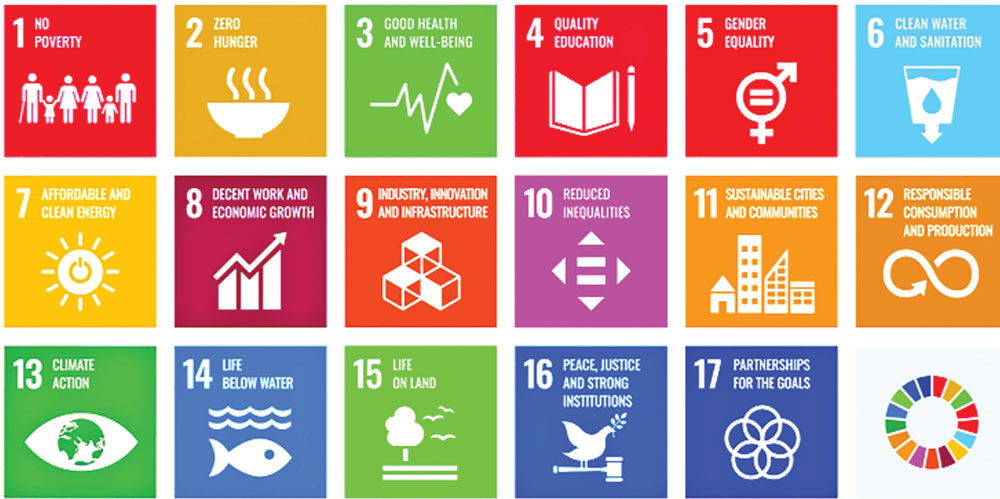
The Sustainable Development Goals (SDGs) are a collection of 17 interlinked global goals to transform our world. They were designed to be a "blueprint to achieve a better and more sustainable future for all" and part of the United Nations 2030 Agenda for Sustainable Development. They were agreed by 193 countries in September 2015.
Each of the 17 goals strive for the universal reduction of climate change and poverty, and the improvement of education, health, and economic growth. United Nations describes the SDGs as seeking to "protect the planet, and improve the lives and prospects of everyone, everywhere."
The SDG's provide worldwide guidance for addressing each of these goals. Crises within the SDG's are faced by most countries and can only be addressed if we work as one global community.
High fertility rates can trap countries in poverty. The World Bank has warned that extreme poverty will not decrease in 2021 due to population growth eclipsing economic growth in the poorest nations. Large family size and poverty often go hand-in-hand. People living in deprived areas are usually not empowered to choose the number of children they have and in some cases feel the need to have many so they can be provided for in their old age. When people are poor and have many children, they cannot invest enough in each child which often leads to kids not being able to attend school and girls getting married off as child brides. Women are also less able to gain financial independence when they have many children to look after at home. Ensuring everyone is empowered to choose small families is key to eradicating poverty.
Feeding the world without destroying more nature will become increasingly difficult and eventually impossible under sustained population growth. According to the World Resources Institute, the calorie requirements of a population of 10 billion are 56% higher than current total crop production. Agriculture is already a leading cause of environmental degradation and further conversion of land for farming purposes will have devastating consequences for biodiversity and our climate.
Insufficient funding for healthcare systems can cause them to buckle under the pressure of growing populations. Lack of access to quality reproductive healthcare including modern contraception and medically safe abortion leads to high unwanted pregnancy rates and preventable maternal deaths.
Greater investment in quality education is key to alleviating poverty and ending population growth. Due to gender inequality, girls are disproportionately affected by lack of access to education.
Empowering women and girls to take control of their bodies and lives is crucial for solving our biggest social and environmental crises. Gender inequality is one of the main drivers of high fertility rates. Not a single country has yet achieved full equality, and the worst gender-based injustices and crimes continue to be common and widespread. According to the UN, ending gender-based violence, harmful practices (including child marriage and FGM), preventable maternal deaths, and unmet family planning needs is affordable and within reach, but still suffers from a severe funding shortage.
The combination of climate change and population growth is fuelling a global water crisis. As our numbers grow, aquifers get overdrawn, pollution increases, and the capacity to safely dispose of wastewater is increasingly compromised.
The number of people using dirty fuels is still increasing due to population growth and slow progress in rolling out renewable energy. Global energy demand is expected to increase by 50% over the next 30 years as a result of population growth and economic development. High-income countries must lead the way in transitioning to clean fuels and support low-income countries to do the same. Ending population growth will make a global switch to affordable and clean energy a lot more achievable.
In high-income nations, the pursuit of economic growth is in direct conflict with other SDGs, in particular in regard to environmental impact. Infinite economic and population growth can never be sustainable on a finite planet. As a global community, we must strive towards a healthy environment and well-being for all, not endless growth.
The larger the population, the harder it is to provide access to modern infrastructure and technologies to everyone, and the more nature we will destroy in the process. Conversion of land to human infrastructure is a key driver of biodiversity loss, and construction is a major source of greenhouse gases.
More than half the world's population lives in urban areas today. By 2050, this proportion is expected to rise to 68%. Rapid urban population growth can outstrip the pace at which infrastructure such as clean water, sanitation, health, jobs and education can be offered.
According to the UN, material footprint per capita in high-income countries is 60% higher than in upper-middle-income countries and more than 13 times the level of low-income countries. Responsible consumption and production of food and goods must go hand-in-hand with measures to end our population growth. We are already using resources 1.75 times faster than they can regenerate - unless things change, we will require three Earths to supply our needs by 2050.
Unsustainable consumption patterns in high-income countries are largely responsible for the climate crisis but every additional person on our planet adds more emissions. The 2019 Scientists' Warning of a Climate Emergency, endorsed by more than 11,000 scientists, called for ending and ultimately reversing human population growth, among other transformative actions, to avert the worst effects of climate change.
Pollution (plastic and runoff), overfishing, coral bleaching, and coastal ecosystem destruction are all exacerbated by population growth. Two-thirds of marine areas have been damaged by human activity and a third of sharks and rays and a third of reef corals are threatened with extinction. Tackling the loss of life under water has to include a commitment to reducing population growth and runaway consumption.
Human population growth is one of the main causes of biodiversity loss. According to WWF, we have lost 60% of all vertebrate wildlife populations since 1970. During that time, our population has more than doubled. To be truly effective in the long-term, conservation efforts must incorporate population solutions.
In the absence of prosperity and strong institutions, population growth contributes to conflicts related to scarce resources. Educating and empowering women and communities, including ensuring access to voluntary family planning services, can help support peace and stability goals by increasing the foundation for stability. And where families can choose the number and timing of their children, women may have more opportunity to take part in civil society and peacebuilding.
Cross-sectoral partnerships that recognise the crucial links between social and environmental issues are key to a better future. COVID-19 has presented unprecedented challenges, reversing decades of development and causing a deep global recession. Never has there been a more critical time for strengthening partnerships and securing the next ten years of collaboration for sustainable development. The international community must foster recognition of the urgent need to end human population growth as soon as is ethically possible, and promote greater investment in empowering solutions.
The SDG's have a 2030 deadline for implementaion. In 2019, the UN Secretary General, An�nioGutteres, called for a decade of action across three essential areas.' Global Action' calling for bold leadership, 'local action' to make a real difference in people's lives, and 'people action' to mobilise partnerships, hold leaders to account and for people to make the Global Goals their own.
However, the COVID-19 has slowed progress dramatically for many of the SDG's, heightening the need for their implementation now more than ever. We were already far behind in terms of progress for some of the SDG's.
Last but not the least, we can all help contribute to the success of the SDGs and sustainable development by both educating ourselves more, speaking out and making practical and positive adjustments to our daily lives. Every choice makes a difference. In this post, we celebrate the amazing actions our supporters are already taking to choose a better future now. Let's show the world what's possible when we come together to take action.
The writer is an editorial assistant, the Daily Observer
Loading...
Loading...
Also read



Editor : Iqbal Sobhan Chowdhury
Published by the Editor on behalf of the Observer Ltd. from Globe Printers, 24/A, New Eskaton Road, Ramna, Dhaka.
Editorial, News and Commercial Offices : Aziz Bhaban (2nd floor), 93, Motijheel C/A, Dhaka-1000.
Phone: PABX- 41053001-06; Advertisement: 41053012; 01793317829, 01550707291, E-mail: [email protected], [email protected] Online: email: [email protected] 41053014; 01550707297 Advertisement: 01550707296
Published by the Editor on behalf of the Observer Ltd. from Globe Printers, 24/A, New Eskaton Road, Ramna, Dhaka.
Editorial, News and Commercial Offices : Aziz Bhaban (2nd floor), 93, Motijheel C/A, Dhaka-1000.
Phone: PABX- 41053001-06; Advertisement: 41053012; 01793317829, 01550707291, E-mail: [email protected], [email protected] Online: email: [email protected] 41053014; 01550707297 Advertisement: 01550707296


