



| HEADLINE |

|
Dhaka wants peaceful Indo-Pacific region
Published : Tuesday, 13 June, 2023 at 12:00 AM
Ahasan Uddin Bhuiyan


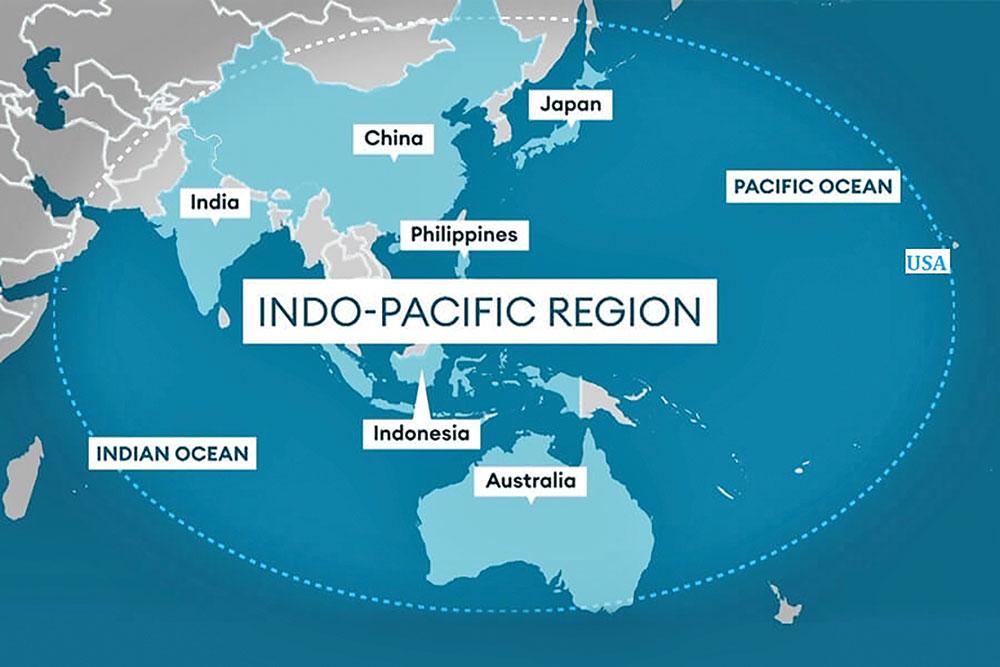
 Indo-Pacific is the region characterized by a vast expanse of territory inhabited by over fifty percent of the world's population, comprising nearly two-thirds of the global economic activity, and encompassing the presence of the world's largest seven military powers. It takes in 60% of the global GDP, 65% of the planet's oceans, and 25% of its landmass. As such, it has emerged as a predominant area of interest for the world's super powers.
 However, it was not until 2007 that the phrase gained contemporary usage when the former Prime Minister of Japan, Shinzo Abe, delivered a significant speech before the Indian parliament entitled "The Confluence of the Two Seas." Australian officially incorporated the concept into its Defence White Paper in 2013; USA mirrored this adoption in 2017 during the Trump administration, while the ASEAN began implementing the concept in 2019. Joe Biden administration carried the Trump administration's legacy through the adoption of the Indo-Pacific Strategy in 2022. Subsequently, Canada, South Korea, Japan, Australia, India, Germany, France, the UK and the EU also formalized their respective IPSs.
Since then, the USA and its allies want Dhaka to participate in the Indo-Pacific Strategy due to the nation's strategic geographical position, which is bordering nation of India and a gateway to both South and Southeast Asia. Besides, Bangladesh has made considerable efforts in executing various initiatives such as the Bay of Bengal Initiative for Multi-Sectoral Technical and Economic Cooperation (BIMSTEC), the Bangladesh-China-India-Myanmar Economic Corridor (BCIM-EC) as well as the Indian Ocean Rim Association (IORA). Dhaka however, has finally come up with its own Indo-Pacific Outlook, with a primary emphasis on the promotion of a free, secure, and peaceful regional environment.
The formulation of such regulations posed a threefold challenge for Dhaka, like- sustaining equitable rapport with China and the United States, mitigating the deterioration of political and diplomatic ties between Dhaka and Washington DC in recent years, and adhering to the constitutional provision that prohibits engagement in any political-military alliance.
Close observation on the Sino-American tension in the context of Indo-Pacific regional hegemony, exposes the perpetual assertion of the US concerning China's naval proliferation and the establishment of artificial islands violating international laws, as a contributing factor fuelling tensions in the region. Washington DC and their allies also tensed on China's deployment of military bases on the disputed Spratly Islands. British Prime Minister Rishi Sunak recently termed China as the "biggest challenge of our age" and claimed that the Chinese are increasingly authoritarian at home and assertive abroad.
During such significant geopolitical tensions and conflicts, China has emerged as Bangladesh's main military arms supplier and, of course, one of the country's largest trading partners as Dhaka is a cognate of the Chinese Maritime Silk Road. Beijing partners and finances a number of infrastructure development projects in Bangladesh. USA has deemed those agreements as 'bad deals' while China warned that the involvement of Bangladesh in the US-led Quadrilateral Security Dialogue (Quad) could be "substantial damage" to ties. So, it has not been easy for Dhaka to take a stand on the Indo-Pacific through balancing the world powers.
Both 'Strategy' and 'Outlook' withal, envision a free, open, peaceful, secure, and inclusive Indo- Pacific, though IPS revealed commitment for a 'free and secure Indo- Pacific region from Chinese occupation', in their terms. Hence, the decision of abstention by Dhaka in the Quad and the development of IPO may be perceived as a strategic maneuver that does not necessarily denote a reorientation of the country's political stance towards the Western nations. Instead, it has irrigated both plants using a single hose.
If we give a glance at Dhaka-Washington DC relationship, we hardly will find any sweet deal between the parties in last two decades. Among the factors affecting the relationship, Dr. Muhammad Yunus might be the biggest name. The Nobel laureate emerged as a political player in Bangladesh following the upheaval of 1/11, has significant connections with high-ranking US policy makers dating back to the administration of former President Bill Clinton. Moreover, he is regarded as the primary architect of the "minus-2 formula," which was developed in the wake of political unrest following the 1/11 turmoil. He also stands accused of allegedly inciting the World Bank to abstain from rendering financial aid in support of the construction of the Padma Multipurpose Bridge.
Younus recently undertook a visit to India and subsequently returned to the discourse. During the said visit, he convened with diplomats from various nations. This occurrence is widely regarded as a portent of Yunus's renewed engagement in political machinations. During the same period, an article was featured in an American newspaper that bore the signatures of 40 distinguished individuals hailing from diverse nations. The article conveyed a growing apprehension regarding the repeated harassment of Yunus at the hands of the government of Bangladesh. Such actions undertaken by Yunus are contributing to a growing distance between the US and the prevailing Bangladesh administration. The current Bangladesh government has been making efforts to develop relationship with the United States, in spite of the machinations of Younus.
Imposition of sanctions on the Rapid Action Battalion (RAB), an elite anti-crime unit of Bangladesh, citing allegations of "extrajudicial killings", is another 'bad scene' in respect to the bilateral relationship between the countries. Though in contemporary discourse, the USA announced its satisfaction with the notable reduction in extrajudicial killings perpetrated by the RAB. The Bangladeshi Prime Minister, Sheikh Hasina, posited that the RAB was founded in the year 2004 on the basis of advice, training and equipment provided by the United States. Hasina raises concerns regarding the legitimacy of imposing sanctions on a force established based on the advice and the guidance of the US. She also claimed that the United States may not desire her ascent to the throne. It means both nations are currently engaged in a dispute pertaining to the matter of RAB.
Besides, the USA's apprehension over the existing political scenario and electoral process in Bangladesh, the cancellation of diplomatic escort privileges by Bangladesh, and the America's recent visa policy, which precludes the issuance of an American visa to any individual involved in perpetrating violence during the Bangladeshi elections are some other 'sweet and sour relationship' scenarios between Dhaka and Washington DC in recent times. In such condition, the IPO could be perceived as a crucial measure towards advancing the diplomatic ties between the nations.
(To be continued)
The writer is a journalist in The Daily Observer
Loading...
Loading...
Also read



Editor : Iqbal Sobhan Chowdhury
Published by the Editor on behalf of the Observer Ltd. from Globe Printers, 24/A, New Eskaton Road, Ramna, Dhaka.
Editorial, News and Commercial Offices : Aziz Bhaban (2nd floor), 93, Motijheel C/A, Dhaka-1000.
Phone: PABX- 41053001-06; Advertisement: 41053012; 01793317829, 01550707291, E-mail: [email protected], [email protected] Online: email: [email protected] 41053014; 01550707297 Advertisement: 01550707296
Published by the Editor on behalf of the Observer Ltd. from Globe Printers, 24/A, New Eskaton Road, Ramna, Dhaka.
Editorial, News and Commercial Offices : Aziz Bhaban (2nd floor), 93, Motijheel C/A, Dhaka-1000.
Phone: PABX- 41053001-06; Advertisement: 41053012; 01793317829, 01550707291, E-mail: [email protected], [email protected] Online: email: [email protected] 41053014; 01550707297 Advertisement: 01550707296


