



| HEADLINE |

|
Dhaka wants peaceful Indo-Pacific region
Published : Wednesday, 14 June, 2023 at 12:00 AM
Ahasan Uddin Bhuiyan


 Bangladesh's IPO is more focused on soft power and cultural diplomacy and the Outlook termed the agenda as a 'culture of peace', with special focus on the 'women, peace and security'. The proposed approach aims to strengthen connectivity, promote the growth of commodities, amenities, assets, and personnel, and guarantee a dependable and unrestricted cyberspace and outer space. The nation is committed to advancing the fields of science, technology, research, and innovation within the region. These endeavors align with Bangladesh's overarching long-term objective of creating a 'Smart Bangladesh' by 2041. The employment of strategic measures is expected to facilitate the enhancement of cyber security within the locality as well.
Notwithstanding its abstinence from military alignment, Dhaka demonstrates a resolute determination to combat terrorism, illicit trade of arms and drugs, human trafficking, intentional biological hazards, and maritime offenses by cooperating with Washington DC and other stakeholders in the Indo-Pacific region.
Beside aforesaid issues, it is worth noting that there are discernible differences between the IPO of Dhaka and the IPS of Washington DC. The 'heading' comes first among those.
Bangladesh's document titled "Indo-Pacific outlook of Bangladesh" (Bangladesher Indo-Pacific Ruprekha), opted for the term "outlook" instead of "policy", "strategy," or "plan of action." This choice reflects a more nuanced and tempered approach that eschews any overtly militaristic objectives. Dhaka has also opted to abstain from defining the geographic confines of the Indo-Pacific region. The IPS defines the territory, from Northeast Asia and Southeast Asia to South Asia and Oceania, including the Pacific Islands. The Free and Open Indo-Pacific (FOIP) policy of Japan, the Indo-Pacific Strategy of France and India's Security and Growth for All in the Region (SAGAR) vision, all encompass the entirety of the Indian Ocean, extending towards the African continent, in their respective definitions of the Indo-Pacific.
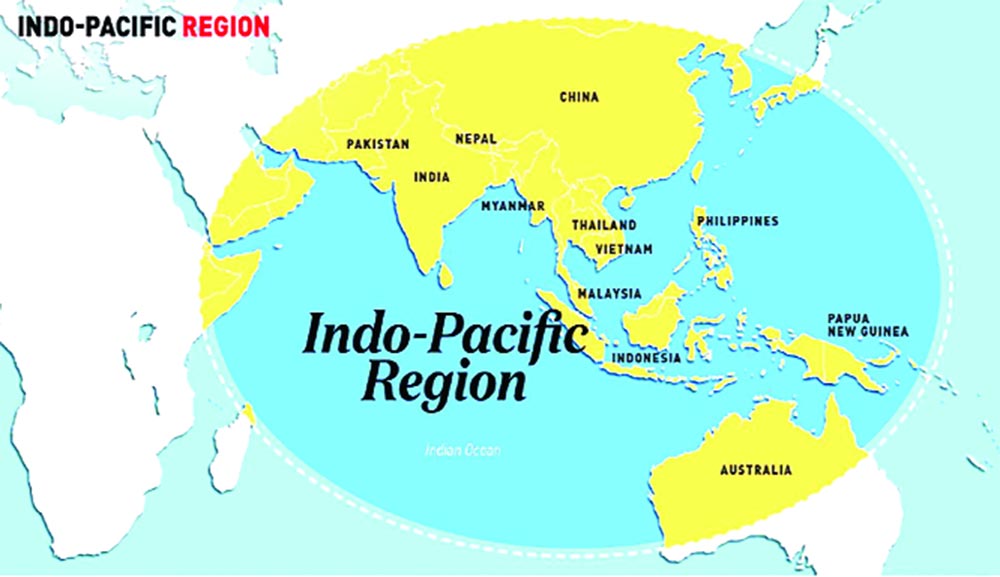 Rohingya repatriation issue is of significant concern, as Bangladesh has provided asylum to over one million Rohingya refugees since 1982, when Myanmar denies Rohingya as their citizen and announced untoward for Rakhine state. The Rohingya population in Bangladeshi territory is markedly exacerbating, alongside increasing criminal activities perpetrated and propagated by Rohingya refugees, as repeatedly articulated by Dhaka. The issue of Rohingya repatriation therefore, has been a topic of intense deliberation in the international diplomatic sphere over the last three decades. In lieu with the negotiation process, Bangladesh and Myanmar signed a repatriation agreement On November 23 in 2017 with Chinese support. China still has been actively working to develop a trilateral repatriation mechanism; though these discussions have not seen the light yet.
The IPS and IPO notwithstanding have placed significant emphasis on the issue of security in the region. As such, it is apparent that resolving the Rohingya crisis will be a decisive priority in achieving sustained peace and stability in the wider Indo-Pacific area. The United States launched a pilot program aimed at relocating a select group of highly vulnerable Rohingya refugees to the United States. Afreen Akhter, the Deputy Assistant Secretary of the United States, recently t provided assurance that the USA will potentially accept additional Rohingya refugees in the future as part of its third-country resettlement program. It is therefore, expected that the repatriation process will be facilitated further by the implementation of the IPO.
Climate change and naval security constitute significant spheres of apprehension for Dhaka. Bangladesh is one of the vulnerable but innocent victims of climate change. Outlook has placed a notable emphasis on the mitigation of climate change, biodiversity degradation, marine pollution, and other detrimental environmental impacts. The underlying aim of Outlook is to foster fair and enduring progress in the region with a view to achieving Sustainable Development Goal 14, facilitated by the principles of inclusive economic advancement, and a collective commitment to prosperity for all. The USA declares its unwavering dedication to combat the effects of climate change and to formulate authoritative environmental plans for the years 2030 and 2050, which adhere to the goal of restricting the global temperature increase to 1. 5 degrees Celsius through reducing regional vulnerability. Both the 'Strategy' and the 'Outlook' aim to guarantee health security through the elimination of the COVID-19 pandemic and the establishment of a coordinated approach to address potential pandemics in the future.
Dhaka gives special emphasis on 'blue economy' within the context of its Delta Plan-2100 and pledges to uphold the United Nations Convention on the Law of the Sea (UNCLOS) to establish a comprehensive framework for governing the legal aspects of territorial waters and ocean domains in the Indo-Pacific region.
The Outlook also prominently highlights agro-based development as an essential element, focused on harnessing the potential of the domestic agriculture, manufacturing, and services sectors to establish robust global and regional value chains. Its objectives entail promoting food security, water solidarity and reducing disaster risks.
The last but not the least, the implementation of the Indo-Pacific Outlook is expected to foster greater proximity of Bangladesh with pivotal trade and investment alliances. But at the same time, Bangladesh's own IPO has defined it as a leader in the region. Consequently, this development may position Bangladesh as a formidable market contender vis-�-vis several neighboring countries, potentially leading to the loss of Generalized System of Preferences (GSP) facilities. The business strategy of Dhaka in the region has not been explicitly articulated, which may be perceived as a smart "exclusion" strategy, keeping potential avenues open for the formulation of sub-regional business strategies. Nevertheless, it is recommended that Dhaka engage in bilateral or multilateral negotiations with the relevant stakeholders in the region to clarify its position on the export market.
The foremost and pivotal challenge in preparing IPO lies in adhering to the constitutional imperative of non-alignment. Article 25 of the Constitution of Bangladesh promotes international peace, security, and solidarity as the root of foreign policy. The article states that Bangladesh's international relations principles prioritize renouncing force and achieving complete disarmament. But Washington DC quite the reverse, wants to- bolster Indo-Pacific security and to build regional resilience to transnational threats. It aims to strengthen US with allies, partners, and regional institutions for quick military response to threats. The plan involves working with allies to enhance interoperability and implement cutting-edge warfighting technology; and avows the US. Coast Guard presence and training to support Taiwan's defense, meant an attempt to interfere in Chinese home defense.
Dhaka however, aims to maintain non-proliferation and peacekeeping and remained adamant on its nonaligned stance and followed 'Friendship towards all, malice toward none' dictum in formulating the Outlook.
The writer is a journalist in
The Daily Observer
Loading...
Loading...
Also read



Editor : Iqbal Sobhan Chowdhury
Published by the Editor on behalf of the Observer Ltd. from Globe Printers, 24/A, New Eskaton Road, Ramna, Dhaka.
Editorial, News and Commercial Offices : Aziz Bhaban (2nd floor), 93, Motijheel C/A, Dhaka-1000.
Phone: PABX- 41053001-06; Advertisement: 41053012; 01793317829, 01550707291, E-mail: [email protected], [email protected] Online: email: [email protected] 41053014; 01550707297 Advertisement: 01550707296
Published by the Editor on behalf of the Observer Ltd. from Globe Printers, 24/A, New Eskaton Road, Ramna, Dhaka.
Editorial, News and Commercial Offices : Aziz Bhaban (2nd floor), 93, Motijheel C/A, Dhaka-1000.
Phone: PABX- 41053001-06; Advertisement: 41053012; 01793317829, 01550707291, E-mail: [email protected], [email protected] Online: email: [email protected] 41053014; 01550707297 Advertisement: 01550707296


