



| HEADLINE |

|
Deal with USA, China, India in a balanced way: Prof Shinoda
Published : Sunday, 3 September, 2023 at 12:00 AM
Shahnaj Begum


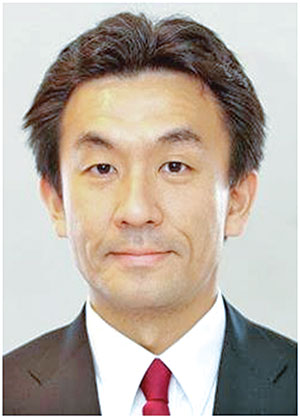 Bangladesh needs to be more balanced in dealing with the USA, China and India to elicit positive responses from all to reap benefit of the relationships by exhibiting its own foreign policy, said Prof Dr Hideaki Shinoda, a Japanese think tank from Graduate School of Global Studies, Tokyo University of Foreign Studies.
The Japanese think tank shared his own ideas over Bangladesh's Indo-Pacific Outlook saying, "Sometimes we have to face challenges, we cannot avoid many issues rather we need to concentrate upon building trust with others through organising dialogue and discussions," Hideaki Shinoda said in an interview with the Daily Observer on Saturday.
When asked if Bangladesh's time-tested foreign policy dictum - friendship to all, malice towards none is not a balanced one or is it not enough to build confidence among others?
"No, there is no straight-cut reply to this question, the ground reality is that the world is now working on agenda basis, problem comes� we sit together and sort it out or apprehending some future issues, we have fixed up some new agenda and sign protocols to address that, countries are 'agreed' over the issue or some work on it on the basis of agree with disagreement," he said.
Explaining the issue, Hideaki Shinoda further said, IPS is a regional issue, it is truly a larger inter-regional or global issue, however, there are three points here (in Bangladesh's outlook) that might help us to find out a path. These issues are exactly echoing the UN Charter.
"Firstly, the UN charter never discussed the most controversial issues, I found its presence in the Bangladesh's Outlook, secondly, by passing all odd things there are also many areas where we all can work together�these are climate, technology transfer, health issues like Covid and finally or the third one is that introduction of open-free rule based border to maintain peace, peace and peace�.however, Bangladesh have a great experience here through its peace keeping role across the globe," he remarks.
Now we have seen that a demonstration of the world's renewed interest in the Indo-Pacific region, various Indo-Pacific strategies, visions, outlooks, guidelines have been introduced and advocated by countries/associations like the USA, EU, UK, France, Germany, the Netherlands, India, ASEAN, Australia, Republic of Korea, Canada, Czech Republic, and Bangladesh at different points in time.
And at the same time we are also seeing that Asia Rebalancing Strategy, Belt and Road Initiative (BRI), Free and Open Indo-Pacific (FOIP), Quadrilateral Security Dialogue (QUAD), Trilateral Security Pact (AUKUS), Indo-Pacific Tilt, Security and Growth for All in the Region (SAGAR), Indo-Pacific Economic Forum for Prosperity (IPEF) have been adopted by countries centring on Indo-Pacific region to address the new security challenges as well as infrastructure, economic and technological developments in this region, now questing is how Bangladesh could be able to choice the right one and balance with all the mentioned countries as there is no common platform?
"In every initiative, there are all these three common things, Bangladesh should work on that and surely maintain its core policy in this regard�..Bangladesh need to show its bias less, balanced policy to all equally which might help to get rid from all odd things in building bi-lateral relationship with all," he said.
He admits that the on-going geo-political situation is not favourable to Bangladesh but he termed Bangladesh as an "emerging power in South Asia."
"I'm not saying that it's a big-power here but it's an emerging power in South Asia, for its growing economy and very important geo-political position and finally for its huge potential work force (human resources)," he explained.
Responding to a question on Bangladesh's economic scenario, he said Bangladesh economy remains quite robust. "But over the long run, I think you have to worry. This is an economy that's been so disproportionately focused on one or two business, he said.
The Japanese think tank hoped that there will be a moment when Bangladesh will need to be in a position to diversify its top source of exports so that it is in a better position to compete with the real big economic stars.
Loading...
Loading...
Also read



Editor : Iqbal Sobhan Chowdhury
Published by the Editor on behalf of the Observer Ltd. from Globe Printers, 24/A, New Eskaton Road, Ramna, Dhaka.
Editorial, News and Commercial Offices : Aziz Bhaban (2nd floor), 93, Motijheel C/A, Dhaka-1000.
Phone: PABX- 41053001-06; Advertisement: 41053012; 01793317829, 01550707291, E-mail: [email protected], [email protected] Online: email: [email protected] 41053014; 01550707297 Advertisement: 01550707296
Published by the Editor on behalf of the Observer Ltd. from Globe Printers, 24/A, New Eskaton Road, Ramna, Dhaka.
Editorial, News and Commercial Offices : Aziz Bhaban (2nd floor), 93, Motijheel C/A, Dhaka-1000.
Phone: PABX- 41053001-06; Advertisement: 41053012; 01793317829, 01550707291, E-mail: [email protected], [email protected] Online: email: [email protected] 41053014; 01550707297 Advertisement: 01550707296


