



| HEADLINE |

|
Are blockades, hartals losing relevance?
Published : Saturday, 25 November, 2023 at 12:00 AM
Anika Fatima


 In recent weeks, Bangladesh has witnessed a series of anti-people activities like blockades and hartals orchestrated by the opposition parties like Bangladesh Nationalist Party (BNP), Jamaat-e-Islami Bangladesh and their allies. These actions were aimed at realizing their one point demand for a neutral government during the upcoming national elections for which schedule was announced recently. Opposition political parties' such programmes have made people increasingly restive as there has been growing discontent among general citizens towards these political protests.
 In our alienated polities, political parties have a tendency to the megalomania and this sense has prompted them to enforce political events like blockades and hartals. However, there has been a little or no response from the public in general and this is conspicuous when we see streets full of their routine vitality, teeming with vehicular movements, bustling businesses, and educational institutions adhering to their schedules.
The busting city landscape of Bangladesh has often been shattered by the deployment of protest tools like hartals and blockades which usually turn into violence and are increasingly losing their efficacy and relevance in contemporary times.
People's suffering knows no bounds because of continued destructive political events for the last few weeks. Over a dozen people have died in addition to damage to many various types of transports and properties. According to the Fire Service and Civil Defence, at least 154 arson attacks occurred across the country in the 17 days of strikes and blockades with over 135 vehicles set afire.
Historically, hartals and blockades were wielded as powerful tools by political parties to voice dissent, call for change, and demand attention to their causes. However, the recent iterations of these strategies have shown a diminishing impact, failing to resonate with the general public or bring about substantial change.
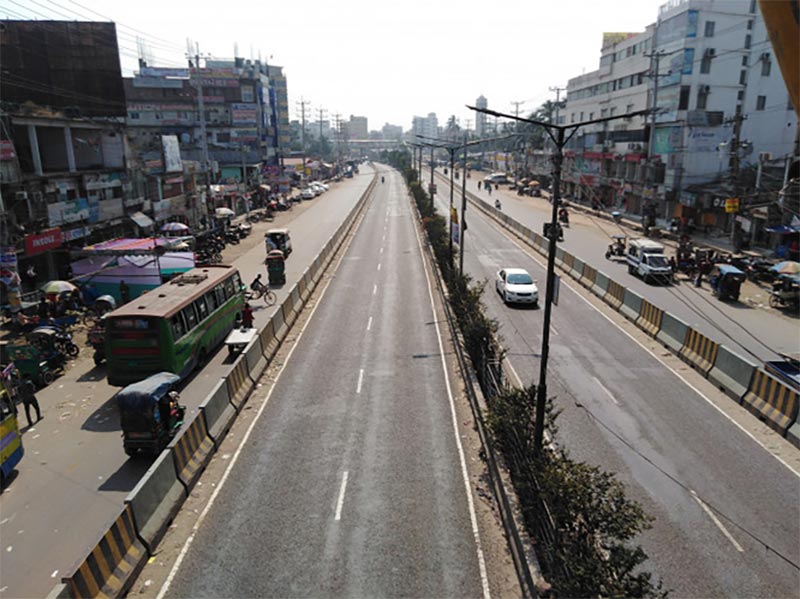
The opposition's endeavours to disrupt daily life have notably fallen flat, devoid of any tangible impact on citizens' routines. Reports from diverse corners of the city echoed a lack of compliance with the protest calls, with commuters encountering traffic snarls akin to any other regular workday. Public transportation, operating at full throttle, bore no signs of disruption, despite the intended disruptions envisaged by the protesting factions.
Furthermore, inter-district buses and night coaches traversed their usual routes, punctuating the narrative of a paralyzed transport network during the protests. Personal accounts from travellers corroborated this normalcy, underscoring the availability of transportation services and dispelling the spectre of a crippled travel infrastructure during the supposed period of dissent.
The disjunction between the opposition's endeavours and public sentiment was further emphasized through firsthand narratives. The persistent efforts by the opposition to enforce shutdowns and blockades following the disruption of their Dhaka rally late October have failed to resonate with the wider public. While BNP and its allies have spearheaded these movements, their inability to substantially disrupt daily life raises pertinent questions about the efficacy and relevance of such protest strategies in the current socio-political milieu.
The divergence between intended disruption and actual outcomes speaks volumes about the widening gap between political agendas and the concerns of ordinary citizens. As the public prioritizes their daily routines over political demonstrations, it signals a growing disenchantment and disengagement with conventional modes of protest.
This discordance is not merely indicative of the failure of recent blockades; it reflects a deeper societal shift. It suggests a fundamental misalignment between the agendas pursued by political entities and the evolving priorities of the populace they seek to represent.
However, the recent attempts at blockades and hartals by Bangladesh's opposition have spotlighted a substantial disconnect between their protest strategies and the response from the general public. The overwhelming display of normalcy amidst calls for disruption underscores a growing discontent and divergence in priorities between political entities and the people they purport to represent. This burgeoning disengagement calls for a critical re-evaluation of the efficacy of traditional protest tactics in a changing societal landscape where public sentiment seems to have shifted away from conventional political agendas.
The writer is an Editorial Assistant, The Daily Observer
Loading...
Loading...
Also read



Editor : Iqbal Sobhan Chowdhury
Published by the Editor on behalf of the Observer Ltd. from Globe Printers, 24/A, New Eskaton Road, Ramna, Dhaka.
Editorial, News and Commercial Offices : Aziz Bhaban (2nd floor), 93, Motijheel C/A, Dhaka-1000.
Phone: PABX- 41053001-06; Advertisement: 41053012; 01793317829, 01550707291, E-mail: [email protected], [email protected] Online: email: [email protected] 41053014; 01550707297 Advertisement: 01550707296
Published by the Editor on behalf of the Observer Ltd. from Globe Printers, 24/A, New Eskaton Road, Ramna, Dhaka.
Editorial, News and Commercial Offices : Aziz Bhaban (2nd floor), 93, Motijheel C/A, Dhaka-1000.
Phone: PABX- 41053001-06; Advertisement: 41053012; 01793317829, 01550707291, E-mail: [email protected], [email protected] Online: email: [email protected] 41053014; 01550707297 Advertisement: 01550707296


