



| HEADLINE |

|
Pahela Baishakh Mangal Shobhajatra now a UNESCO Heritage
Published : Thursday, 1 December, 2016 at 12:00 AM
Shahnaj Begum


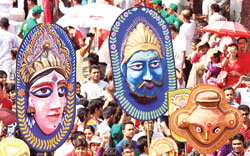 "Mangal Shobhajatra," the Bengalis traditional march-past taken out on the Bangla NewYear is now a UNESCO cultural heritage.
The decision came from the 11th session of the inter-governmental committee on intangible cultural heritage in Ethiopian capital, Addis Ababa, Bangladesh Ambassador in Paris M Shahidul Islam in a statement on Wednesday said.
"Mangal Shobhajatra' has been included in the List of Intangible Cultural Heritage of Humanity," the statement said.
Traditionally, on the first day of the Bengali Calendar celebrated on April 14 or April 15 in Bangladesh and in the Indian states of West Bengal and Tripura by the Bengali people and also by minority Bengali communities in other Indian states, including Assam, Jharkhand and Orrisa.
The traditional greeting for Bengali New Year is "Shubh� N�bob�rsho" which is literally "Happy New Year."
According to a report published in the local media 10-years back, people from the small and serene town of Jessore woke up early morning on the first day of Baishakh of 1392 Bangla year, April 14 in 1985, to the beats of dhol (drums).
The processionists paraded through the town wearing colourful topor (a type of headgears), bearing colourful masks of animals. People, who witnessed the procession, witnessed history, the history of a colourful procession -- Mongol Shovajatra -- at the dawn of Pahela Baishakh.
Sculptor Mahabub Jamal Shamim recalls the history of Mongol Shobhajatra to the daily where he claimed that "Some years later, Dhaka Fine Arts Institute brought out a similar procession in 1989, the brainchild of three youths: Mahabub Jamal Shamim, Moklesur Rahman and Heronmay Chanda who were the pioneers of the Jessore procession. Soon the colourful Mongol Shobhajatra spread countrywide and became an integral part of Bangla Navobarsa," he said.
"We did not want to be limited to a small canvas. We wanted to spread fine arts across the country. The entire country was a single canvas for us. With this philosophy, Moklesur Rahman a print artist, painter Heronmay Chanda and I went back to Jessore in 1985 to establish a unique Fine Arts Institution after we had graduated. With the support of our teacher, sculptor Habiduzzaman, we established Charupith, a fine arts institute in Jessore on February 8 in 1985 at the old building of Jessore MM College at Puratan Kasba in the town. The institute needed an introduction to the Jessore residents, so we took the initiative of a colourful procession to pay our tributes to the language martyrs on February 21.
At 6:00 pm of the Bangla year 1392, the first drum beat heralded our festival. We marched down the town roads with children dancing to the harmony of Bangla musical instruments. The townspeople were astonished when they saw our procession and we were thrilled by their response. Next year other cultural organisations from Jessore joined us in the procession, he said.
He recalled his memory saying that "in 1988 we returned to Dhaka to complete our post graduation. Dhaka Fine Arts Institute was going through a crisis due to political instability. We decided that we would spread some joy and try to bring some semblance of normalcy. We secretly arranged a colourful procession on the occasion of Zainul Festival the same year. As in the past we had masks, models of animals and traditional instruments to the tune of Bangla musical instruments at the inauguration of Zainul Festival on December 31. To our delight the institution reverberated with gaiety. They forgot all divides: Awami League-BNP, teachers-students spontaneously joined the procession that paraded through the Dhaka University campus.
Later, the institute took the initiative to bring out a similar procession the next Pahela Baishakh in 1989 which was Bangla 1396. The procession was named Mongol Shobhajatra. The next year Mymensingh and Barisal took out the Mongol Shobhajatra.
And thus the Mongol Shobhajatra became a national phenomenon, he said.
Loading...
Loading...
Also read



Editor : Iqbal Sobhan Chowdhury
Published by the Editor on behalf of the Observer Ltd. from Globe Printers, 24/A, New Eskaton Road, Ramna, Dhaka.
Editorial, News and Commercial Offices : Aziz Bhaban (2nd floor), 93, Motijheel C/A, Dhaka-1000.
Phone: PABX- 41053001-06; Advertisement: 41053012; 01793317829, 01550707291, E-mail: [email protected], [email protected] Online: email: [email protected] 41053014; 01550707297 Advertisement: 01550707296
Published by the Editor on behalf of the Observer Ltd. from Globe Printers, 24/A, New Eskaton Road, Ramna, Dhaka.
Editorial, News and Commercial Offices : Aziz Bhaban (2nd floor), 93, Motijheel C/A, Dhaka-1000.
Phone: PABX- 41053001-06; Advertisement: 41053012; 01793317829, 01550707291, E-mail: [email protected], [email protected] Online: email: [email protected] 41053014; 01550707297 Advertisement: 01550707296


