



| HEADLINE |

|
ADR has become vital to alleviate backlog of cases in BD courts
Published : Monday, 28 October, 2024 at 12:00 AM
Business Correspondent


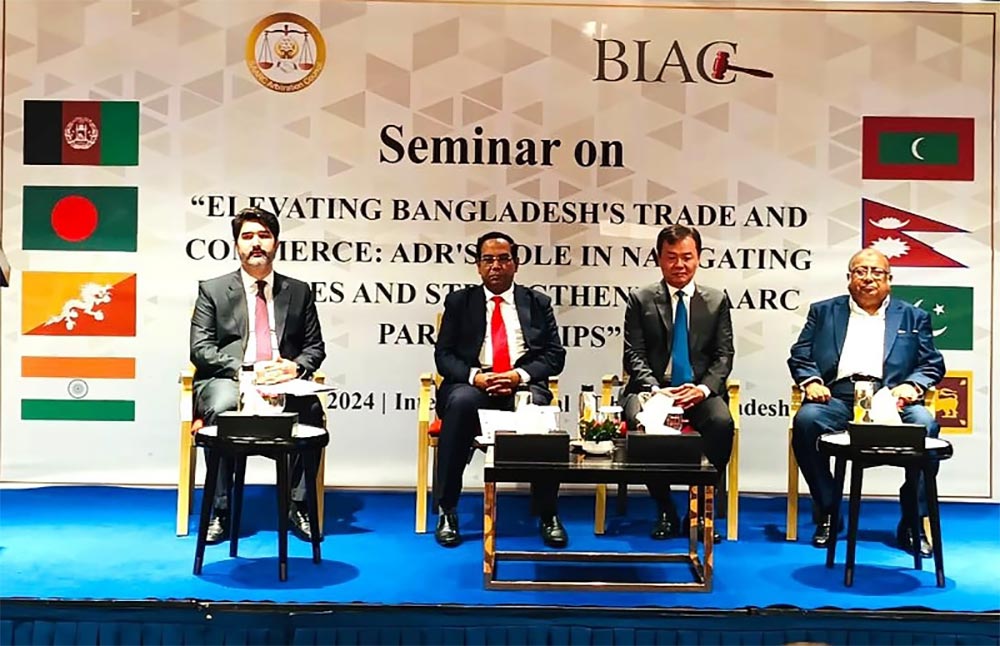 Bangladesh Supreme Court Justice Ahmed Sohel said as the country's legal system had been struggling to settle a staggering volume of over 4.2 million pending cases, the Alternative Dispute Resolution (ADR) became important in alleviating the legal court backlog.
 He was speaking as the chief guest at a seminar titled "Elevating Bangladesh's Trade and Commerce: ADR's Role in Navigating Disputes and Strengthening SAARC Partnerships" at the InterContinental Dhaka, on Saturday.
SAARC Arbitration Council (SARCO), in collaboration with Bangladesh International Arbitration Centre (BIAC), organized the seminar. Delivering an insightful keynote address on the critical role of the ADR Justice Sohel said currently each judge handling an average of 94,000 cases.
He emphasized the urgent need for ADR as a streamlined, cost-effective solution to reduce this judicial burden, urging stakeholders to refer cases to BIAC, Bangladesh's only registered arbitration institution, known for its adherence to international standards and efficient dispute resolution processes.
Justice Sohel also outlined essential steps to strengthen ADR in Bangladesh, advocating for specialized ADR training for judges and lawyers to enhance dispute resolution quality. He further emphasized the need for increased public awareness campaigns to inform citizens of ADR's accessibility and benefits.
The seminar featured an esteemed panel, including former Supreme Court Justice A.F.M. Abdur Rahman and other prominent figures from the legal and business sectors.
The panel discussed the growth of foreign investment in Bangladesh and the necessity of a robust ADR system to resolve investor disputes swiftly, thereby enhancing investor confidence and contributing to economic growth.
They noted that a strong ADR framework could attract further investment from both foreign and SAARC nations, fostering greater trust in the dispute resolution process.
A key topic was the Singapore Convention on Mediation, signed by 57 countries, which bolsters the enforceability of mediated agreements on a global scale. The panel suggested that Bangladesh consider signing the convention to facilitate faster, out-of-court settlements.
They also recommended establishing a dedicated oversight body to support the cohesive formulation and implementation of ADR policies across Bangladesh.
In his welcome address, BIAC Vice Chairman Muhammad A. (Rumee) Ali, shared BIAC's significant contributions over the past 13 years to advance ADR in Bangladesh.
These efforts include developing the Mediation & Arbitration Rules 2019 and hosting a series of training programs, seminars, and webinars. Mr. Rumee emphasized the importance of including ADR clauses in contracts to expedite dispute resolution.
Closing the seminar, BIAC Chairman Mahbubur Rahman stressed the importance of regional collaboration for economic growth and stability.
"The partnerships we have cultivated today will be crucial in establishing a resilient and integrated regional economy," he stated.
He reaffirmed BIAC's commitment to advancing ADR both in Bangladesh and across the SAARC region and expressed eagerness to continue collaborating with esteemed bodies like SARCO to expand the adoption of ADR practices.
The seminar was attended by distinguished advocates, bankers, and business leaders, who actively participated as panelists and moderators. Notable attendees included former Justices Tariq Ul Hakim, Abdus Salam Mamun, and Abu Ahmed Jamadar from the Supreme Court of Bangladesh, as well as Choining Dorji, Director General of SARCO.
Loading...
Loading...
Also read


Editor : Iqbal Sobhan Chowdhury
Published by the Editor on behalf of the Observer Ltd. from Globe Printers, 24/A, New Eskaton Road, Ramna, Dhaka.
Editorial, News and Commercial Offices : Aziz Bhaban (2nd floor), 93, Motijheel C/A, Dhaka-1000.
Phone: PABX- 41053001-06; Advertisement: 41053012; 01793317829, 01550707291, E-mail: [email protected], [email protected] Online: email: [email protected] 41053014; 01550707297 Advertisement: 01550707296
Published by the Editor on behalf of the Observer Ltd. from Globe Printers, 24/A, New Eskaton Road, Ramna, Dhaka.
Editorial, News and Commercial Offices : Aziz Bhaban (2nd floor), 93, Motijheel C/A, Dhaka-1000.
Phone: PABX- 41053001-06; Advertisement: 41053012; 01793317829, 01550707291, E-mail: [email protected], [email protected] Online: email: [email protected] 41053014; 01550707297 Advertisement: 01550707296


