



| HEADLINE |

|
Gulshan café attack the most shocking incident of 2016
Birth of CTTC marks change in cop anti-militancy tactics
Published : Saturday, 31 December, 2016 at 12:00 AM
Mamunur Rashid


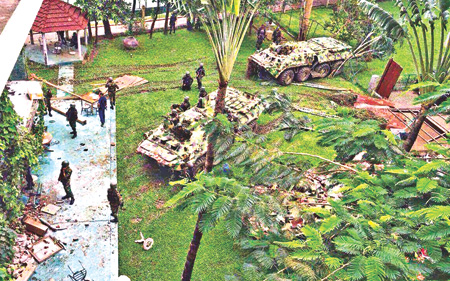 As the year comes to a close in which many incidents occurred. The senseless killing of foreigners and locals at an upscale eatery in city's posh Gulshan area stands out alone as the most shocking incident of the year 2016.
A group of gunmen stormed the Holey Artisan café in the city's Gulshan neighbourhood and murdered 22 people, most of them foreigners, on July 1.
After this incident Neo-Jamaat-ul-Mujahideen, Bangladesh (JMB) showed its prowess to do something terrible in the country at any time.
The law enforcement agencies including Rapid Action Battalion (RAB) and intelligence agencies changed their traditional system of conducting raids to round up terrorists. TheDMP launched a new wing, Counter Terrorism and Transnational Crime (CTTC) unit to curb militancy.
The CTTC unit in collaboration with other law enforcement agencies killed at least 40 banned militant outfit members so far since the army action against militants in Gulshan on July 2.
In last operation at Ashkona in Dakkhin Khan the law enforcers noticed that a woman militant tied a suicide vest containing grenade to her waist. "She was requested to surrender. But, at one stage, she blew herself off, leaving her dead on the spot and her child critically injured. The child, who identified herself as Sabina, daughter of Iqbal and Sakira, was rushed to Dhaka Medical College Hospital with splinter wounds on her chest and hands.
After killing of 40 militants, the government had previously announced that all involved in the Holey Artisan incident had been caught and the situation was under control.
Among the Gulshan attackers, almost all were part of the privileged society and all disappeared willingly from their homes. Of the deceased militants, Nibras Islam was a student of Monash University in Malaysia, Rohan Imtiaz was a student of Scholastica School, Meer Saameh Mubasher was an 'O' Level candidate at Sunnydale School, Shafiqul Islam Ujjal graduated from the Bogra Government Azizul Haque College and Khairul Islam Payel was a Madrasha student.
Meanwhile the Solakiya attacker Abir Rahman was a BBA student at North South University. Interestingly, Gulshan cafe attackers went missing at different times.
Safayet Hossain, 24, Zayen Hossain Khan Pavel, 23, and Sobuj alias Sujon, 25, and Mehedi Hasan, 27 - all residents of Banani - went missing about 15 days ago. They were last seen dining together at a Banani restaurant.
Family members of the youths said they do not know why their children went missing all of a sudden. Almost all the guardians or relatives of the missing youths - Zayen's father Ismail Hossain Khan Rasel, Mehedi's uncle Mahbub Alam, Sujan's brother Sumon and Sayeed Anwar's uncle Akram Kabir - told the Daily Observer that they do not think their dear ones, in any way, might have any links to any militant organisation.
The main mastermind Tamim Ahmed Chowdhury orchestrated Bangladesh's worst militant attack at the Holey Artisan café, he sought and won approval for it from the Islamic State.
A Canadian of Bangladeshi origin, he was told by his contact in the militant group, Abu Terek Mohammad Tajuddin Kausar, to target foreigners, according to a senior police official who has seen communications between the two men. Tamim, located in Bangladesh at the time, proposed an attack on a Dhaka eatery frequented by expatriates.
The back-and-forth between Tamim, 30, and Kausar, 35, which includes drafts of articles later published in Islamic State magazines, has not been previously reported.
In the year before the cafe atrocity, a string of grisly individual murders, including of bloggers and foreigners, had already raised the alarm for overseas investors.
In its Rumiyah magazine published after the café massacre, Islamic State claimed two dozen attacks in the country since September 2015. The claim could not be independently verified.
After the siege, police raided suspected jihadi hideouts and said they killed dozens of militants and arrested hundreds more.
Still, the government of Prime Minister Sheikh Hasina has said Islamic State does not exist in the impoverished South Asian nation of 160 million people, and instead blames the rise in political violence on the Islamist opposition.
Opposition leaders deny any link and say it can be traced to the bitter rivalry, which has long poisoned politics in the country, between Hasina's ruling Awami League and its main rival, the Bangladesh Nationalist Party (BNP), as well as Jamaat-e-Islami.
"These are all home-grown people," said Interior Minister Asaduzzaman Khan, adding that the militants belonged to a new faction of the JMB, a banned group he said had ties to the opposition Jamaat-e-Islami party.
The money, which the police official said was sent via the informal hawala cash transfer network, came from a UK-based company. The company's founder, Siful Sujan, was killed a few days later in Syria.
At the time, investigators could not establish that the money had been sent on Islamic State's instructions, the police official said. Tamim's group, meanwhile, recruited Tanvir Kaderi and his wife, Abedatul Fatema, who were enjoying a comfortable middle-class life in Dhaka, with two children and steady jobs.
"We were a very happy family," Kaderi's son Mohammed Tahrim Kaderi Abir wrote in a confession presented before a magistrate. Abir, an eighth grade student, wrote that his parents' behaviour started to change after they went on the Haj pilgrimage in 2014. Afif Kaderi, the 14-year-old boy who died in a police raid at a militant hideout in Ashkona of Dhaka's Dakkhin Khan on Saturday, was an arms trainer for women. Afif is the brother of Abir and son of Tanvir Kaderi'. After that, Kaderi told a preacher he had dreamed he was standing with a weapon in his hand in the middle of a desert.
Kaderi also started spending time with acquaintances from the local mosque, who introduced the family to others, including associates of Tamim.
They in turn preached to the family about faith and jihad and showed them videos of the war in Syria. One gave them a copy of Dabiq magazine, an Islamic State publication, according to the confession.
The preparations for the café attack began at least as early as June, around the beginning of the Muslim holy month of Ramadan, according to Abir's confession. Kaderi rented an apartment in Basundhara area of Dhaka, near the cafe.
A few days later the five militants who conducted the attack showed up at the house. Kaderi's family moved to Dhaka's old city the night of the raid. Chowdhury was killed on August 27. That and the other raids gave police access to his correspondence with Kausar.
In one, Tamim was asked by Kausar to answer questions for an interview, which was eventually published in Dabiq in April under the nom de guerre Abu Ibrahim al-Hanif. Al-Hanif was identified in the magazine as head of Islamic State in Bangladesh.
In another, Tamim sent the draft of an article about the café attack, which was published after his death in Rumiyah magazine, the police official said.
Kausar's mother said he moved to Australia in 2006 and she had not heard from him since before the attack. Tahera Begum, who lives in a town 135 miles from Dhaka, said she did not know whether he had links with Islamic State. Before his death, Tamim made Kaderi the new point of contact with Kausar, the police official said.
In the ensuing chaos, police were attacked with grenades and knives, while some women in the apartment threw chili powder at them. Kaderi ran into a room. As they tried to apprehend him, he swung a scythe at police, who were using his son as a shield. Kaderi told his son, "If you get hit, you will either be martyred or Allah will reward you."
By the time the raid was over, Kaderi had slit his own throat. The last known link to Islamic State in Bangladesh was dead, although the police official said they did not know if anyone else was in contact with the militant group.
Afif Kaderi, the 14-year-old boy, who died in a police raid at a militant hideout in Ashkona of Dhaka's Dakkhin Khan on Saturday, was an arms trainer for women. Abedatul Arfin alias Khadiza, wife of Tanvir Kaderi and another children twine brother of Afif Kader are now in jail
Afif Kaderi was an expert of making explosives, according to her statement to an official of CTTC unit of the DMP during interrogation.
Loading...
Loading...
Also read



Editor : Iqbal Sobhan Chowdhury
Published by the Editor on behalf of the Observer Ltd. from Globe Printers, 24/A, New Eskaton Road, Ramna, Dhaka.
Editorial, News and Commercial Offices : Aziz Bhaban (2nd floor), 93, Motijheel C/A, Dhaka-1000.
Phone: PABX- 41053001-06; Advertisement: 41053012; 01793317829, 01550707291, E-mail: [email protected], [email protected] Online: email: [email protected] 41053014; 01550707297 Advertisement: 01550707296
Published by the Editor on behalf of the Observer Ltd. from Globe Printers, 24/A, New Eskaton Road, Ramna, Dhaka.
Editorial, News and Commercial Offices : Aziz Bhaban (2nd floor), 93, Motijheel C/A, Dhaka-1000.
Phone: PABX- 41053001-06; Advertisement: 41053012; 01793317829, 01550707291, E-mail: [email protected], [email protected] Online: email: [email protected] 41053014; 01550707297 Advertisement: 01550707296


