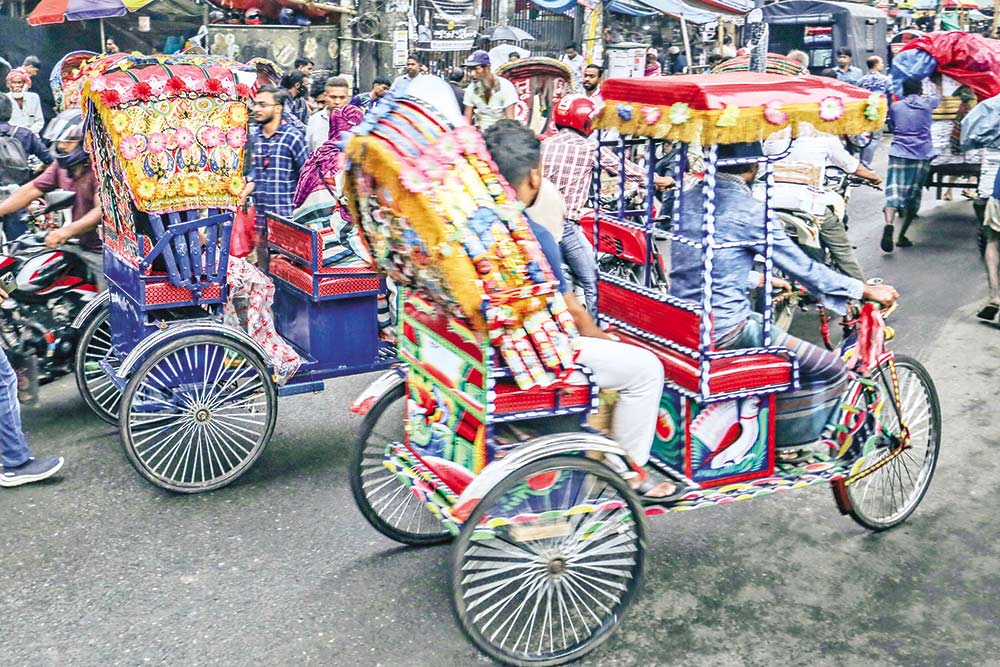
The city dwellers are facing a new type of sufferings due to haphazard plying of battery-run auto-rickshaws which return to Dhaka's mains road causing traffic chaos.
Earlier, these rickshaws were only plying in alleyways in the capital. But, they become rampant across the capital's main road following withdrawal of ban by ousted prime minister Sheikh Hasina last year.
Now these vehicles take control on city roads. Even they are racing with buses and trucks and taking flyovers in some places to ply. If get the chance, they are running on the opposite direction of key roads, making traffic polices helpless. This is increasing accidents.
However, experts and ordinary passengers expressed mixed reactions over the battery-run rickshaw. Some say that it is inhumane to drive a rickshaw by foot in this modern era. Moreover, the speed of a foot-powered rickshaw is low. In comparison, the driver of a battery-run rickshaw has to work less, is faster, and earns more.
Battery-powered rickshaws can run with increased speed have the higher risk of accidents than ordinary rickshaws, argued another group calling for imposing an immediate ban on such vehicles in the capital.
"Easybikes and battery-powered rickshaws have become rampant across roars in the capital. These vehicles are roaming on the main roads violating traffic rules," Mozammel Haque Chowdhury, Secretary General of Passenger
Welfare Association of Bangladesh's told The Daily Observer.
He added, "Thousands of jobless people have bought battery-powered rickshaws and driving these vehicles in Dhaka finding it an easy earning source. Free import and availability of garages have made the task easy."
Blaming battery-powered rickshaws for rising number of road accidents in Dhaka, Mozammel Haque demanded a ban on the plying of easybikes and battery-powered rickshaws in the capital.
GaousPearee, Director of Work for a Better Bangladesh Trust's, told The Daily Observer, "In 2007, the average speed of vehicles in Dhaka was 21 km per hour. But due to the abundance of rickshaws and small cars, it has now come down to 4.8 km per hour. There is no such rickshaw system in developed countries. But we have unscientifically allowed to run battery-powered auto-rickshaw here."
He said battery-powered rickshaws pose a new challenge for the capital's traffic system when it seems to be unmanageable amid rising number of private cars and narrow roads.
"The police should play an effective role in controlling auto-rickshaws as well as manage the traffic in Dhaka," she added.
Considering the public safety, the interim government ordered the ban of auto-rickshaws in Dhaka. This led to a movement by auto-rickshaw drivers. In the face of the movement, the court suspended the order for a month. But even though months have passed, no new decision has been made on this regard.
Banker Nurul Ahad said, "Commuters are taking ride on an only vehicle for short distances in Dhaka city due to their availability. Besides, we have to wait for a long time to get a foot-drawn rickshaw. I am regularly taking ride on auto-rickshaw as such vehicles consume less travel time than conventional rickshaw."
When asked, he said, "I know risk is there but it is convenient for me when there are fewer pedal rickshaws."
Sharing his experience on an accident Nurul Ahad, said, "One day I saw an auto-rickshaw overturn with a passenger as the driver lost control over because of high speed. Following the incident, passenger turned unconscious and the driver's leg was broken. All this happened before my eyes. Even then, we have to ride auto-rickshaw to save time in this congested city."
Raju Hamid, a battery rickshaw puller in Khilgaon Mothertech area, said that he used to drive pedal rickshaws. However, fewer passengers boarded his rickshaw due to the availability of battery rickshaw. Later, he also started driving such vehicle to cover up his earning.
He said if we run battery rickshaw inside lanes and bylines we can demand at least Tk 20 to Tk 30 from a passenger. In this case, the drivers can earn Tk 500 to Tk 600 per day. This tiny income is not enough for us to survive after paying Tk 450 to the rickshaw owner.
"So, we are eying for long-distance trips and roaming all key roads to earn more," he added.
Battery-run rickshaw drivers themselves said that some of them had no experience driving rickshaws before. They were previously in other professions. They started driving rickshaws because they saw that battery rickshaws require less effort and earn more.
Dr M Shamsul Haque, a professor in the Civil Engineering Department of Bangladesh University of Engineering and Technology and director of the Accident Research Institute of BUET, told The Daily Observer that how many rickshaws will the police seize? These are not manageable. It is doubtful whether the regulatory authorities know how many rickshaws are appropriate for Dhaka.
It can be seen that DTCA and BRTA as a whole have no technical knowledge and are not accountable to anyone.
Governments will come and go, institutions will remain. But if the institutions are incompetent, weak and if their accountability cannot be ensured, then this problem will not be solved, he said.
On January 23, DMP Commissioner Sheikh Md. Sajjad Ali, at a meeting with representatives of battery-powered rickshaw owners and labor organizations at the DMP headquarters, said that battery-run rickshaws will not be allowed to ply on the main roads of the capital, including those where passenger buses ply.
But in reality, this is not reflected on the roads.
On February 23, Dhaka North City Corporation (DNCC) Administrator Mohammad Ejaz, during an exchange of views with journalists at DNCC Nagar Bhaban, said rickshaw movement on the main roads of Dhaka city will be suspended after Eid.
Dhaka Metropolitan Police (DMP) Deputy Commissioner (Media and Public Relations) Muhammad Talebur Rahman said police are always working to prevent such rickshaws from entering the main roads. Even then, in some places, they escape the vigilance of police notice and enter the main roads.
He also said that they are raising awareness about this issue by discussing it with owners, rickshaw drivers, and locals at different times. However, it is difficult for the police alone to control these. Therefore, the public and all concerned have to work together.