



| HEADLINE |

|
Govt issues 'public service ordinance, 2025'
Published : Sunday, 25 May, 2025 at 9:05 PM
Observer Online Report


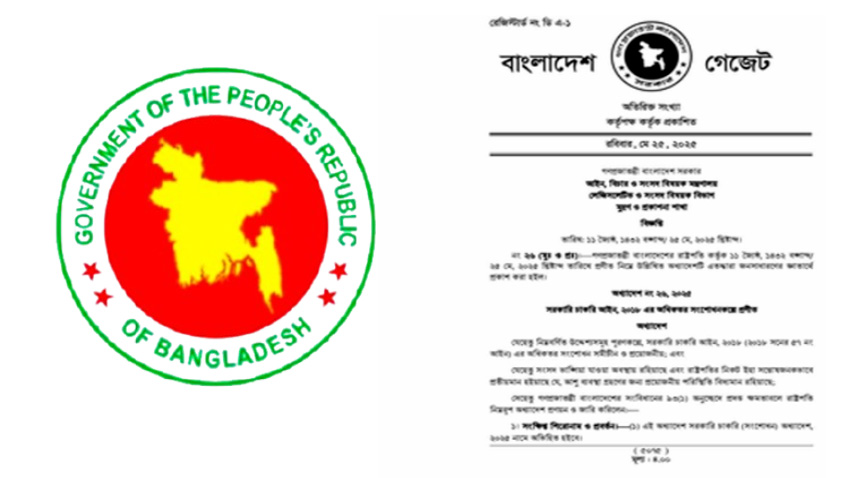
The government has issued the Public Service (Amendment) Ordinance, 2025 on Monday evening, despite ongoing protests by government employees within the Secretariat premises.
Employees from various ministries and departments, under the banner of the Bangladesh Secretariat Officers-Employees United Council, held demonstrations for the second consecutive day, branding the new ordinance as "repressive" and "draconian." They have demanded its immediate withdrawal and vowed to continue their movement until the demand is met.
The ordinance, approved in principle last Thursday during a meeting of the interim government's advisory council, amends the Public Service Act, 2018 by introducing several new provisions that employees claim are restrictive and infringe on constitutional rights.
According to the ordinance, four types of conduct by government employees are now classified as misconduct:
1. Engaging in acts deemed disloyal or that encourage disobedience or disrupt discipline or official duties;
2. Collective or individual absence from duty without leave or valid reason;
3. Inciting others to abstain from work or neglect their duties;
4. Obstructing colleagues from attending work or discharging their duties.
Punishments for such misconduct include demotion, removal from service, or dismissal.
Employees from various ministries and departments, under the banner of the Bangladesh Secretariat Officers-Employees United Council, held demonstrations for the second consecutive day, branding the new ordinance as "repressive" and "draconian." They have demanded its immediate withdrawal and vowed to continue their movement until the demand is met.
The ordinance, approved in principle last Thursday during a meeting of the interim government's advisory council, amends the Public Service Act, 2018 by introducing several new provisions that employees claim are restrictive and infringe on constitutional rights.
According to the ordinance, four types of conduct by government employees are now classified as misconduct:
1. Engaging in acts deemed disloyal or that encourage disobedience or disrupt discipline or official duties;
2. Collective or individual absence from duty without leave or valid reason;
3. Inciting others to abstain from work or neglect their duties;
4. Obstructing colleagues from attending work or discharging their duties.
Punishments for such misconduct include demotion, removal from service, or dismissal.
Notably, the ordinance introduces a streamlined disciplinary process, allowing penalties to be imposed without a formal departmental inquiry. The process includes-- issuing a show-cause notice within 7 days of charge framing, allowing 7 additional working days for the accused to respond before a penalty is imposed, provision for appeal within 30 working days—except in cases where the penalty is imposed directly by the President. In such cases, only a review petition may be submitted to the President.
Protesting employees have criticized the ordinance as unconstitutional and a step backward in public sector reform. They allege that the law reintroduces "authoritarian clauses" from decades-old service regulations under the guise of reform.
The movement continues, with civil service unions calling for dialogue and urging the government to repeal the ordinance and initiate broader stakeholder consultations.
Protesting employees have criticized the ordinance as unconstitutional and a step backward in public sector reform. They allege that the law reintroduces "authoritarian clauses" from decades-old service regulations under the guise of reform.
The movement continues, with civil service unions calling for dialogue and urging the government to repeal the ordinance and initiate broader stakeholder consultations.
Loading...
Loading...
Also read









Editor : Iqbal Sobhan Chowdhury
Published by the Editor on behalf of the Observer Ltd. from Globe Printers, 24/A, New Eskaton Road, Ramna, Dhaka.
Editorial, News and Commercial Offices : Aziz Bhaban (2nd floor), 93, Motijheel C/A, Dhaka-1000.
Phone: PABX- 41053001-06; Advertisement: 41053012; 01793317829, 01550707291, E-mail: [email protected], [email protected] Online: email: [email protected] 41053014; 01550707297 Advertisement: 01550707296
Published by the Editor on behalf of the Observer Ltd. from Globe Printers, 24/A, New Eskaton Road, Ramna, Dhaka.
Editorial, News and Commercial Offices : Aziz Bhaban (2nd floor), 93, Motijheel C/A, Dhaka-1000.
Phone: PABX- 41053001-06; Advertisement: 41053012; 01793317829, 01550707291, E-mail: [email protected], [email protected] Online: email: [email protected] 41053014; 01550707297 Advertisement: 01550707296


