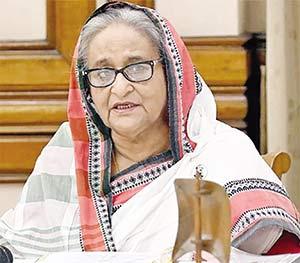
The International Crimes Tribunal (ICT) on Sunday formally took cognizance of five charges of crimes against humanity against former Prime Minister Sheikh Hasina, in connection with her alleged role in ordering and orchestrating what prosecutors have termed the July Uprising Genocide.
Following the acceptance of the charges, the tribunal issued arrest warrants for Sheikh Hasina and former Home Minister Asaduzzaman Khan Kamal.
A three-member bench of the tribunal-headed by Chairman Justice Md Golam Mortuza Majumder and comprising Justice Md Shafiul Alam Mahmud and retired District and Sessions Judge Md Mohitul Haque Enam Chowdhury-passed the order after a detailed review of the prosecution's submission.
Earlier in the day, the ICT's investigation agency submitted a comprehensive report to the prosecution, detailing five specific charges related to the July 2024 events.
In the afternoon, Chief Prosecutor Mohammad Tajul Islam submitted a formal 135-page charge sheet accusing Sheikh Hasina, Asaduzzaman Khan Kamal, and former Inspector General of Police Chowdhury Abdullah Al-Mamun of direct and indirect involvement in crimes against humanity.
The charges relate to their alleged roles in planning and executing violent crackdowns on the anti-discrimination student movement, which, according to the prosecution, resulted in over 1,500 civilian deaths.
The prosecution's submission includes 8,747 pages of documentary and audiovisual evidence, as well as a list of 81 proposed witnesses. Sheikh Hasina has been identified as the principal instigator in all five charges.
The charge sheet hearing commenced at approximately 12:15 PM and was broadcast live by state-run BTV, a rare move underscoring the case's national significance.
This latest move follows the tribunal's admission of an earlier case regarding the targeted killing of six protesters in Chankharpool, Dhaka. With Sunday's cognizance, Sheikh Hasina now faces two formally admitted cases before the ICT-a pivotal moment in the evolving landscape of post-Awami League political accountability.
Prosecutor Tajul Islam described Sheikh Hasina as the "nucleus of enforced disappearances and secret detention centers," referring to allegations of state-run 'mirror houses' used during her 15-and-a-half-year tenure for detaining political dissidents and activists.
These proceedings are part of a broader judicial and transitional justice process initiated after the fall of the Awami League government on August 5, 2024, in the wake of a mass uprising that led to administrative collapse and widespread civil unrest. The previously inactive ICT was reinstated under the new government with a mandate to reopen unresolved or suppressed cases of crimes against humanity.
In addition to the July Genocide case, two more cases against Sheikh Hasina remain pending before the tribunal. One involves alleged systematic enforced disappearances and extrajudicial killings, while the other pertains to the mass killing of Hefazat-e-Islam supporters during the Shapla Square rally in Motijheel.
Legal experts say the ICT's revived role signals a turning point in efforts to establish accountability for state-led violence, with far-reaching implications for Bangladesh's justice system and political future.