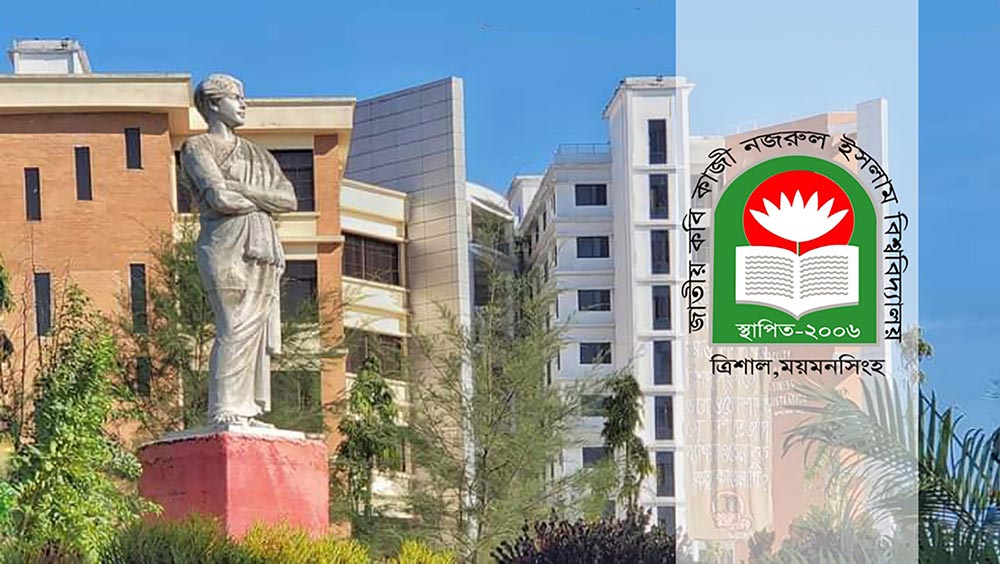
Jatiya Kabi Kazi Nazrul Islam University (JKKNIU) located at Trishal in Mymensingh District has been struggling with severe shortage of teachers in its 19 years of journey.
Despite the steady rise in student enrolment and expansion of new departments at the university, the number of faculty members remains far below the required level, severely affecting teaching, research, and overall academic activities.
According to the university's 2025 Annual Report, 10,809 students are currently pursuing undergraduate and post-graduate programmes. Based on global standards, the university requires at least 540 full-time teachers - one for every 20 students.
However, there are only 220 faculty members in place, many of whom are on study leave, further reducing the effective strength.
Official records reveal that nine out of the university's 26 departments and institutes are operating with five or fewer teachers. The Institute of Nazrul Studies has no teachers at all, while the Department of Population Science has eight sanctioned posts, but half of the teachers are away on leave. Departments of Philosophy, Marketing, and Anthropology each have just four teachers, while Film and Media Studies is managing with five. Statistics and History are left with only three teachers each, and the Management and Sociology departments are functioning with only two teachers.
The University Grants Commission (UGC) has directed all universities to adopt Outcome-Based Education (OBE), which requires a minimum of 15-16 teachers per department. Meeting that benchmark, however, remains virtually impossible under the present circumstances.
Vice-Chancellor Professor Dr Md Jahangir Alam admitted to the crisis. "We have repeatedly informed the UGC and sent formal letters regarding the shortage. Although assurances have been given, no visible progress has been made. Without UGC approval, new faculty recruitment is not possible," the VC added.
Students say they are the worst sufferers. With classes often conducted by guest lecturers from other departments and universities, courses remain unfinished, examinations are delayed, and results are frequently published late.
"Regular classes and exams are not being held, leaving us far behind," said Md Yusuf, a first-year Sociology student.
"Whenever we complain, the administration points to the shortage of teachers."
Ratul Rahman, a final-year Marketing student, echoed similar frustration. "Teachers are overburdened with extra classes, which affects both teaching quality and our learning," he said.
Faculty members also expressed concern. Dr Md Abdul Momen, Chairman of the Marketing Department, said, "Each 20 students should have one teacher. But in many departments, two to four teachers are handling hundreds of students. In our department, just four faculty members manage 25 courses across five batches. This makes it nearly impossible to uphold academic standards, let alone research or seminars."
Dr Muhammed Shamsuzzaman, Chairman of the History Department, informed, "Teachers are responsible for lectures, grading, research, administrative tasks, and more. With so few faculty members, quality education is suffering and OBE guidelines cannot be effectively implemented."
The continuing teacher crisis has already resulted in irregular classes, session jams, and stalled research initiatives.
Teachers and students warn that unless urgent recruitment measures are taken, the university's academic standards may face a serious setback.





