CHAPAINAWABGANJ, widely known as the "Mango Capital of Bangladesh," is a district where history, culture, and politics intersect in remarkable ways. The region's fertile soil, nourished by the Padma and Mahananda rivers, produces the country's most famous mangoes, which not only dominate domestic markets but also reach consumers abroad.
These orchards, stretching across villages, are more than a source of livelihood-they form the heart of the district's identity. Alongside this natural abundance stands a rich historical legacy, embodied in the majestic Choto Sona Mosque, the Mughal-era Tahakhana, and other medieval Islamic monuments that continue to draw researchers, tourists, and heritage lovers. Folk traditions, crafts, and festivals further enrich the area's cultural landscape, making Chapainawabganj one of the most distinctive regions in Bangladesh.
But beyond its cultural and agricultural fame, the district now finds itself at the centre of intense political attention as the 13th Jatiya Sangsad election approaches.
With three constituencies, Chapainawabganj-1, 2, and 3, the district has long been regarded as a stronghold of the Bangladesh Nationalist Party (BNP). Popularly referred to as a "BNP fortress," it has historically resisted the dominance of the ruling Awami League (AL). This year, however, the political stage looks dramatically different.
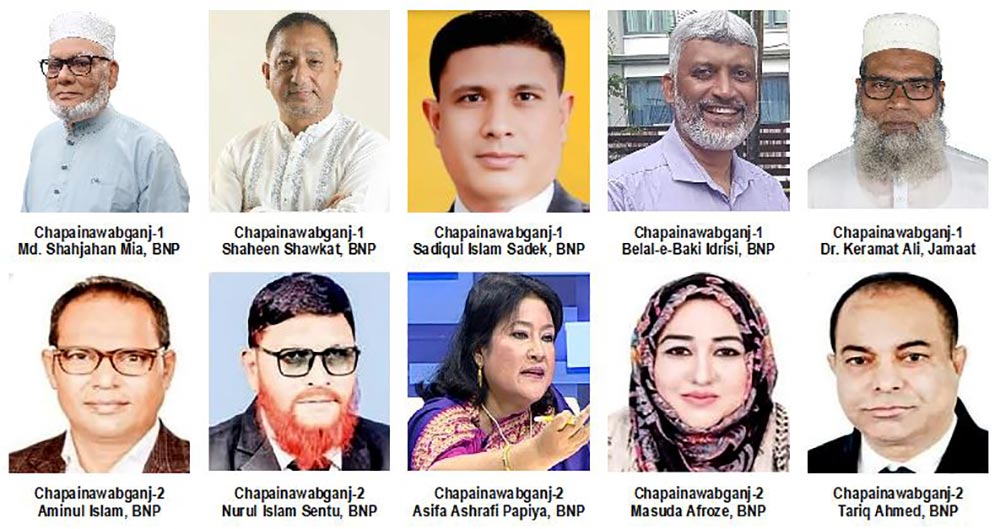
In Chapainawabganj-1, Shibganj Upazila is witnessing a fierce race among BNP heavyweights, with long-time leader Prof. Shahjahan Mia facing tough internal rivalry from Advocate Syed Shaheen Shawkat. In Chapainawabganj-2, the situation is even more complex, as multiple BNP factions clash for nominations, weakening the party's organizational unity and giving Jamaat candidate Dr. Mizanur Rahman a rare opening. Meanwhile, in Chapainawabganj-3, four-time MP Harunur Rashid confronts resistance from within his own party, while Jamaat's Nurul Islam Bulbul is making inroads with disciplined campaigning.
Local observers say the central question is no longer about AL's presence but whether BNP can overcome its internal feuds to retain dominance or whether Jamaat, with its growing grassroots network, can translate organizational strength into parliamentary success. With campaign activities intensifying, tea stalls, marketplaces, and village gatherings are abuzz with political debates. The district that feeds the nation its sweetest mangoes is now poised to deliver one of the most decisive electoral verdicts of 2025.
CHAPAINAWABGANJ-1: This constituency includes Shibganj Upazila.
Aspirants and potential candidates are spending busy days with various programmes while central BNP heavyweights alongside local leaders are moving door-to-door in an effort to win voter confidence.
With the announcement of the electoral roadmap on the anniversary of the mass uprising, people are preparing to vote after a long break. Political activities in Shibganj have intensified, signalling a fierce battle in what is popularly known as the "BNP fortress."
Although Jamaat has organizational strength in the constituency, its candidates have never managed to reach parliament. However, the party has seen multiple wins in local government elections.
This time, Jamaat has declared Rajshahi City Ameer Dr. Keramat Ali as its candidate, who is actively engaging in public outreach and community activities to strengthen his organizational base.
Meanwhile, BNP faces an internal competition over nominations. Four names are being discussed: BNP Chairperson's adviser and five-time former MP Prof. Shahjahan Mia, Central Organizing Secretary (Rajshahi Division) Advocate Syed Shaheen Shawkat, Krishak Dal leader Sadiqul Islam, and local BNP leader Belal-e-Baki Idrisi.
Party insiders reveal that Prof. Shahjahan Mia has long been the uncontested BNP face here, but this time Shaheen Shawkat has emerged as a strong contender. Their rivalry has left grassroots activists somewhat divided. While a section of local workers still back Shahjahan Mia for his decades-long political stature, others argue that Shaheen Shawkat's role in organizing the BNP across Rajshahi during the party's toughest years makes him deserving of the nomination.
In fact, programmes on August 5 were observed separately by both camps, highlighting the growing divide. Shaheen's supporters point to his active role in anti-government movements and relatively clean image as an advantage.
Among BNP hopefuls, Shahjahan Mia emerged as the most popular candidate across almost all unions, outperforming both internal rivals and Jamaat's nominee.
BNP supporters argue that Shahjahan remains the strongest and most recognizable figure in the constituency. Known as a development-focused leader, he has already intensified organizational and social activities in Shibganj. His supporters are projecting him as BNP's official candidate, with increasing public appearance in religious and social gatherings.
Speaking to reporters, former upazila vice-chairman and ex-Jubo Dal leader Shahidul Haque Haidari said, "Shahjahan Mia is not only popular among BNP workers but also among people of all walks of life in Shibganj. He is the architect of Shibganj's development."
On the other hand, Shaheen Shawkat's followers insist that his sacrifice during BNP's crisis years and his leadership in Rajshahi Division make him more suitable. Shaheen himself said, "I have fought against the fascist regime for people's right to vote. The people's response assures me that BNP's Sheaf of Paddy will win by a huge margin."
Other aspirants are also lobbying. Businessman Belal-e-Baki Idrisi claimed that his close ties with the local people will earn him the party's ticket. Former student leader Sadikur Rahman believes his popularity among BNP's youth wing gives him an edge.
Jamaat's Dr. Keramat Ali, a two-time former chairman of Shibganj Upazila Parishad, has ramped up campaigning since August 2024. Declaring himself as Jamaat's confirmed candidate, he said, "My party nominated me long ago. I am confident we will win. However, as the party is also considering proportional representation, I will honour any decision."
CHAPAINAWABGANJ -2: This constituency comprises Nachol, Gomostapur, and Bholahat upazilas.
Traditionally known as a BNP bastion, the seat is witnessing unprecedented internal rifts as multiple BNP factions vie for the party's nomination. The result is a fractured organizational base, with no faction willing to yield.
Among BNP hopefuls, the most prominent name is Md. Aminul Islam, Central organizing secretary for industry and commerce and the sitting MP from the 2018 election. Despite winning, Aminul stirred controversy by taking oath in the parliament against the party's central decision, angering many grassroots leaders and workers. This rebellion weakened his standing within BNP, leaving the nomination field wide open for others.
Other contenders include Advocate Nurul Islam Sentu, a senior lawyer who provided legal assistance to persecuted BNP activists during years of repression; former Rahanpur mayor Tariq Ahmed, known for organizing the party during difficult times; and Masuda Afroz Huq Suchi, General Secretary of the District Mohila Dal, who emphasises her grassroots activism and role in anti-government protests.
Syeda Asifa Ashrafi Papia, a former member of parliament from a reserved seat, served as the general secretary of the Chapainawabganj District unit of the BNP is seeking nomination from BNP. She said, "I have worked for the party all my life, and I will continue to do so in the future. I hope the BNP will nominate me, and I am confident that I will win."
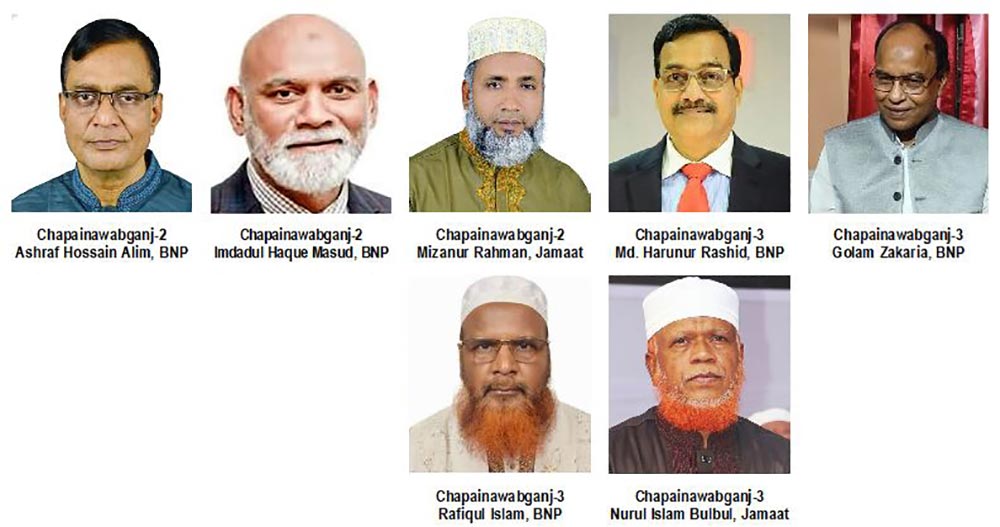
Additionally, local leaders such as Enayet Karim Touki, Asadullah, Ataur Rahman, Imdadul Haque Masud, Ashraf Hossain, Moazzem Chowdhury, and Abdus Salam Tuhin are also lobbying for BNP's nomination, making the contest increasingly chaotic.
Meanwhile, Jamaat has already finalised its single candidate, Dr. Mizanur Rahman, assistant secretary of the District Jamaat. Jamaat's return to electoral politics with its registration and the "balance" symbol restored has injected a new dimension into the contest. For the first time in decades, BNP faces a credible challenge here.
Supporters of each candidate are vocal both on the ground and across social media. Rallies, door-to-door campaigns, and cultural and religious event participation have become key strategies for candidates to showcase their popularity.
Jamaat's candidate Dr. Mizanur Rahman has launched extensive grassroots campaigns, visiting villages, meeting local communities, and presenting himself as a leader beyond partisan politics. He emphasised his commitment to social welfare, saying, "Jamaat is a well-organized party. Our popularity has grown compared to previous elections. If there is a free and fair election, victory for the balance is certain."
Party insiders believe Jamaat's vote share has grown substantially over the past decade, particularly after AL's decline in the area. However, they acknowledge that BNP's strong vote bank remains their biggest obstacle.
BNP leaders are equally vocal. Masuda Afroz Huq Suchi highlighted her activism: "I stood by persecuted and victimised leaders and activists across three upazilas during the fascist regime. I have remained active in movements against oppression. I trust the party will consider my dedication."
Former mayor Tariq Ahmed emphasised his organizational contributions: "During the repressive period, I kept BNP united. I am now campaigning based on the party's 31-point programme, and I am confident of delivering victory if nominated."
Advocate Nurul Islam Sentu pointed to his sacrifices: "When BNP leaders were forced into hiding under case and attack, I provided legal support and worked to keep party activities alive from ward to district level. I expect the party to recognise this."
Meanwhile, senior BNP leader and ex-MP Aminul Islam remains a formidable figure, despite grassroots resentment. His past win still resonates with a section of voters. However, his rivals are determined to block his return to the parliament.
Ordinary voters, however, express scepticism. At tea stalls and marketplaces, many complain that "seasonal candidates" appear only during elections and disappear once denied nominations. They argue that parties should prioritise honest and qualified candidates to ensure development from villages to upazila levels.
CHAPAINAWABGANJ-3: The constituency covers Sadar Upazila.
This parliamentary area is equally embroiled in BNP's internal divisions. At least five BNP aspirants are in the field, creating factional chaos, while Jamaat has already declared Nurul Islam Bulbul, a Central Working Committee member and Dhaka South Unit Ameer.
Meanwhile, the National Citizen Party (NCP), the party of the students we were behind the July Revolution, has started its organizational activities in this district. However, they have not yet finalised any candidate for this seat. Their election-related activities are virtually non-existent.
Historically, BNP has dominated this constituency, winning four times since 1991. AL secured three terms, while Jamaat won once. However, the three most recent polls-2014, 2018, and 2024-were widely disputed as "one-sided," "night-time voting," and "dummy elections."
BNP's most prominent figure here remains Harunur Rashid, Adviser to the party Chairperson and four-time MP. First elected in 1996 as a young student leader from Rajshahi University, Harun has never lost in a competitive election. In 2018, he won by a landslide despite widespread allegations of irregularities. His fiery speeches in the parliament criticising the AL made him nationally popular.
But within BNP, Harun now faces opposition. Since the District BNP's reorganization in 2021, Harun's loyalists were excluded from leadership positions. Instead, Golam Zakaria (District Convener and veteran leader) and District Member Secretary Rafiqul Islam have emerged as alternative power centres. This has left grassroots activists divided, with many frustrated by the leadership tussle.
On the other side, Jamaat's declared candidate Nurul Islam Bulbul is making waves with well-organized campaigns. Recently, he visited areas affected by Padma River erosion and distributed relief to flood victims, earning public goodwill. He declared, "After the fall of the Hasina government, people dream of new possibilities. This time, they want to see Jamaat as the alternative."
Observers note that this constituency could be one of the most unpredictable in the district. While BNP has historically dominated it, Jamaat's disciplined organization and Bulbul's popularity may pose a real threat if BNP remains divided.
BNP leaders admit the risk. Golam Zakaria said, "I was the founding general secretary of the District BNP and made the Sheaf of Paddy symbol known across villages. I carried the party through difficult years, and the people expect me to contest. I have support across party lines."
Similarly, Rafiqul Islam argued, "I carried the party's responsibilities during tough times. I fought in the streets for democracy. I believe my sacrifices will be acknowledged with nomination."
Yet BNP activists acknowledge that Harunur Rashid remains the most recognisable and popular face. Youth leaders insist his candidacy is essential. Chapainawabganj District Jubo Dal Convener Tabiul Islam Tarif said, "Harunur Rashid is the architect of development here. He is BNP's most popular leader, and we are working in the field considering him the likely candidate."
With AL's presence almost non-existent following the party's fall from power, the political stage in Chapainawabganj is now dominated by BNP and Jamaat.
The district, historically a BNP stronghold, now faces new realities as BNP suffers from internal feuds, weakening its grassroots unity. Jamaat is increasingly organized, disciplined, and confident, with candidates already confirmed in key constituencies. Voters are demanding clean, honest leadership, tired of seasonal contenders and factional politics.
As the 13th Jatiya Sangsad election draws closer, Chapainawabganj is set to emerge as one of the most closely watched battlegrounds in Bangladesh. The district's deep-rooted political loyalties, combined with BNP's internal divisions and Jamaat's renewed confidence, have created a highly volatile atmosphere. For BNP, the challenge lies not only in defeating its opponents but also in healing factional rifts that threaten its organizational strength. For Jamaat, the task is to prove that its disciplined grassroots network can finally deliver a parliamentary breakthrough.





