



| HEADLINE |

|
Amad’s dream: A diaspora story of solidarity in Bangladesh’s July revolution
Published : Wednesday, 10 September, 2025 at 4:43 PM
Observer Online Desk


The July 2024 mass uprising was not only one of the most significant events in Bangladesh’s history but also an important moment in world history. The movement that began last year transcended national boundaries and resonated deeply with the Bangladeshi diaspora across the globe. From different corners of the world, expatriates expressed solidarity—some returned to Bangladesh to join the protests directly, while others strengthened the movement from abroad through financial, social, and cultural support.
Notably, the role of diaspora women has been highlighted in the short documentary Amad’s Dream, directed by U.S.-based Bangladeshi visual storyteller Aashish Kiphayet.
The 9-minute-30-second documentary has already drawn significant attention on the international stage. Amad’s Dream was officially selected for the prestigious Anatolia International Film Festival in Istanbul and the Golden Bridge Istanbul Short Film Festival. Moreover, it received Honorable Mention awards at the East Village New York Film Festival and the Athens International Art Film Festival. Reflecting on the recognition, director Aashish Kiphayet said:
“I feel honored to present the July Revolution on the international stage. There is growing interest worldwide in the youth-led movement in Bangladesh. International film critics, directors, and producers have shown genuine curiosity and appreciation, which has been a truly unique experience for me.”
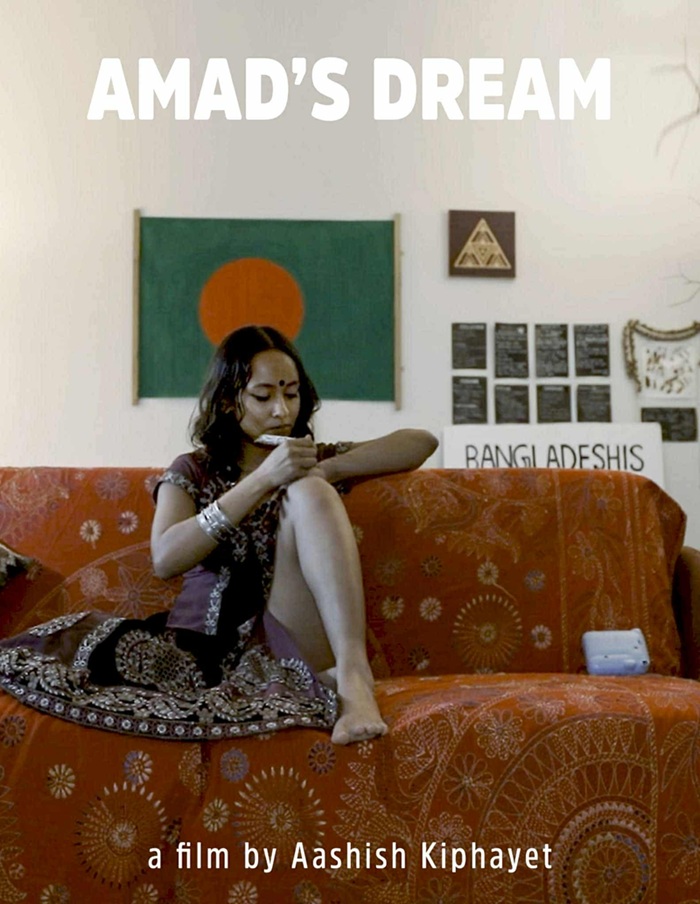
The central character of Amad’s Dream is Amad Mahbub, a Bangladeshi woman who is both a mehndi (henna) and kathak dance artist. She migrated to the United States to escape social oppression and pursued higher education in neuroscience. The documentary portrays her journey of resilience—navigating personal struggles, maintaining cultural roots, and embracing political consciousness. More than just a story of one woman’s struggle or the challenges of diaspora life, the film reflects the vital role played by Bangladeshis abroad during the July 2024 democratic uprising.
Notably, the role of diaspora women has been highlighted in the short documentary Amad’s Dream, directed by U.S.-based Bangladeshi visual storyteller Aashish Kiphayet.
The 9-minute-30-second documentary has already drawn significant attention on the international stage. Amad’s Dream was officially selected for the prestigious Anatolia International Film Festival in Istanbul and the Golden Bridge Istanbul Short Film Festival. Moreover, it received Honorable Mention awards at the East Village New York Film Festival and the Athens International Art Film Festival. Reflecting on the recognition, director Aashish Kiphayet said:
“I feel honored to present the July Revolution on the international stage. There is growing interest worldwide in the youth-led movement in Bangladesh. International film critics, directors, and producers have shown genuine curiosity and appreciation, which has been a truly unique experience for me.”
The central character of Amad’s Dream is Amad Mahbub, a Bangladeshi woman who is both a mehndi (henna) and kathak dance artist. She migrated to the United States to escape social oppression and pursued higher education in neuroscience. The documentary portrays her journey of resilience—navigating personal struggles, maintaining cultural roots, and embracing political consciousness. More than just a story of one woman’s struggle or the challenges of diaspora life, the film reflects the vital role played by Bangladeshis abroad during the July 2024 democratic uprising.
Across the world, members of the diaspora engaged in different ways: amplifying the movement’s message on social media, providing financial support, or using their professional expertise to contribute to the cause. The film artistically and symbolically captures this reality, showing how Amad used her mehndi art as an expression of solidarity with the movement—using her earnings from henna designs to support her homeland.
Director Aashish Kiphayet is an audio-visual storyteller based in Washington, D.C., USA. He works on themes of immigration, social justice, and civil rights. In 2025, he earned a master’s degree in New Media Photojournalism from the Corcoran School of the Arts and Design at George Washington University. His work has been published in The Times, Bloomberg News, The Guardian, and The Hill.
Director Aashish Kiphayet is an audio-visual storyteller based in Washington, D.C., USA. He works on themes of immigration, social justice, and civil rights. In 2025, he earned a master’s degree in New Media Photojournalism from the Corcoran School of the Arts and Design at George Washington University. His work has been published in The Times, Bloomberg News, The Guardian, and The Hill.
Loading...
Loading...
Also read



Editor : Iqbal Sobhan Chowdhury
Published by the Editor on behalf of the Observer Ltd. from Globe Printers, 24/A, New Eskaton Road, Ramna, Dhaka.
Editorial, News and Commercial Offices : Aziz Bhaban (2nd floor), 93, Motijheel C/A, Dhaka-1000.
Phone: PABX- 41053001-06; Advertisement: 41053012; 01793317829, 01550707291, E-mail: [email protected], [email protected] Online: email: [email protected] 41053014; 01550707297 Advertisement: 01550707296
Published by the Editor on behalf of the Observer Ltd. from Globe Printers, 24/A, New Eskaton Road, Ramna, Dhaka.
Editorial, News and Commercial Offices : Aziz Bhaban (2nd floor), 93, Motijheel C/A, Dhaka-1000.
Phone: PABX- 41053001-06; Advertisement: 41053012; 01793317829, 01550707291, E-mail: [email protected], [email protected] Online: email: [email protected] 41053014; 01550707297 Advertisement: 01550707296


