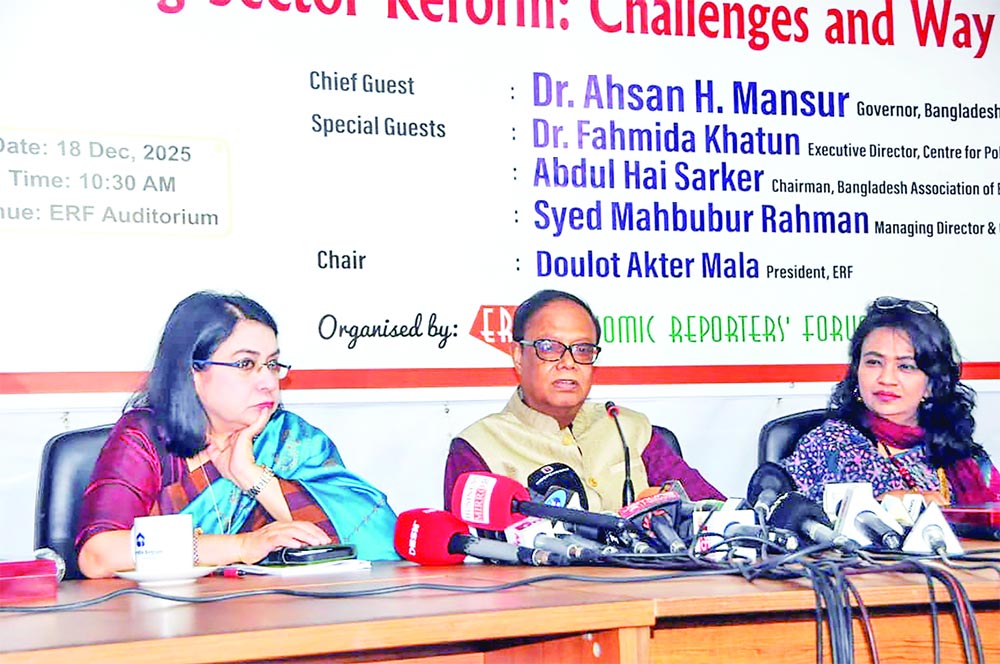
Bangladesh Bank (BB) governor Dr Ahsan H Mansur on Thursday said the real scale of default loans had remained hidden for years due to weak reporting and regulatory leniency while warning that banking sector reforms can no longer be delayed if financial stability to be protected.
Speaking as chief guest at a seminar titled "Banking Sector Reforms: Challenges and Way Forward" organised by Economic Reporters' Forum (ERF) in the city, the governor said the central bank has now started revealing the actual picture of the banking sector by calculating non-performing loans strictly under existing rules.
"Earlier, the defaulted loan rate was shown low because the real picture was hidden. Now it has increased because it is being calculated according to the rules," he said.
Dr Mansur said BB has already moved into a tighter supervisory mode and will re-examine large loans, particularly those above Tk200 million to ensure proper collateral, documentation and accountability.
"If rules were violated, responsibility will be fixed, not only on borrowers but also on bank officials and directors," he said, adding that protecting depositors is now a top priority of the regulator.
He said deposit insurance coverage of up to Tk2 lakh would fully protect small depositors and help restore confidence in the banking system. "We are not buying dollars by creating pressure in the market, and we are not printing money to cover weaknesses," the governor said, stressing that stability must come from discipline, not shortcuts.
Dr Mansur also said Bangladesh is gradually moving out of macroeconomic stress and the central bank is targeting foreign exchange reserves of around $34 to35 billion by the end of the current fiscal year without relying on fresh foreign borrowing. However, he cautioned that banking sector weaknesses remain a major risk if reforms are not enforced decisively.
The Centre for Policy Dialogue (CPD) executive director Dr Fahmida Khatun said the banking sector is suffering from deep structural and governance failures, with default loans now reaching a level close to the national budget.
She said repeated loan rescheduling, political interference and weak enforcement have destroyed credit discipline and pushed banks away from their core role of supporting productive businesses.
"Banks are no longer serving entrepreneurs in the true sense. Honest borrowers are paying the price while habitual defaulters continue to enjoy protection," she said, adding that without full operational autonomy for Bangladesh Bank, reform efforts would remain superficial.
Dr Fahmida said political commitment is essential for real change. "Unless those in power accept that the banking sector cannot be run for vested interests, the crisis will continue," she said, calling for transparency, strong supervision and accountability at board and management levels.
Former Association of Bankers, Bangladesh (ABB) chairman Syed Mahbubur Rahman said the sector is now exposed to serious systemic risk because banks are using short-term deposits to finance long-term loans. "This asset-liability mismatch is dangerous, and it is happening because the capital market has failed to provide long-term funding," he said.
He said banks are being forced to shoulder risks they were never designed to carry, which is increasing liquidity stress and making institutions more cautious in extending new credit. "You cannot fix this problem with circulars alone. Governance has to improve, and defaulting must become costly," he said.
The former ABB chairman warned that unless moral hazard is addressed, banking sector weakness will continue to slow investment and economic growth. "If defaulters believe they will always be rescued, no reform will work," he added.





