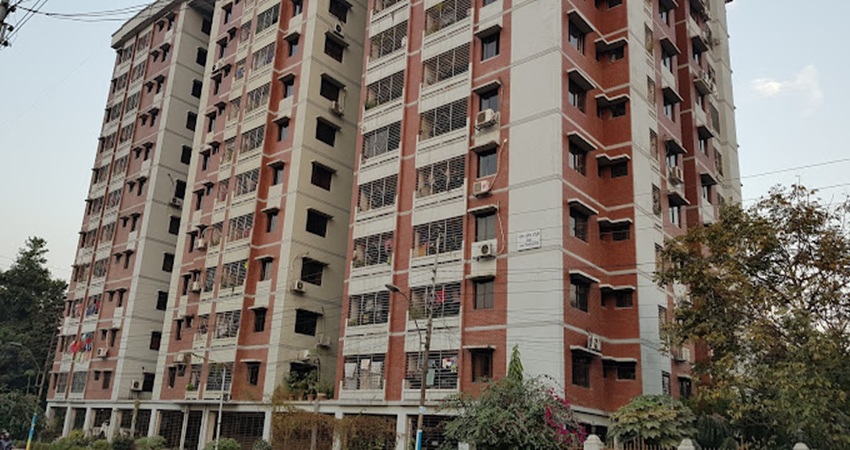
Dhaka University’s (DU) faculty housing allocation system faces serious irregularities as special consideration clauses systematically bypass the established points-based seniority mechanism, whilst former resident teachers continue occupying hall quarters indefinitely at reduced rates.
These were revealed by analyzing two notices: ‘Shikkhokder Basha Baraddo Committee’r Shobar Karjobiboroni, March 2026’ (Minutes of the Teachers’ Housing Allocation Committee Meeting, March 2026) and ‘Shikkhok O Kormokartader Basha Borodder Talika, March 2026’ (List of Housing Allotments for Teachers and Officers, March 2026), published on the university’s Estate Office website on March 29.
The university operates a point-based seniority system designed to ensure transparent housing allocation. However, multiple allotments made under ‘special consideration’ effectively allow the House Allotment Committee to circumvent hundreds of senior teachers waiting in queue, raising questions about fairness and potential favouritism.
Development Studies department professor and Shahid Sergeant Zahurul Huq Hall provost Dr Md Faruk Shah received flat G-5 in Shahid Munier Choudhury Bhaban on a temporary basis until June 2026 after his Provost bungalow was deemed unfit for living. Documents indicate that he is resigning from his provost duties for personal reasons, yet still receives a tower flat allotment typically reserved for senior teachers with high point totals, highlighting how special provisions can override the standard merit-based system.
Similarly, associate professor of the Computer Science and Engineering (CSE) department and assistant proctor Dr Md Mossaddek Khan was allotted flat 1-C in Shaheed Abul Khair Bhaban building under special consideration to facilitate his duties monitoring university cyber and online activities. This use of work necessity to bypass a waiting list of over 200 senior teachers, some with over 800 points, creates perceptions of systematic unfairness within the allocation process.
The conflict becomes stark when examining waiting lists. At least 103 teachers await four-room houses whilst over 244 teachers wait for three-room houses. Teachers with points as high as 856.2, such as mathematics department professor Dr Khondokar Mezbahuddin Ahmed, remain in the application process for upgrades, whilst those with significantly fewer points like Dr Mossaddek Khan at 616.9 points receive allotments through special consideration channels.
A structural corruption risk exists within the House Allotment Committee itself. Professor Dr Mohammad Abu Yusuf serves as an active committee member responsible for confirming minutes and making allotment decisions, whilst simultaneously listed as a teacher actively applying for a four-room house with 825.1 points. Though documents do not explicitly show him voting on his own application, his presence on the deciding body whilst being a beneficiary represents a clear conflict of interest.
Beyond tower allotments, significant irregularities involve former resident teachers who continue occupying university hall housing long after official terms ended. Former resident teachers at Jagannath Hall and Sheikh Fazilatunnesa Mujib Hall reportedly live in their quarters despite tenures being over, occupying spaces needed for current staff.
DU estate office initially decided to charge these overstaying residents a standard rent of TK 40,000-50,000 per month starting March 2026 as penalty for improper occupation. However, the provost of Jagannath Hall recommended a collective petition from these teachers to avoid standard rent, requesting to pay only the prescribed house rent according to standard university rules until allotted permanent housing.
Granting this request would allow individuals to occupy hall housing indefinitely at lower cost than authorised residents, whilst simultaneously remaining on waiting lists for central pool housing, creating a two-tier system where connected individuals enjoy extended occupancy at reduced rates whilst junior faculty struggle to secure accommodation.
The inconsistency in handling overstaying residents reveals deeper administrative reluctance to enforce regulations. Whilst some face threats of high Standard Rent, the committee ultimately referred the matter back to the Provost Standing Committee for further opinion, delaying enforcement of penalty rent. This bureaucratic loop suggests reluctance to enforce rules against peers, further entrenching unfair conditions where unauthorised residents prevent new staff from accessing entitled housing.
Documents indicate that extreme waiting times have become normalised within the system. Senior teachers with exceptional service records and high point totals wait years for appropriate accommodation, whilst special consideration provisions allow committee discretion to override merit-based queuing. The points disparity between those receiving special allotments and those waiting highlights how individual connections or specific roles can trump established seniority metrics.
The structural issues extend beyond individual cases. The sheer volume of teachers awaiting housing, over 347 across three-room and four-room categories, suggests DU’s residential infrastructure cannot meet demand under current allocation practices. When special considerations further reduce available units for regular allocation, the system’s inability to serve its teaching staff becomes more pronounced.
Administrative inconsistency compounds these problems. Different standards appear to apply depending on position, connections, or circumstances, rather than uniform application of established policies. The reluctance to enforce Standard Rent on overstaying hall residents, despite Estate Office decisions, demonstrates how bureaucratic referrals can indefinitely delay accountability measures.
The combination of bypassed seniority systems, conflicts of interest within deciding committees, unauthorised occupancy at reduced rates and administrative inconsistency creates conditions where fairness and transparency are systematically undermined. Senior faculty awaiting housing based on earned points face a system where discretionary special considerations and extended occupancy by former residents reduce their prospects of timely allotment.
AM