X
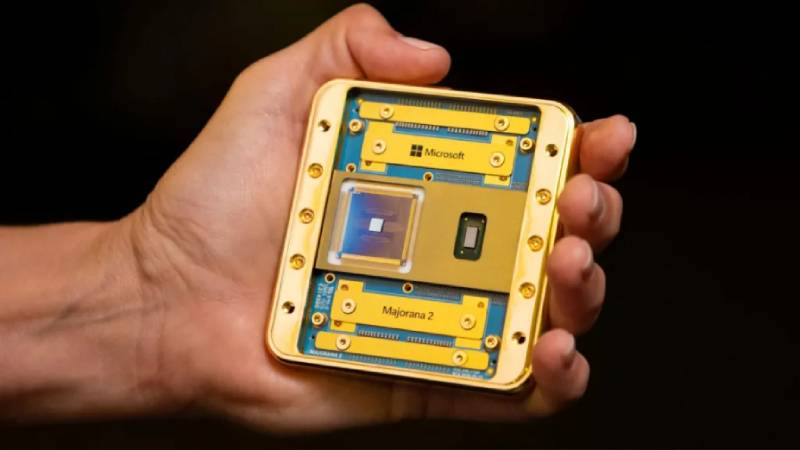
Majorana 2 chip
Microsoft claims that its new quantum chip Majorana 2 ‘is 1,000 times more reliable’ than its previous version.
The tech giant says the qubits on Majorana 2 survive for an average of 20 seconds, rather than the milliseconds of Majorana 1.
At the heart of quantum computing are qubits, which offer the promise of answering questions that defeat today’s machines, but are notoriously delicate and unstable.
That means the new chip is 1,000 times more reliable- an improvement in performance the tech giant compares to the difference between a phone that needs charging every day to one which needs charging every few years.
“We will have a quantum machine in 2029 that can solve commercially viable, reasonable problems”, said Zulfi Alam, corporate vice president of Microsoft Quantum.
That would still require huge further advances as such a device would require millions of qubits- the current chip, Alam said, has 12.
Assessing the firm’s claims are difficult because it does not release the full details of what it has discovered publicly, citing commercial confidentiality.
There is a worldwide race to develop the technology, given its potential to take on tasks currently considered too enormous for even the most powerful traditional computers.
Microsoft has spent 20 years pursuing an approach to quantum computing known as “topological”.
The firm’s approach to this is based on exploiting the properties of a so-called quasi-particle, which had existed only in theory, since it was first predicted in the 1930s by Italian physicist Ettore Majorana.
To do this it had to exploit a novel state of matter- different from the three familiar states of liquid, solid or gas.
Paul Stevenson, a physics professor at the University of Surrey, said the tech giant’s timeline sounded plausible- if its research lived up to its claims.
“Microsoft appears to have made a leap in their attempt to produce viable topological qubits,” he said.
“If they succeed, they will leap from being a player with no production quantum computer, to being a serious player in the race to make the next generation of fault-tolerant machines.”