
For those who travel the streets of Dhaka every day, one scene had long become painfully familiar: vehicles refusing to stop even when the traffic light turned red, zebra crossings treated not as pedestrian rights but as convenient stopping zones for cars. Whether traffic signals were obeyed often depended not on personal responsibility but on the presence of a traffic sergeant. In that familiar chaos, a crack has finally appeared. No, there is no new law. No sudden moral awakening has swept across society. What has arrived is a camera-or more accurately, an eye. An eye that never sleeps, never gets tired, and offers no opportunity for deception.
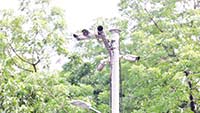
The Dhaka Metropolitan Police (DMP) has installed Artificial Intelligence (AI)-powered cameras on major roads across the capital. Along the stretch from Shahbagh to Jahangir Gate, 105 PTZ (Pan-Tilt-Zoom) cameras have been deployed. These cameras can rotate 360 degrees and clearly read vehicle registration plates from a distance. They can automatically detect more than ten types of traffic violations, including running red lights, driving in the wrong direction, riding without helmets, failing to wear seat belts, illegal parking, and lane violations.
Since the system began operating on a trial basis on May 7, it has collected data on thousands of vehicles within just fifteen days. After verification, 611 cases were finalized. Notices are being sent to the registered addresses of vehicle owners. Failure to pay fines within the specified period may result in court summonses or even arrest warrants through magistrates. The system is that strict.
The results are already visible. On roads such as Kazi Nazrul Islam Avenue, Banglamotor, and Karwan Bazar-areas once synonymous with daily disorder-vehicles are now stopping before zebra crossings. Drivers are waiting for green signals before moving forward. One pedestrian in Karwan Bazar remarked, “For the first time, some roads in Dhaka feel safe to cross.” Within that simple statement lies years of helplessness and a glimmer of hope.
Yet this development has also revealed a familiar national characteristic. We do not like following rules, but we certainly do not want to be caught breaking them. We violate laws but seek ways to avoid the consequences. The change brought about by AI cameras is not necessarily a triumph of conscience; it is largely a shift in fear. Previously, people feared the traffic sergeant. Now, they fear the camera. The difference is simple: a sergeant could sometimes be deceived; a camera cannot.
And as soon as a way to deceive the camera emerged, some people embraced it. During a DMP press briefing, an astonishing fact came to light: certain motorcyclists were covering the last three digits of their license plates with cloth or tape before taking to the roads. One such rider, Lavlu Haque, was identified after a seven-day investigation in Lalbagh and received a one-month prison sentence along with a monetary fine. This incident is not amusing-it is deeply troubling. The individual did not learn to obey traffic laws; he learned how to evade detection.
The story does not end there. Another group quickly saw an opportunity for digital fraud. As news of the AI camera system spread, criminal networks began sending fake SMS notifications claiming that recipients had been fined for traffic violations. These messages included dates, details of the alleged offense, the amount of the fine, and a payment link. Clicking the link led users to websites that closely imitated official BRTA portals. Once personal or financial information was entered, bank accounts and mobile financial wallets could be emptied.
Why is this scam so effective? Because it exploits a familiar weakness. Many people know they have broken traffic rules at some point. When they receive a message stating, “A case has been filed against you,” panic comes before verification. Fraudsters simply take advantage of that panic. Both BRTA and DMP have clearly stated that they do not send SMS messages containing payment links. Official notices are delivered through signed letters sent by mail. Only two designated DMP numbers may be used for SMS communication.
This entire episode highlights an uncomfortable truth: the problem is not the camera, the law, or the technology. The problem is us.
For decades, many of us have grown accustomed to a mindset that treats rules as something meant for others, not ourselves. Obeying traffic laws is often viewed as foolish, while finding ways around them is seen as clever. This mentality runs deep. It manifests not only on the roads but in everyday life-cutting queues, occupying sidewalks, misusing public resources, and exploiting loopholes whenever possible. Even when technology is introduced for public benefit, some people seek ways to turn it into a tool for deception.
So when we see AI cameras bringing order to the roads, a difficult question arises: Are we capable of following rules only out of fear? Can we not do so out of conscience, responsibility, and respect for the safety of others? There is no denying that AI cameras have already produced positive results and will likely continue to do so. According to DMP plans, the system will be expanded to most major intersections across the capital within the next six months. This is a commendable initiative that deserves public support.
However, cameras alone are not a permanent solution. No technology on earth can compensate for the absence of values and ethics. Today, people have discovered ways to conceal license plates. Tomorrow, they may invent new methods. Fraudsters are already creating fake websites and will undoubtedly develop more sophisticated schemes. In the ongoing contest between technology and deception, lasting victory can only come through human conscience.
In developed societies, traffic laws are not obeyed primarily because of cameras. They are followed because people understand that the person walking beside them has a life that matters. The child crossing a zebra crossing has the right to reach home safely. The motorcyclist who wears a helmet is protecting not only himself but also the family that depends on him. Such awareness requires education. It requires values taught within families. It requires a social environment where honesty is respected rather than ridiculed.
AI cameras have given us an opportunity. Even if fear is the initial motivation, let it help cultivate a habit of following rules. But that habit should not exist only when a camera is watching. Outsmarting a camera may someday become possible. Outsmarting your own conscience never is.
The sooner we understand that truth, the sooner Dhaka’s roads will become safer-and the sooner our society will become more civilized.
The writer is an essayist





