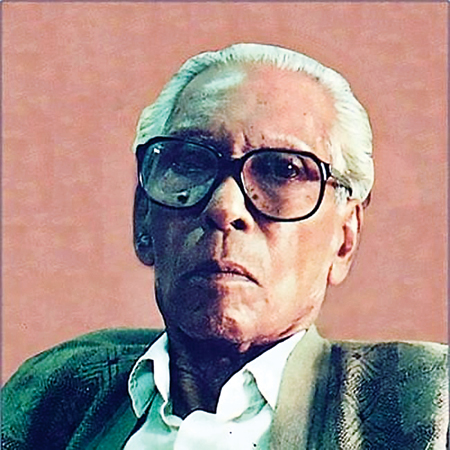
Abdul Latif was a veteran singer, lyricist and composer. While a student of class Vll, he was selected for the 16th Bengal Battalion of the Indian Territorial Force in 1939. After six months this force was disbanded. He began to live in Calcutta (now Kolkata). Although he did not directly join politics, he became associated with politics-related cultural movement. Towards the beginning of the 1940s, he joined the literary group of the Congress in Calcutta. Here music lessons were given to politically conscious new artistes by a music teacher, Sukriti Sen. Abdul was the lone Muslim in the group. At about this time when Mahatma Gandhi came to Noakhali leading a peace mission to stop the Hindu-Muslim riot Abdul Latif joined in.
Latif was born in Barisal in 1924. Although born in a conservative Muslim family Abdul Latif was attracted to music from his childhood. At one stage, his aunt being offended by his musical character, drove him out from the house. To her, singing was unislamic. Undaunted by the suddenness of this event, young Abdul Latif pleaded for a chance to let him sing a song for her. She agreed. He sang a Nazrul song full of praise for Allah and his prophet in the tuneful style of Abbasuddin. The song moved her deeply and she agreed to let him sing. This family consent set him on the way to pursue his career as a singer.
Abdul Latif came in close contact with well-known singer Mumtaz Ali Khan, reputed singer and music director Abdul Halim Choudhury. Halim encouraged him to write songs to fill the vacuum created by the large scale departure from the country of Hindu singers and composers in the post-1947 political development. In 1949-50 Abdul Latif started writing modern songs and later folk songs.
Latif had in him the spirit of people's songs that he imbibed from the Calcutta-phase of his life. The chorus songs that he sang with the Congress literary group were people's songs. This became part of his bloodstream. His psychology was deeply rooted in the folk culture of his rural life in Barisal. He enriched his own voice with the tunes of such folk songs as kirtan, panchali, kathakota, Behular bhasan, royanigan, Kobigan , gunai jatra, jari-GAN and palkigan. This trend in due course brought him a distinctive position as a singer.
He died on February 23 in 2006. February 23 marked the 11th death anniversary of Abdul Latif.
The writer is a freelance contributor.





