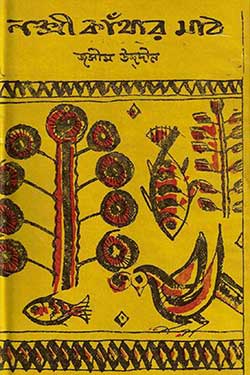
Poetry should be an illustration of extreme beauty of simplicity. The renowned poet Jasimuddin has traced the beauty of simple and sincere language of everyday life in his masterpiece known as Nakshi Kanthar Math (The Field of Embroidered Quilt) published in 1929 by Akshar Publication. This book has been translated in different languages. He has written a good number of books, but this book has added a new dimension to Bengali literature.
The style of narrating the poem clarifies the designation of PolliKobi in Bangladesh. Poetic style should be "a selection of the language really used by men in humble and rustic language", stated by William Wordsworth. Jasimuddin has thrown light on the same things. He enriched his poetry with folk elements and traditional languages of Bangladesh that is thoroughly interwoven with the simple people.
The book is the absolute disclosure of human feelings. The readers may go under the surface of the profound thought of the poet while going through the text. He has wonderfully drawn the characters of the poem titled as Saju, the daughter of peasant and Rupai, the peasant in his poetry. All the events depicted in Nakshi Kathar Math take place centering on the couple of character. The book contains a single poem with fourteen long stanzas.These stanzas manifest the whole life of the central characters continuingly. The poet has contemplated their simple life into the depth. He wrote every single line by upholding the structure of the poetry. He ornamented each and every line with colorful vivid imageries, metaphors, synecdoche, metonymy and rustic elements.
Readers may feel the spirit of the rustic area by the entire elements used by Jasimuddin. There are some phrases obtained from the poetry, such as "the nest of tailor bird" "the tune of flute", "Kusum, Kolmi Flower", etc that portraits the simple and sincere life of villagers. The phraseology of the text is quite precise, expressive and simple, that is, easier and recognizable than the other pieces of writings. He described the prettiness of a young wife in his work of art through this line:
"The face ofteen seems the illusion of a green leaf of paddy"
Stanza: 2, Verse: 3
The appearance of a young wife of countryside has been portrayed as "the illusion of a green leaf of paddy." The line is the utmost phrase of natural representation of a young wife in an artistic way. Jasimuddin showed his ultimate practice of simplicity and capability of using household dictions numerously like "green leaves of paddy" throughout the poetry.
There is a style that seems very different for the readers while skimming and scanning the text. The poet has added some of chants from different sources as aprologue before starting the stanzas. All chants give an indication to the reader travelling through the poetry. He expressed the simple people's simple thoughts, ups and downs, sorrows and happiness, emotions and love through simple and humble code. The lines of Jasimuddin are not merely lines but a stream of tragedy and romanticism.
The gravity the text let the readers roam around the romantic passage of a peasant and his young wife. Here is a line that makes the reader feel their happiness:
New clown with his new mistress build a new cottage,
Two hearts of them are unsteady and embrace.
Verse: 41-42; Stanza: 9
The contentment and happiness of the couple turns into the tragedy within one year of their married life. Saju was left isolated by her husband and did not return until the premature death of his beloved wife. Saju longed for her husband Rupai in tears and typed both her pathetic and idealistic stories of life in Quilt. The quilt is known as Nakshi Kantha that expresses the pathetic tune of solitude. She ignored all her excruciation, and physical weaknesses while portraying the images of her own life. The way the poet describes the lively pictures of a young wife and her husband's laughter and grief, a reader may find similarity inpersonal and his or her dear and near one's life.
The nook and corner of the poetry testify the sharp observation and personal philosophy of the poet about the folk society and their life. It is a great poetry poised by Jasimuddin. It is to be considered as the folk epic tale in Bengali literature, but some elements that make the poetry an epic is missing here. The fiction expresses through Nakshi Kathar Math is larger-than-life.
The book is the expression of two aspects of real life. The aspects are identified as bonding of love and extreme sorrows of life that can be found in people's lives both in rural and urban areas. Though the poet has highlighted the rural people's life, these aspects plays a dynamic role in defining the stream of simple people's life.
The book describes the social aspects of the general people. The cycle of humankind for instance, infancy, childhood, juvenile hood, adulthood, love affairs, married life, sufferings, death, etc has skillfully depicted through this poetry of Jasimuddin. The reader will feel the same feelings of existing society while experiencing the text.
The poet has introduced the poetry with regional dialect that is very close to natives by which they express their sensation of their existence. The poet also has showed his competency of using dialect through his masterpiece. The text is quite trouble-free to be comprehensible to any readers of both highly and hardly cultured category.
The issue that has been discoursed by the poet is universal in that sense that any reader of local or foreign will find the contemporary society and its representation. Any reader may appreciate the book and sense the universality of aspects discussed here.
Joshinta Areng is schooling with Notre Dame University Bangladesh





