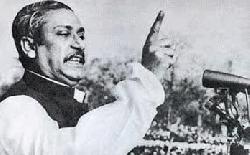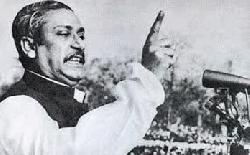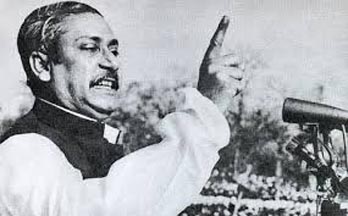
As Pakistani army convoy started rolling out of cantonment in their bid to annihilate Bengalis in then Dacca on the fateful night of March 25, 1971, one well-wisher telephoned Bangabandhu Sheikh Mujibur Rahman and had asked him to go into hiding. But being the leader who never cared about his life over his people, he simply refused to flee.
"If I go into hiding they will burn the whole of Dacca to find me," Bangabandhu had answered.
Journalist Simon Dring in his article titled "Tanks Crush Revolts in Pakistan" in Daily Telegraph wrote about the firmness of Bangabandhu in the face of certain death.
"...as this was going on, other units had surrounded the Sheikh's house. When contacted shortly before 1 am, he (Bangabandhu) was expecting an attack by any minute and that he had sent everyone except his servants and a bodyguard away to safety," the article said.
A neighbour said that at 1.10 am, one tank, an armored car and trucks loaded with troops drove down the street firing over the house (Dhanmandi 32 number).
"Sheikh you should come down," an officer called out in English as they stopped outside.
Sheikh Mujibur Rahman replied by stepping out onto his balcony and saying, "Yes, I am ready but there is no need to fire; all you need to have done was call me on the telephone and I would have come."
The officer then walked into the garden of the house and told the Sheikh: "You are arrested."
"As he was driven off-presumably to army headquarters, the soldiers moved into the house, took away all documents, smashed everything in sight, locked the garden gate, shot down green, red and yellow "Bangladesh" (Free Bengal) flag and drove away," the article narrated.
In Pakistani army custody, the people's leader avoided certain death with the help of a jailer, who hid Bangabandhu in his personal apartment for two days to avoid his execution in the jail.
It was told in a report published in British newspaper "The Sunday Telegraph" titled "Sheikh Mujib flies in and sees Heath, Plea for aid" with a sub-heading "Gaoler 'Hid Sheikh'" by its diplomatic correspondent Ronald Payne on January 9, 1972.
The report said, "A Bangladeshi official said in London last night that Sheikh Mujibur Rahman avoided execution with the help of a gaoler (jailer). He knew Yahya Khan was about to abdicate, and he hid the Sheikh in his personal quarters for two days."
The report quoted Bangabandhu as saying "I was ready to die. The day I went to gaol (jail), I didn't know whether I was to live or not, but I knew that Bangladesh would be liberated."
The Pak army occupied all three of the targets on March 25, 1971 but the first round of resistance in Dhaka city continued, sporadically, till April 6, 1971. Meanwhile, the Kalurghat Bridge area was controlled by an East Bengal Regiment under Major Ziaur Rahman who revolted against the Pakistani army. Bengali soldiers were requested to gueard the station. On request of Belal Mohammed of the Shadhin Bangla Betar Kendro (SBBK), at 19:45 hrs on 27 March 1971, Major Ziaur Rahman broadcast announcement of the declaration of independence on behalf of Sheikh Mujibur which is as follows.
"This is Shadhin Bangla Betar Kendro. I, Major Ziaur Rahman, at the direction of Bangobondhu sheikh Mujibur Rahman, hereby declare that the independent People’s Republic of Bangladesh has been established. At his direction, I have taken command as the temporary Head of the Republic. In the name of Sheikh Mujibur Rahman, I call upon all Bengalis to rise against the attack by the West Pakistani Army. We shall fight to the last to free our Motherland. By the grace of Allah, victory is ours. Joy Bangla." -Zia
Source: Audio of Zia’s announcement (An interview with Belal Mohammed who requested Zia to give the speech)
Major Ziaur Rahman brodcasted the declaration of independence on behalf of Sheikh Mujibur Rahman which was a moral boosting impact to the nation that an army major is on the side of Sheikh Mujib. He was quoted in international media as the provisional Commander-in-Chief of the Liberation Army.
Swadhin Bangla Betar Kendro And Bangladesh’s Declaration Of Independence – Mashuqur Rahman & MMR Jalal (also published in Prothom Alo and the Daily Star)
Shaheed Minar (Monument to commemorate the martyrs of the Language Movement) was blown up by the army with demolition charges.
Archer Blood, the American Consular General sent a telegram to different American consulate offices and embassies around the world expressing extreme horror at the systematic killing.
1. Here in Decca we are mute and horrified witnesses to a reign of terror by the Pak[istani] Military. Evidence continues to mount that the MLA authorities have list of AWAMI League supporters whom they are systematically eliminating by seeking them out in their homes and shooting them down.
2. Moreover, with the support of the Pak[istani] Military. non-Bengali Muslims are systematically attacking poor people’s quarters and murdering Bengalis and Hindus.
A telegram from the Embassy in India to the Department of State on the subject of Government of India’s reaction to East Pakistan Developments.
During the debate in Lok Sabha Indira Gandhi, the Prime Minister of India made an intervention and talked about the political situation in East Pakistan. She also discussed about it in Rajya Sabha:
“We are interested in this matter for many reasons, firstly as one Member has said, that Shri Mujibur Rahman has stood for the values which we ourselves cherish the values of democracy, the values of secularism and the values of socialism. We are also concerned with the truly wonderful and unique way in which the people there had stood behind him and behind these values. We are no less full of sorrow and grave concern and even agony at what is happening there but I can only appeal to the Hon. Members that this is not a moment when the Government can say anything more and whatever the Government may or may not be able to do it would not be wise if this becomes a matter for public debate.”