



| HEADLINE |

|
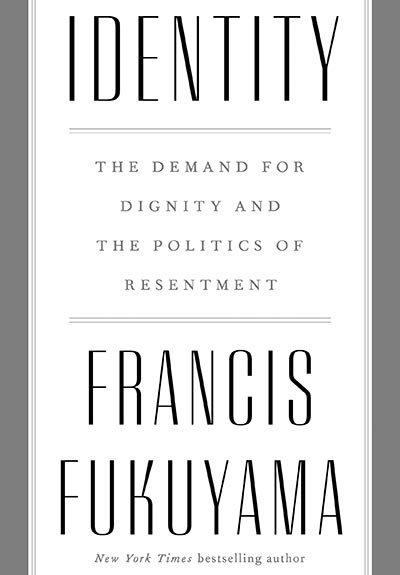
Identity: the demand for dignity and the politics of resentment
Francis Fukuyama
Published : Saturday, 12 October, 2019 at 12:00 AM
Reviewed by Akmal Hossain


Rahima Akhter Khusi, a twenty-year-old Rohingya teen, was suspended from a local university name is 'Cox's Bazar International University' (CBIU) in September 2019. The girl was a first-year student and enrolled for pursuing Bachelor of law (LLB Hons.) at the university, but sketchedcriticism from different corner of people, particularly young generation on social media, many did comments for her admission, in contrast, many oppose due to her Rohingya identity. According to rules and regulation of Bangladesh government, Rohingya people are not eligible to take any official or recognized education in Bangladeshi institutions.
Aforementioned case study perfectly reflects about 'identity politics.' The girlhas faced of her identity crisis. This type of identity politics has become the agenda of today's globalized world politics. From Myanmar to India and China, from France to the USA, everywhere politicians are using this populist venture to become an elected or reelected leader of their respective country.
Francis Fukuyama, the well-known political scientist and commenter has immaculately described the implication of identity politics in his recent book 'Identity: the demand for dignity and the politics of resentment'published in 2018 by Macmillan, the USA. Although many write up are available about identity politics, then why Fukuyama wrote this book, is a big question. Fukuyama has given answer of this question in his book.
Fukuyama writes, without development of two recent phenomenons, 'this book would not have been written had Donald J. Trump not been elected president in November 2016'. He also says, 'like many Americans, I was surprised by this outcome and troubled by its implications for the United States and the world'. According to Fukuyama, the second major electoral surprise was of that year, the first being 'Britain's vote to leave the European Union the previous June.'
Before describing the essence of Fukuyama's book, let discussfirst what is identity politics. First of all, it is difficult to define what identity politics is due to its pervasive meanings, nature and types. Identity politics theorist Eric Ericson said it elusive, ambiguous, and vagueness. Writer Andrew Heywood defined it 'as an orientation towards social theorizing and political practice, rather than a coherent body of ideas with a settled political character'. The fundamental feature of identity politics is that it pursues to 'challenge and overthrow domination by reshaping a group's identity through what amounts to a process of politico-cultural self-assertion'.
In this book Fukuyama's main contribution to identity politics is that he has given a philosophical explanation of identity politics instead of traditional interpretation such materials benefits provided by the economists. In the 1960s, according to Fukuyama, we have seen many powerful new social movements emerged across the world's developed liberal democracies based on nationalism, gender, race, and religion. But today's identity politics is not like that. Fukuyama writes, To the extent that people cooperate with one another, it is because they calculate that cooperation will serve their individual self-interest better than if they act on their own based on their 'rational choice'.
Why identity emerged is a bis question to us. To give answer of that question Fukuyama refers Socrates and other western philosophers. Fukuyama quotes Socrates, (P. 19) that he believed that such a need formed an integral "third part" of the human soul, one that coexisted with a "desiring part" and a "calculating part." In Plato's Republic, he termed this the thymos, which English translations render poorly as "spirit." According to Fukuyama, 'this third part of the soul, thymos, is the seat of today's identity politics.'
Since French revolution to the recent day's movements such as, Arab revolution can be seen as the source resentment of politics and lack of equality, dignity and recognition. Fukuyama writes, Mohamed Bouazizi's, a Tunisian street vendor, self-humiliation was the lack recognition of him as human being and man as well. According to Fukuyama, people of Arab revolution were shared among all of these protesters were resentment that they had been humiliated and disregarded by their authoritarian governments (p.37).
Then important question is, has democracy failed to recognize the both Isothymia, megalothymia and thymos part of the human being? In liberal democracy the rule of law limits power by conceding citizens certain basic rights-such as freedom of speech, right to association, right to property, and right to religious belief the state may not check individual choice.
But Fukuyama wrote, modern liberal democracies have failed to halt massive economic inequality, digital unfreedom, violation of human rights and of course, economic recession that can be considered the essential elements of liberal democracy. As consequence, people's disillusionment has increased manifold to liberal democracy across the world and prompted rises of authoritarianism.
As a result, new identity politics has been emerged not only in illiberal democracies but also in the liberal democracies such as the UK, the USA and many European countries. This identity politics can be seen as struggle for something good like independent movements in 1960s and for something bad like movement against immigration in the west.
According to Fukuyama, these new or national identities have been created by four main paths (p.110). 'Firstly, is to transfer populations across the political boundaries of a particular country, either by sending settlers into new territories, by forcibly evicting people who live in a certain territory, or by simply killing them off-or all three. The second path to nationhood is to move borders to fit existing linguistic or cultural populations. The third path is to assimilate minority populations into the culture of an existing ethnic or linguistic group. The fourth path is to reshape national identity to fit the existing characteristics of the society in question'.
Fukuyama's Amazing contribution to identity politics gives us insight to think about recent global political phenomena that shapes our everyday life. But a simple problem can be stated in Fukuyama's right up. He exaggerates on thymos, the third part of human soul that wants recognition of their activities. A soldier, who is ready to sacrifice his or her life for a country wants recognition. I think Fukuyama's statement not only a myth but also may mislead us about identity politics.
There are many important reasons for that people think themselves separate from others. Race, religion, ethnicity, language, gender and so forth may be the source of identity politics. But Fukuyama has not given importance on them. Feminists, moreover, sought equality based on economic and political aspects which are necessary to empowering of them. Therefore, only recognition is not enough to halt new identity politics that curbs the liberal democracies across the world and creates politics of resentment.
In the crisis time of liberal democracy due to emergence of new identity politics what is to be done?
According to Fukuyama, People always will think themselves based on their different identities. But we have to remember, 'people's identities are neither fixed nor necessarily given by birth. Identity can be used to divide, but it can also be used to unify. That, in the end, will be the remedy for the populist politics of the present.' Cultural assimilation, showing respect to others' different identities, reducing income inequality and accountability in politics can be seen to limit bad identity politics. If we failed to do this, a more conflictual world is waiting for us that may kill the liberal democracies.
The writer is a researcher and political
analyst, University of Dhaka
Loading...
Loading...
Also read





Editor : Iqbal Sobhan Chowdhury
Published by the Editor on behalf of the Observer Ltd. from Globe Printers, 24/A, New Eskaton Road, Ramna, Dhaka.
Editorial, News and Commercial Offices : Aziz Bhaban (2nd floor), 93, Motijheel C/A, Dhaka-1000.
Phone: PABX- 41053001-06; Advertisement: 41053012; 01793317829, 01550707291, E-mail: [email protected], [email protected] Online: email: [email protected] 41053014; 01550707297 Advertisement: 01550707296
Published by the Editor on behalf of the Observer Ltd. from Globe Printers, 24/A, New Eskaton Road, Ramna, Dhaka.
Editorial, News and Commercial Offices : Aziz Bhaban (2nd floor), 93, Motijheel C/A, Dhaka-1000.
Phone: PABX- 41053001-06; Advertisement: 41053012; 01793317829, 01550707291, E-mail: [email protected], [email protected] Online: email: [email protected] 41053014; 01550707297 Advertisement: 01550707296


