



| HEADLINE |

|
Kamal Kabir’s world of marine life and amorphous forms
Published : Monday, 6 January, 2020 at 12:00 AM
Takir Hossain


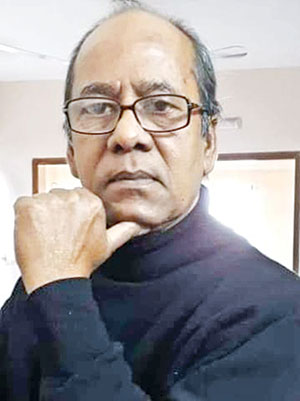 T. A. Kamal Kabir completed his BFA from Bangladesh Government College of Arts and Crafts (now the Faculty of Fine Arts, University of Dhaka) in 1974. Few months earlier in the same year, his father died and he faced a great hardship and turmoil afflicting his family. During that time, he went to prominent artist Quamrul Hassan and searched for a job. The great painter offered him to work with him. Kabir worked there as an assistant. He worked there for eight to ninth months and improved his artistic capabilities. Afterwards, he joined the Karukrit Advertising Private Limited and gradually flourished himself. Drawing was his forte and he quickly delivered his works. For his aptitude, he had quickly earned reputation and his name became well-known in the local advertising arena. Later, Kabir joined Adbiz Ad Firm. The firm evolved into a dynamic, award-winning firm providing outstanding results to local, national and international businesses, in a wide array of professional services, including advertising, marketing, branding, business consultation, public relations, social media planning and graphic design.
After 17 years of self-exile from the world of painting, Kamal Kabir reappeared with a novel feeling and sentiment in 1994. He organised a solo exhibition at Alliance Francaise de Dacca (now Dhaka) where he particularly concentrated on the underwater world. He subsumed himself deep into this world of tranquility.
Fish is the predominant aspects of his works. His canvas is a space where rich texture and thick colour join into one another. Sometimes, a single fish, few fishes and a bunch of fishes on his canvas seem to be placed at varied angles and a sense of wonder consequently takes over the viewer's imagination.
It was noticeable at his first exhibition that Kabir is extremely meticulous about using space and the painter superbly demonstrates texture according to the aesthetic requirement of the paintings. The paintings represent emotion and sentiment in a manner which clearly outline the fact that the artist wants to be universally understood, but in a non-figurative mode. Oil is one of the finest and toughest mediums rarely used by our painters but Kabir successfully used the medium with all its hurdles at his first exhibition. From the onset of his career, he has worked with oil for bringing up the media's effect steadily. The medium also allows an artist to create a sense of serenity. For Kabir, oil provides more flexibility and creative freedom than any other type of paint.
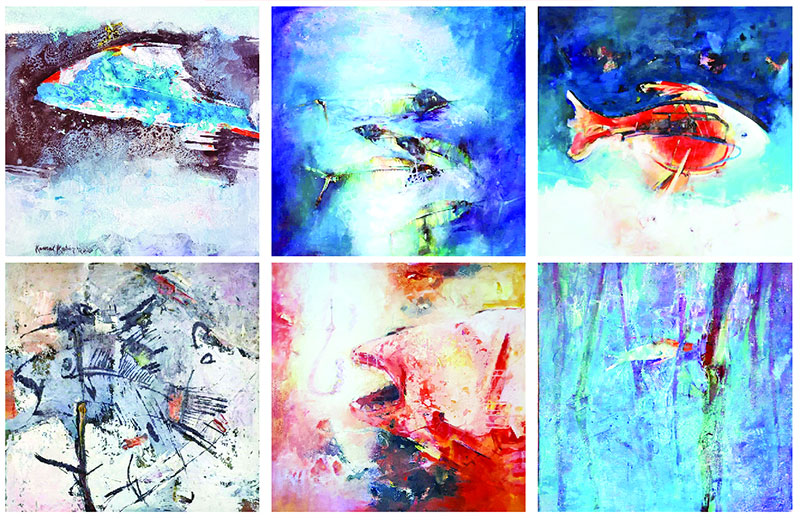 Kabir's images are abound with his signature use of deep droplets and various fish forms, marked by the strong backdrop of colourful images that cannot be explained and rather have to be felt. Every single thick line, sprinkle and profound colour on Kabir's canvas exudes different moods and feelings. His prime subjects are often very simple but thought provoking. Human figures are completely absent in his works. He feels comfortable working with a large sized canvas, according to his theme and composition. His works are characterised by a powerful engagement with marine life and open space, and with bold and sweeping brushstrokes. He has played with texture and illusion for surface effects, as the surface looks more impressive and appealing. Space has been created on the canvas although some of the colours have appeared flatly in his works. The tonal-plus-linear approach gives his work a different quality and distinctive look.
It is a unanimous assessment that twenty-first century art can be categorised into two separate movements. One can be called conceptual, which is typified by works of art that deal with socially and politically engaging issues. The other one, regarded as the foremost concept in this century's art practice is abstraction in all its diverse manifestations. Kamal Kabir is represented by the last one. He has freedom to identify himself with his working styles that are apparently synchronised and technically phenomenal. He has been digging into his roots for over two decades. He strives to proceed with a certain style that deems to become a personal hallmark of his artworks.
In Wassily Kandinsky's description of art, the inner element is most significant; without it no work of art can exist. Kabir blends emotion and intelligence in his paintings believed to employ semi-abstract expressionism. His works appear to be sparkling and dynamic because of the use of profuse shades and evocative textures. Flamboyant colours, malleable brush-strokes, and imagery are noticeable features in the impressive paintings of Kamal Kabir, a gifted painter who has been striving to make a distinct place for himself in Dhaka's art scene.
An introspective and imaginative painter, Kabir has taken his colours from imagination and that is why colour is the most significant aspect in his paintings. He likes to experiment with different sizes of fishes in all their various facets. At first, the painter applies colours directly, piling up thick layers on the canvas. Then he portrays fishes of different sizes on his canvas. But the layers provide a distinctive touch to Kabir's work and that is why his canvas carries an individual trademark. He has concentrated on applying colours. Deep layers of colours provide a unique texture to his canvas and that is why his canvas carries a singular hallmark. His paintings create an expression on the essence of a colour and what the colours really means. Over the years, Kabir has developed this technique, which is very expensive and time consuming, requiring immense effort and devotion.
Kabir's purpose has been to capture the mystery of the world below water. The world makes him always puzzled and his search for beauty and for contemplation on the waterworld has influenced him to hold up in his paintings a vibrant blithe picture of the marine world. The poetry in the aquatic produces a surge of sensitivity in him, enabling him to hear and interpret the sounds, colours and rhythms in and around the marine world. The sturdiness of his lines (thick and scribbles) and colours are inspired by the world underwater and have evolved from a more traditional style to semi-abstractions that propagate wide-ranging views and imaginations. Kabir's canvases sometimes are lavish in abstract images with colours and ambiguous forms. But this semi-abstraction does not in any way obstruct the viewers' perception of the artist's feeling and pensiveness. Most of his canvases are large and it is noticeable that he has piled colour on colour with the use of hard brush, spatula and soft brush - some of his preferred tools and ingredients. These exercises project his ideas about feelings and moods.
Kabir's present paintings break new grounds for demonstrating open space and technical aspects. The paintings seem more concise and technically phenomenal than ever before. It is noticeable that Kabir is meticulous about using space and he superbly demonstrates texture according to the aesthetic requirement of the paintings. Blue is a predominant aspect in his works. The painter has also worked with bright colours - azure, yellow, emerald green, mauve and crimson. It is clear that his maneuvering of the colours proffered by the marine world is a very exciting feature in his works where there are colours present in all kinds of mind-puzzling forms.
When Kabir gets immersed with his paintings, he loses himself. He is recognised for nurturing enough gallantry to destroy his labourious productions if he finds them unsatisfactory and therefore he creates a new pattern, as the world of painting surrounds him from all possible dimensions. He most certainly does not seem to relent and on the contrary cannot help but breathe life into each painting. In this very way Kabir applies colours and creates forms, lines and compositions. He puts layers upon layers of paint and draws forms and objects continuously, until he feels that he has achieved what he has been striving for. The outcome is a contemplative, subtly balanced arrangement of colours and space that does not fail to draw an art enthusiast's eyes.
Kamal Kabir is simultaneously workaholic and scholarly sound. Over the course of years, he has been doggedly experimenting. He gives a precise explanation to his forms and compositions which make a new meaning for his paintings. He always provides a new look for each of his expositions. The painter is always driven to explore something novel. It breaks boredom for him and he believes art can be enriched through experimentation.
Loading...
Loading...
Also read







Editor : Iqbal Sobhan Chowdhury
Published by the Editor on behalf of the Observer Ltd. from Globe Printers, 24/A, New Eskaton Road, Ramna, Dhaka.
Editorial, News and Commercial Offices : Aziz Bhaban (2nd floor), 93, Motijheel C/A, Dhaka-1000.
Phone: PABX- 41053001-06; Advertisement: 41053012; 01793317829, 01550707291, E-mail: [email protected], [email protected] Online: email: [email protected] 41053014; 01550707297 Advertisement: 01550707296
Published by the Editor on behalf of the Observer Ltd. from Globe Printers, 24/A, New Eskaton Road, Ramna, Dhaka.
Editorial, News and Commercial Offices : Aziz Bhaban (2nd floor), 93, Motijheel C/A, Dhaka-1000.
Phone: PABX- 41053001-06; Advertisement: 41053012; 01793317829, 01550707291, E-mail: [email protected], [email protected] Online: email: [email protected] 41053014; 01550707297 Advertisement: 01550707296


